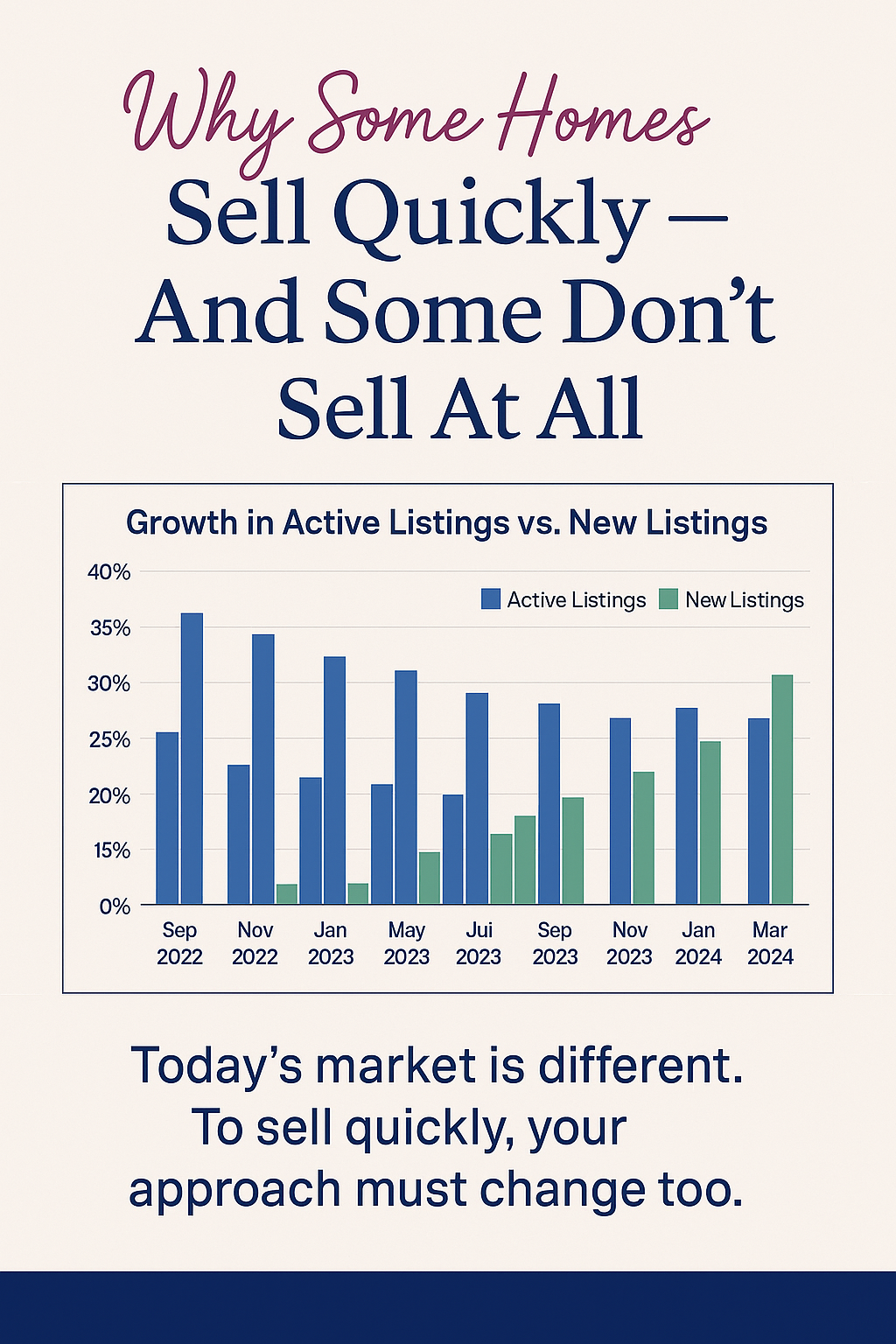

Why Some Homes Sell Fast — and Others Sit on the Market

A few years ago, homes were flying off the market. With record-low inventory, nearly anything sold — and fast. But today’s real estate landscape looks different. Inventory is up nearly 20% compared to last year, and in many areas, supply has returned to pre-2020 levels.

So, what does that mean for sellers?
👉 Your home needs to stand out from the moment it hits the market.

🔍 Why Homes Sit on the Market

Most of today’s inventory growth comes from homes that are still active — the ones that haven’t sold yet — rather than new listings. According to Realtor.com, many of these homes are taking longer to sell, which tells us something important:
It’s not just about listing your home — it’s about how you list it.

Common reasons homes linger on the market include:

  • Pricing too high based on old market conditions
  • Skipping essential repairs or updates
  • Poor listing photos or staging
  • Limited showing availability
  • Weak marketing strategies

A few years ago, sellers could list “as-is” and still attract multiple offers. Not anymore. Today’s buyers are choosier, more informed, and have more options.

💡 What Makes a Home Sell Quickly

Selling quickly in this market isn’t about luck — it’s about strategy.
Here’s what successful sellers have in common:

  1. Pricing Realistically – A competitive price based on today’s market, not yesterday’s headlines.
  2. Curb Appeal and Condition – Small upgrades and clean presentation go a long way.
  3. Professional Marketing – High-quality photos, social media visibility, and listing optimization matter.
  4. Accessibility – The easier it is to show, the faster it sells.

Remember: your first few weeks on the market are crucial. That’s when your listing gets the most exposure online. Nail your presentation early, and buyers will act fast.

🤝 Why the Right Agent Makes All the Difference

Working with an experienced REALTOR® means having someone who understands local trends, buyer behavior, and pricing strategy. According to the National Association of REALTORS® (NAR), sellers who work with agents are twice as likely to get an offer within a month compared to those who list on their own.

An expert agent will:

  • Recommend the right listing price using local comparable sales
  • Help you prep and stage for maximum impact
  • Use professional marketing that reaches buyers where they’re searching

Bottom Line

Even with more homes for sale, your property can still sell quickly — if it’s priced right, presented beautifully, and marketed strategically.

If you’re thinking about selling in Hampton Roads, Chesapeake, or Newport News, let’s connect! I’ll help you position your home to attract attention — and offers — from day one.

If you’re looking to sell, call Michele! If you’re looking to acquire — I’m your hire!

Michele Salyer, REALTOR®
Salyer Wilmoth Homes | A Better Way Realty
📞 7575023671 | 🌐 www.salyerwilmothhomes.com

July 15, 2026

6 Things to Know About Space, Access, and Lifestyle in Deep Creek

TL;DR


Deep Creek may appeal to Chesapeake buyers who want to compare homes with different layouts, yards, garages, storage options, subdivision styles, and outdoor settings, but the area’s size and variety make property-specific research essential because more square footage does not always create more usable space, a larger lot can bring additional maintenance, road access can change significantly from one address to another, parks and waterways may be nearby without being walkable from every home, daily errands are often easier with a car, and the most suitable property will be the one whose commute, storage, outdoor function, ownership costs, HOA obligations, drainage conditions, and regular routes align with the buyer’s actual routine rather than an assumption about what living in Deep Creek is supposed to feel like.

1. More Square Footage Is Not the Same as More Usable Space

Buyers often begin a search by setting a minimum square-footage requirement. That can help narrow the inventory, but the number alone does not explain whether a home will function well.

A larger Deep Creek home may still feel inefficient if too much space is devoted to hallways, oversized formal rooms, awkward transitions, or areas that do not support the buyer’s routine. A smaller property may feel more practical when the kitchen, living areas, bedrooms, storage, and outdoor access are arranged efficiently.

When touring a home, look beyond the advertised square footage and consider:

  • Whether the main living spaces connect naturally
  • How furniture would fit without blocking walkways
  • Whether bedrooms provide adequate privacy and storage
  • Where groceries, shoes, bags, cleaning supplies, and seasonal items would go
  • Whether bonus rooms have a realistic everyday purpose
  • How easily the home can adapt when routines change
  • Whether stairs or separated levels improve or complicate daily use

A large living room may photograph well, but a mudroom, pantry, accessible laundry area, first-floor flex room, or well-positioned coat closet may add more practical value.

Before letting the square-footage number determine which home feels more valuable, use The Floor Plan Test Most Buyers Don’t Realize They Need to examine kitchen flow, furniture placement, bedroom separation, storage, noise, natural light, and how you would move through the property on an ordinary day.

Buyers should also verify whether finished areas are included correctly in the reported square footage and whether converted garages, additions, enclosed porches, or bonus rooms were properly permitted. A space that looks usable during a tour may affect appraisal, insurance, financing, or resale differently if its status is unclear.

The strongest Deep Creek home is not automatically the one with the largest number. It is the one where the available space supports the way you expect to use it.

2. Yards, Garages, and Storage Can Matter More Than Bedroom Count

Many buyers searching in Deep Creek are not only comparing bedrooms and bathrooms. They are also evaluating the parts of the property that make everyday ownership easier: driveways, garages, sheds, workshops, patios, porches, fences, and usable outdoor areas.

Two homes with the same bedroom count can feel completely different when one offers a two-car garage, accessible attic storage, a wider driveway, and a functional backyard while the other provides limited parking and fewer places to store equipment.

This is why Why Two Homes in Chesapeake at the Same Price Can Feel Completely Different is particularly useful when comparing Deep Creek properties. Homes that appear nearly identical in an online price search may provide very different layouts, lot function, maintenance demands, storage, and long-term value once you examine them more closely.

When evaluating outdoor and storage space, consider how it actually functions rather than relying only on measurements. A large backyard may contain mature trees, drainage paths, utility easements, steep grading, wetlands, or areas that are difficult to access. A smaller yard may be easier to maintain and provide a more useful layout.

Ask practical questions:

  • Can vehicles enter and exit the driveway comfortably?
  • Is there room in the garage after a vehicle is parked?
  • Can lawn equipment reach the backyard?
  • Is the shed permitted, powered, or included in the sale?
  • Does fencing require repair?
  • Where does rainwater move across the property?
  • Are there HOA restrictions on boats, trailers, sheds, fences, or exterior changes?
  • How much time and money will the lot require throughout the year?

More land can provide flexibility, but it can also mean more mowing, tree maintenance, drainage work, exterior upkeep, and pest management. Buyers should decide whether the additional space delivers benefits they will realistically use.

For buyers who need help comparing lot function, storage, parking, and floor plans across current Deep Creek homes for sale, Salyer Wilmoth Homes can build a property search around those specific features rather than relying only on bedroom count and price.

3. Access Can Change Significantly From One Deep Creek Address to Another

Deep Creek’s size is one of the reasons buyers should test routes from the exact property.

A listing may appear convenient to Norfolk, Portsmouth, Suffolk, Greenbrier, another part of Chesapeake, or a military installation when viewed on a regional map. The actual experience may depend on where the home sits in relation to neighborhood entrances, connecting roads, traffic signals, bridges, work zones, and peak travel periods.

The City’s planning work for Deep Creek identifies access, connectivity, transportation, alternative travel options, and safety as important considerations. That does not mean every address has the same advantages or challenges. It reinforces why buyers should evaluate routes individually.

Before making an offer, test the drive from the property to:

  • Work or military installations
  • Grocery stores and regular shopping
  • Medical appointments
  • Childcare or schools, when relevant
  • Frequently visited relatives or services
  • Parks, gyms, and recreation
  • Interstate connections and regional destinations

Drive during the hours you are most likely to travel. A route that looks manageable on a weekend afternoon may feel different during the weekday morning commute.

Also examine the final portion of the trip. A property may be close to a major road in mileage but located behind several signals, railroad crossings, narrow streets, or a single subdivision entrance.

Michele Salyer can help you narrow the search to Deep Creek properties that align more closely with the routes and destinations that matter to you, but travel times and road conditions should always be verified personally.

4. Deep Creek Can Support Outdoor Interests, but Proximity Does Not Always Mean Walkability

Deep Creek provides access to public recreation options that include parks, trails, athletic facilities, wooded areas, and water-related activities.

Deep Creek Park includes trails, athletic fields, a playground, picnic shelters, grills, restrooms, and a dog park. Deep Creek Lock Park provides a wooded setting, scenic overlooks, historic lock views, and a canoe and kayak launch.

These amenities can add meaningful options to a buyer’s routine, but a home’s inclusion in the broader Deep Creek area does not mean every destination will be accessible on foot.

Buyers should map the route from the specific property and examine:

  • Actual driving distance
  • Sidewalk availability
  • Road crossings
  • Bicycle access
  • Parking
  • Trail entrances
  • Park operating hours
  • Whether the route feels practical for the intended activity

A park that is several minutes away by car may still be valuable if you expect to use it regularly. Conversely, an amenity that appears close on a map may be separated from the home by a major road or an indirect route.

Properties near canals, tidal inlets, ponds, marsh areas, or other water features also require additional property-specific review. What Buyers Should Know About Buying Near the Water in Deep Creek explains why water views and access should be considered alongside flood information, insurance, drainage, moisture, shoreline structures, permits, and maintenance responsibilities.

The better question is not simply whether Deep Creek has outdoor recreation. It is whether the particular property gives you practical access to the activities you expect to use.

5. Many Daily Routines Will Be Easier With a Car

Buyers who prefer a dense setting with restaurants, shops, and services directly outside the neighborhood should examine each Deep Creek location carefully.

Some properties may be near groceries, services, parks, and major connecting roads. Others may sit farther inside residential sections where most errands require driving. The experience can vary substantially depending on the subdivision and the property’s position within it.

Before deciding whether the location works, create a realistic weekly map. Include the destinations you use repeatedly rather than only major attractions.

Consider:

  • How long a grocery trip will take
  • Whether one route handles most errands
  • How often you travel to other Hampton Roads cities
  • Whether household members commute in different directions
  • How easily deliveries and service providers can reach the property
  • Whether the distance from restaurants or retail matters to your routine
  • How construction or traffic changes could affect your most common route

This is especially important for buyers relocating from areas where daily errands are completed on foot or by public transportation. A property can offer attractive space and still create frustration when the driving pattern does not match the buyer’s expectations.

Deep Creek may be a strong fit when you are comfortable with a car-oriented routine and the property gives you the space, layout, or outdoor features that make the tradeoff worthwhile.

6. There Is No Single Deep Creek Lifestyle

One of the most important things buyers should know is that “living in Deep Creek” can describe several different ownership experiences.

One property may be inside an established subdivision with mature landscaping. Another may be in a planned community with architectural guidelines, shared amenities, sidewalks, and HOA fees. Another may offer fewer restrictions, a larger lot, or proximity to wooded or water-adjacent land.

The differences can include:

  • Housing age and architectural style
  • Lot size and maintenance demands
  • HOA rules and fees
  • Street width and parking
  • Sidewalks and common areas
  • Distance from shopping and services
  • Road and traffic exposure
  • Yard privacy and neighboring sightlines
  • Flood, moisture, or drainage considerations
  • Access to parks, trails, and waterways

Visit several sections before narrowing your search. Return at different times of day, observe traffic and noise patterns, and compare the full cost of ownership—not only the purchase price.

For another practical way to decide whether the wider area belongs on your shortlist, 8 Signs Deep Creek Might Be the Right Chesapeake Area for You connects the location’s housing variety, commute options, property features, outdoor access, and ownership responsibilities to the routines buyers will experience after closing.

Buyers should make decisions using objective property characteristics, verified information, and their own priorities. Real estate marketing and guidance should focus on the home, amenities, access, condition, costs, and transaction—not assumptions about the types of people who belong in a particular neighborhood.

Deep Creek may be the right Chesapeake area for you when its variety gives you enough options to find a property that supports your routine. The deciding factor should be the specific home and how it functions in real life.

Frequently asked questions

Is Deep Creek, Chesapeake, VA, a good place to live?

Deep Creek can be a good fit for buyers who value housing variety, usable property features, access to parks and outdoor recreation, and connections to several parts of Hampton Roads. Whether it is right for you depends on the exact property, commute, budget, desired maintenance level, access to regular destinations, HOA preferences, and daily routine. Buyers should compare individual homes and streets rather than relying on a broad description of the entire area.

Do homes in Deep Creek usually have larger yards and more space?

Some Deep Creek properties offer larger yards, garages, storage, flexible rooms, or more outdoor space, but those features are not universal. Lot size, home size, subdivision design, restrictions, and property condition vary throughout the area. Michele Salyer can help you identify current Deep Creek listings that match specific space requirements, such as a first-floor bedroom, workshop, wider driveway, fenced yard, or non-HOA setting.

Is Deep Creek convenient for commuting to Norfolk, Portsmouth, or Greenbrier?

Certain Deep Creek addresses may provide practical routes toward Norfolk, Portsmouth, Greenbrier, Suffolk, and other parts of Chesapeake, but commute convenience depends on the specific property, departure time, traffic, construction, and road access. Test the route during realistic travel hours before making a decision. Salyer Wilmoth Homes can help narrow your search around the locations you travel to most often.

Is Deep Creek walkable, or will I need a car?

Many Deep Creek locations are more practical for buyers who are comfortable driving for errands, services, dining, and recreation. Some homes may have sidewalks or be closer to parks and neighborhood amenities, but walkability varies considerably by address. Map the actual route from each property rather than assuming the broader area provides the same pedestrian access everywhere.

How do I choose the right part of Deep Creek for my home search?

Start with your budget, commute, preferred property features, HOA tolerance, storage needs, outdoor priorities, and regular destinations. Then compare several Deep Creek sections and evaluate each home’s layout, lot function, access, maintenance requirements, drainage, insurance considerations, and total ownership cost. Contact Michele Salyer for a property-by-property Deep Creek search based on the way you expect to use the home.


Thinking about buying in Deep Creek? Get local, property-specific guidance to compare space, routes, ownership responsibilities, and everyday lifestyle tradeoffs before making an offer.

Want to explore the area beyond this list? Visit the Deep Creek Community Guide for more local insight, available homes, and helpful information to support your Chesapeake home search.

Michele Salyer, REALTOR®

📞 757-502-3671

🌐 www.salyerwilmothhomes.com

“If you are looking to sell, Call Michele! If you are looking to acquire, I’m your hire!”

Atlantic Sotheby's International Realty

Equal Housing Opportunity

Posted in Buyer Guides
July 14, 2026

How to Position a Deep Creek Home to Attract Serious Buyers

TL;DR

Positioning a Deep Creek home to attract serious buyers requires more than cleaning the property, taking attractive photographs, and choosing a list price; sellers should begin by understanding how buyers are comparing Deep Creek homes with other available Chesapeake properties, identify the home’s strongest verifiable advantages, complete the repairs and maintenance items most likely to affect buyer confidence, price according to current competition and recent market evidence, prepare every interior and exterior space to communicate a clear function, organize records for major systems, improvements, HOA obligations, drainage work, flood considerations, and insurance-related questions, and create accurate marketing that explains why the property deserves attention without exaggerating its condition or targeting a particular type of buyer. A well-positioned listing should make the home easy to understand from the first online impression through the showing, offer, inspection, appraisal, and closing process, while reducing avoidable uncertainty about condition, ownership costs, layout, outdoor usability, and future maintenance. The strongest strategy does not attempt to disguise every limitation or renovate every dated feature; instead, it aligns the home’s presentation, documentation, showing experience, and pricing so qualified buyers can recognize its real value, compare it confidently with competing listings, and decide whether it supports their priorities well enough to justify a serious offer.

Start With the Buyer’s Most Important Question: Why This Home?

Every effective listing needs a clear answer to one question: Why should a buyer choose this property instead of another home available at a similar price?

A generic statement such as “great home in a great location” does not give buyers enough information. Serious buyers want specific reasons to schedule a showing, continue evaluating the property, and consider writing an offer.

For a Deep Creek home, the strongest positioning may involve features such as:

  • An updated roof, HVAC system, water heater, or electrical panel
  • A functional one-level or first-floor bedroom layout
  • An attached or detached garage
  • Usable driveway and parking space
  • A fenced yard, patio, porch, or outdoor storage
  • Flexible rooms that can serve several practical purposes
  • Access to major roads and frequent destinations
  • A non-HOA setting or clearly explained HOA structure
  • Renovations that reduce immediate work for the next owner
  • A lot configuration that provides useful outdoor space

Not every home will have the same advantages. The seller’s job is to identify the features that can be verified and supported rather than relying on broad claims.

A smaller home may compete well because of its efficient floor plan and manageable upkeep. An older property may stand out because its major systems have already been replaced. A home without extensive cosmetic updates may still attract attention because of its lot, garage, location, or renovation potential.

The best listing strategy does not pretend the home is something it is not. It helps the right buyers recognize what the property does particularly well.

Price the Home for the Market Buyers Are Seeing Now

Pricing is one of the most important parts of positioning a Deep Creek home. Buyers do not evaluate the list price in isolation. They compare it with active listings, recently sold properties, pending homes, price reductions, condition, square footage, lot features, and expected ownership costs.

A seller may understandably focus on what a neighbor received, what was spent on renovations, or how much money is needed from the sale. Buyers, however, are usually focused on what their available alternatives offer today.

That is why the pricing conversation should include more than recent closed sales. Active competition matters because those are the properties buyers can currently tour and purchase.

If a competing home has a newer roof, updated bathrooms, a larger garage, or fewer visible repairs, the subject property may need a pricing or preparation advantage. If the seller’s home has a more functional layout, better outdoor space, or valuable system upgrades, those differences should be reflected in the marketing.

Pricing too high can weaken the first weeks on market, when a listing often receives its strongest initial attention. Buyers may save the property online but postpone a showing because they believe the value is not yet aligned. Others may wait for a price reduction.

Because the launch price affects search visibility, buyer perception, and early momentum, How to Price Your Chesapeake Home to Attract Serious Buyers Early is a helpful next read before deciding whether the property’s condition and presentation truly support the proposed number.

A strategic price should create interest without making the seller appear unrealistic. The goal is not merely to generate views or showing requests. It is to attract buyers who understand the home’s value and are financially prepared to act.

Lead With Property Features Buyers Can Verify

Listing descriptions are most persuasive when they replace vague adjectives with useful information.

Words such as “beautiful,” “charming,” and “amazing” may support the tone of a listing, but they should not carry the entire marketing message. Serious buyers are more likely to respond to facts that help them evaluate the property.

Instead of saying that a home is “completely updated,” explain what was updated and when. Instead of describing the backyard as “huge,” identify its practical features. Instead of stating that the home is “conveniently located,” help buyers understand which routes or parts of Chesapeake can be accessed from the property.

Useful details may include:

  • Approximate dates of roof, HVAC, and water-heater replacement
  • Kitchen or bathroom renovation information
  • Garage capacity and additional storage
  • First-floor bedrooms or bathrooms
  • Crawl-space, foundation, or drainage improvements
  • Window, siding, plumbing, or electrical updates
  • Driveway capacity
  • Patio, deck, fence, shed, or workshop features
  • HOA fees and included services, when applicable
  • Available warranties, service records, or permits

Accurate details can help a home stand out because they reduce ambiguity. They also help buyers determine whether the property is worth touring before they spend time traveling to it.

Buyer behavior in other established Chesapeake neighborhoods offers a useful comparison. Selling a Home in Sawyers Mill? 9 Details Buyers Notice First explains how buyers often evaluate curb appeal, kitchens, bathrooms, major systems, garages, storage, outdoor function, lot placement, and marketing together rather than forming their opinion around one feature alone. Deep Creek sellers can apply the same property-first thinking while tailoring the strategy to their specific home and street.

Marketing should remain factual and Fair Housing compliant. Focus on the property, transaction, location, and objective amenities rather than describing the type of person or household who should live there.

Make the Home Feel Maintained, Not Merely Decorated

Staging can help buyers understand a home, but staging cannot fully overcome visible maintenance concerns.

A professionally styled room may photograph well, yet serious buyers will still notice damaged trim, loose fixtures, stained ceilings, deteriorated caulking, overgrown landscaping, unusual odors, and unfinished repairs.

These details may appear minor to a seller who has lived with them for years. To a buyer, they can suggest that larger issues may also have been postponed.

Before listing, examine the property from the perspective of someone seeing it for the first time. Pay attention to:

  • Peeling or heavily marked paint
  • Damaged doors, screens, and hardware
  • Dripping faucets or running toilets
  • Missing outlet covers
  • Burned-out or mismatched lightbulbs
  • Loose railings
  • Visible water stains
  • Damaged flooring
  • Dirty HVAC vents
  • Clogged gutters
  • Overgrown shrubs
  • Debris near the foundation or crawl-space entrance
  • Unfinished repair materials

Not every imperfection needs to be corrected. The seller should prioritize items that affect safety, function, first impressions, financing, insurance, or buyer confidence.

Before starting a costly renovation or trying to correct every dated finish, review What Chesapeake Sellers Should Fix Before Listing — and What Can Wait for a practical way to separate meaningful preparation from improvements that may not produce enough market benefit to justify the expense.

A clean, maintained home signals that the property has received regular attention. That perception can make buyers more comfortable investigating the home further.

Stage Every Space to Show a Clear Function

Serious buyers are not only asking whether a room looks good. They are trying to understand how the home would function after move-in.

Each room should have a clear purpose. A dining room filled with storage boxes, a bedroom used as a catch-all space, or an overloaded garage can make it harder for buyers to judge dimensions and flexibility.

Sellers should remove enough furniture and personal belongings to allow buyers to see:

  • The natural walking paths through the home
  • The relationship between the kitchen, dining, and living areas
  • Whether standard furniture can fit comfortably
  • Available storage
  • The usefulness of bonus rooms
  • Access to doors, windows, closets, and outdoor areas
  • How the garage functions beyond storing household items

This does not require removing every personal object or making the property look unoccupied. The home should feel clean, organized, and understandable.

A room should not be marketed for a use it cannot reasonably support. For example, sellers should be cautious about calling a space a bedroom if it does not meet applicable requirements or presenting an unpermitted area as finished living space.

Strategic staging helps the home communicate its actual strengths rather than creating expectations that may fall apart during due diligence.

Position the Outdoor Space as Part of the Property’s Value

Outdoor areas can influence how buyers compare Deep Creek homes, particularly when properties offer different lot sizes, garages, sheds, driveways, decks, patios, fences, or wooded surroundings.

The outdoor presentation should show both appearance and function.

Start with basic preparation:

  • Cut the grass and edge walkways
  • Trim vegetation away from the home
  • Remove unused equipment and debris
  • Clean the driveway, porch, patio, or deck
  • Repair visibly loose boards or damaged gates
  • Clear access to sheds, garages, and crawl spaces
  • Make sure exterior lighting works
  • Address standing water when possible
  • Clean gutters and extend downspouts appropriately

Then consider what buyers need to understand. If the property has a large driveway, show it clearly in the photography. If the backyard includes a powered shed or workshop, explain that feature accurately. If the lot has mature trees, provide open views that help buyers evaluate their placement.

Privacy should also be presented honestly. Avoid broad claims such as “completely private” unless the property truly supports them. Buyers will evaluate neighboring windows, fencing, traffic, sound, and sightlines during the showing.

Accurate outdoor marketing builds trust and prevents buyers from feeling that the listing concealed important conditions.

Prepare for Flood, Drainage, and Insurance Questions

Buyers considering homes throughout Coastal Virginia may ask about flood zones, drainage, prior water intrusion, crawl-space conditions, and insurance costs.

Sellers should prepare for these questions before the home reaches the market.

Useful preparation may include gathering:

  • Current flood-zone information
  • Existing flood-insurance details, when applicable
  • Seller disclosures
  • Receipts for drainage or moisture-related work
  • Crawl-space service records
  • Foundation or structural evaluations
  • Survey or elevation information, when available
  • Documentation for sump pumps, encapsulation, dehumidifiers, or drainage systems
  • Insurance claim history that must be disclosed
  • Permits or warranties for completed improvements

A seller should not make guarantees about future flooding, insurance premiums, lender requirements, or the absence of risk. These issues can depend on the individual property, maps, policy terms, lender standards, and future conditions.

The better approach is to provide accurate available information and encourage buyers to verify matters through appropriate professionals.

Transparent documentation does not necessarily weaken a property. In many cases, it helps serious buyers distinguish between a known, managed condition and an unanswered concern.

Strengthen the Home’s Digital First Impression

Most buyers will encounter the listing online before deciding whether to schedule a showing. That means positioning begins with the first image, headline, and visible property details.

Professional photography should help buyers understand the home rather than exaggerate it.

Strong listing photos generally show:

  • A clear exterior view
  • The main living spaces in a logical sequence
  • Room proportions
  • Kitchen storage and work surfaces
  • Bedrooms and bathrooms
  • Garages, sheds, and workshops
  • Outdoor spaces
  • Relevant updates
  • Features that distinguish the property from nearby competition

Avoid excessive editing, unrealistic skies, distorted wide-angle images, and virtual changes that could mislead buyers. Virtually staged photographs should be disclosed where required and should not alter permanent property conditions.

The photo order also matters. Buyers should be able to follow the home naturally rather than moving between unrelated rooms.

The listing description, photographs, property facts, and pricing should all tell the same story. If the marketing emphasizes turnkey condition but the images show incomplete repairs, the inconsistency can weaken trust.

A clear digital presentation encourages serious buyers to schedule informed showings rather than generating curiosity from people who are unlikely to pursue the property.

Reduce Uncertainty Before the First Showing

Serious buyers are more likely to remain engaged when the seller can answer reasonable property questions promptly.

Before showings begin, organize important information such as:

  • Utility providers
  • Average utility costs, when available and appropriate
  • HOA documents and current fees
  • Appliance information
  • Major system ages
  • Renovation records
  • Warranties
  • Permits
  • Survey documents
  • Pest or moisture treatment records
  • Access instructions for garages, sheds, crawl spaces, and other areas

The goal is not to disclose information publicly that should remain private or be provided only through the appropriate transaction process. The goal is to prevent avoidable delays and conflicting answers.

Buyers may become cautious when basic property facts cannot be confirmed, when access to important areas is blocked, or when documentation is repeatedly promised but unavailable.

Being prepared allows the listing agent to respond efficiently and can help qualified buyers move from interest to a more serious evaluation.

Make Showings Easy Enough for Serious Buyers to Act

Even well-positioned homes can lose momentum when showings are difficult to schedule.

Sellers should create as much reasonable access as their circumstances allow, especially during the first days on market. Buyers may be comparing several homes during a limited window, and a property that is repeatedly unavailable can fall off the schedule.

Before each showing:

  • Open curtains or blinds where appropriate
  • Turn on lights
  • Adjust the temperature for comfort
  • Remove strong odors
  • Secure valuables and sensitive documents
  • Place pets in a safe, agreed-upon location
  • Clear countertops
  • Make beds
  • Remove trash
  • Ensure buyers can access important property areas

The seller should generally leave during the showing unless circumstances require another arrangement. Buyers often need space to discuss the property openly with their agent.

Showing feedback should be evaluated strategically. One comment may reflect one buyer’s preferences, but repeated concerns about price, condition, odor, lighting, clutter, or a specific repair may reveal a positioning problem.

Once the listing has completed its first weekend, What Sellers Should Expect From Buyer Feedback After the First Weekend on Market can help explain the difference between isolated opinions and patterns that may require attention.

The response should not always be an immediate price reduction. Sometimes improved access, better photographs, clearer documentation, targeted repairs, or adjusted marketing can address the issue.

Build a Strategy That Supports Strong, Qualified Offers

Attracting serious buyers is not the same as accepting the first offer received.

A seller should evaluate the complete offer, including:

  • Purchase price
  • Financing type
  • Down payment
  • Earnest money deposit
  • Requested closing date
  • Inspection terms
  • Appraisal provisions
  • Seller-paid costs
  • Contingencies
  • Personal-property requests
  • Settlement timing
  • The buyer’s documented ability to perform

A higher offer may carry more uncertainty than a slightly lower offer with stronger financing, fewer complications, or clearer terms.

The property’s positioning influences the quality of these offers. When buyers understand the condition, price, documentation, and value before writing, their offers may be more informed and less likely to unravel over an issue that could have been addressed earlier.

The best strategy is built around the seller’s priorities and the realities of the property—not pressure to choose a particular offer structure.

Frequently asked questions

What is the best way to sell a house fast in Deep Creek, Chesapeake?

The best way to improve a Deep Creek home’s chance of selling efficiently is to combine accurate pricing, strong property preparation, professional marketing, reasonable showing access, and transparent information about condition and ownership responsibilities. Sellers should compare the home with current competition, resolve avoidable concerns, and make it easy for qualified buyers to understand the property’s value. No strategy can guarantee a specific sale timeline.

How should I price my Deep Creek home to attract serious buyers?

Price the home according to recent comparable sales, current competing listings, property condition, updates, lot features, location, and buyer alternatives. The strongest price is not automatically the highest possible number; it is the amount that positions the home competitively while supporting the seller’s goals. Contact Michele Salyer for a property-specific pricing review based on current Deep Creek market competition.

What repairs should I make before listing a Deep Creek home?

Prioritize repairs that affect safety, function, financing, insurance, water intrusion, buyer confidence, and the home’s first impression. These may include active leaks, damaged flooring, loose railings, visible moisture concerns, broken fixtures, deteriorated exterior components, or unfinished projects. Cosmetic improvements should be evaluated according to likely cost, market impact, and competing inventory rather than completed automatically.

Do I need to disclose flood or drainage issues when selling a home in Chesapeake, VA?

Sellers should complete all legally required disclosures accurately and consult their real estate professional or qualified legal counsel when uncertain about a specific issue. Known flooding, water intrusion, drainage work, insurance claims, repairs, or related conditions may require careful documentation. Sellers should not conceal known material concerns or make unsupported promises about future flood risk or insurance requirements.

What makes buyers choose one Deep Creek home over another?

Buyers often compare price, condition, layout, major system ages, outdoor space, garage and storage options, location, maintenance requirements, insurance considerations, and total ownership cost. A home can become more competitive when its strongest features are easy to recognize and its potential concerns are addressed clearly. Salyer Wilmoth Homes can help identify which details are most likely to influence buyers evaluating your specific property.


Thinking about selling a home in Deep Creek? A property-specific positioning plan can help you decide what to repair, what to emphasize, how to price, and how to present the home to qualified buyers without spending money on updates that may not improve your result.

Want to explore the area beyond this list? Visit the Deep Creek Community Guide for more local insight, available homes, and helpful information to support your Chesapeake home search.

Michele Salyer, REALTOR®

📞 757-502-3671

🌐 www.salyerwilmothhomes.com

“If you are looking to sell, Call Michele! If you are looking to acquire, I’m your hire!”

Atlantic Sotheby's International Realty

Equal Housing Opportunity

Posted in Buyer Guides
July 13, 2026

What Buyers Should Know About Buying Near the Water in Deep Creek

TL;DR


Buying near the water in Deep Creek can offer attractive views, outdoor access, and a setting that may be difficult to reproduce elsewhere, but buyers should evaluate the property as a complete ownership package rather than purchasing primarily for the scenery by confirming what type of water borders or surrounds the property, reviewing the current FEMA flood designation without assuming that the mapped zone captures every drainage concern, obtaining homeowners and flood-insurance estimates before important contract deadlines, inspecting the roof, foundation, crawl space, grading, drainage, moisture controls, dock, bulkhead, shoreline, and exterior materials, determining whether wetlands or Chesapeake Bay Preservation Area requirements could limit future work, reviewing surveys, easements, permits, warranties, repair records, and ownership boundaries, and visiting during different weather, tide, traffic, and seasonal conditions; the strongest Deep Creek waterfront purchase is one in which the buyer understands not only how the property looks on a calm day, but also how it functions, what it costs to maintain, what improvements may be allowed, and whether its long-term responsibilities remain comfortable after the initial appeal of the water view wears off.

Clarify What “Near the Water” Actually Means

“Near the water” is a broad marketing phrase. It does not automatically mean that the home includes usable waterfront, private access, boating rights, or control over the shoreline.

A Deep Creek listing may involve:

  • Direct frontage on a creek or canal
  • A tidal inlet or marsh view
  • A home across the street from the water
  • A community pond or stormwater feature
  • Shared neighborhood water access
  • A private dock or pier
  • A public launch or park located nearby
  • A drainage canal behind or beside the lot

Each situation should be evaluated differently. A water view may provide visual value without adding shoreline maintenance. Direct frontage may offer access but introduce questions about erosion, water depth, bulkheads, docks, and permits. A home near public access may support certain recreational plans without requiring the buyer to maintain a private structure.

Before becoming attached to the setting, ask the listing agent to explain precisely what is included with the property. Then verify those representations through surveys, title documents, permits, municipal records, inspections, and appropriate professionals.

Buyers who are still weighing the broader lifestyle tradeoffs may also benefit from Waterfront Proximity Near Norfolk or Virginia Beach: A Buyer’s Guide to Risk, Cost, and Lifestyle, which explores why a water view, direct access, and nearby coastal recreation should be evaluated alongside insurance, upkeep, commute, and resale.

The important question is not simply, “Is this waterfront?” It is, “What rights, responsibilities, restrictions, and costs come with this particular relationship to the water?”

Review the Flood Zone—but Do Not Stop There

One of the first questions buyers ask is whether a Deep Creek waterfront or water-adjacent home is located in a FEMA flood zone.

Flood maps matter because lenders use them when determining certain insurance requirements, and the designation may affect construction, renovation, financing, and future resale. The City of Chesapeake provides links to FEMA mapping and local floodplain resources for address-specific research.

However, the flood-zone label should not be treated as the complete risk assessment. The City of Chesapeake advises that flooding can occur outside a mapped flood zone and that most homeowners insurance policies do not include flood protection.

When evaluating a property, review:

  • The current FEMA flood-zone designation
  • Whether the lender will require flood insurance
  • Any available elevation certificate
  • The elevation of the home and major mechanical equipment
  • Prior flood or water-intrusion disclosures
  • Drainage around the lot
  • Nearby ditches, stormwater systems, canals, and low areas
  • Whether access roads have a different exposure than the house
  • Planned additions or renovations that may trigger additional requirements

A house may be positioned above surrounding land while the driveway or road experiences water accumulation. Another property may be outside a higher-risk zone but still have poor grading or a history of crawl-space moisture after prolonged rain.

For a more focused explanation of how separate coverage may affect lender requirements, affordability, and the total monthly payment, read What Buyers Should Know About Flood Insurance Before Buying Near Norfolk or Chesapeake.

Flood-zone research should therefore be one part of a broader property-specific review—not a substitute for inspections, insurance quotes, disclosures, and observation.

Obtain Insurance Quotes Before Important Contract Deadlines

Buyers sometimes wait until shortly before closing to price insurance. That delay can create an unpleasant surprise when the home is near water, has a prior claim, includes an older roof, or requires separate flood coverage.

Request insurance estimates early enough to understand:

  • The homeowners-policy premium
  • Whether flood insurance is required or recommended
  • Applicable wind, named-storm, or hurricane deductibles
  • Coverage for docks, piers, bulkheads, sheds, or detached structures
  • Whether replacement-cost limitations apply
  • The effect of prior claims
  • Coverage exclusions related to water, seepage, or groundwater
  • Whether additional inspections or documentation are required

The City of Chesapeake states that most of the city is susceptible to some level of flooding and encourages property owners to consult an insurance professional. Chesapeake also participates in FEMA’s Community Rating System, which may provide premium reductions for qualifying properties, although individual rates must be confirmed with an insurer.

Do not assume that the seller’s premium will transfer directly to you. Rates may depend on the property, coverage, claims history, policy structure, lender requirements, and the buyer’s individual circumstances.

The monthly payment advertised in a mortgage calculator may look manageable, but the more useful figure is the combined cost of principal, interest, taxes, homeowners insurance, flood coverage when applicable, HOA fees, utilities, and anticipated maintenance.

Inspect for Moisture, Drainage, and Water Intrusion

A standard home inspection is important for any purchase, but buyers considering a Deep Creek property near the water should pay particular attention to moisture pathways and drainage.

The inspection should include careful review of:

  • Crawl-space or foundation conditions
  • Vapor barriers and insulation
  • Wood moisture levels
  • Mold-like growth or musty odors
  • Standing water or staining
  • Sump pumps and dehumidifiers
  • Foundation vents and access openings
  • Gutters and downspouts
  • Lot grading
  • French drains or other drainage improvements
  • Exterior penetrations
  • Deck, porch, and stair supports
  • The elevation of HVAC equipment and utilities

Evidence of prior moisture does not automatically mean a home should be rejected. The more important questions are what caused it, whether the source was corrected, what repairs were completed, and whether the solution appears appropriate and maintainable.

Ask for invoices, warranties, service records, permits, and specialist reports when available. A newer encapsulation system, drainage installation, or structural repair should be evaluated based on documentation and current performance—not simply mentioned as an upgrade.

During the showing, also look beyond the house. Notice whether the yard slopes toward the foundation, whether neighboring land drains onto the lot, and whether downspouts discharge close to the structure.

Visit the Property During Different Conditions

A waterfront property may present very differently depending on the weather, tide, season, and time of day.

When practical, return to the property:

  • After a period of rain
  • During high and low tide
  • In the morning and evening
  • On a weekday and weekend
  • When nearby roads are experiencing normal traffic
  • When outdoor noise and activity can be evaluated

Look at the shoreline, yard, driveway, crawl-space entrance, street drainage, nearby ditches, and access roads. Pay attention to insects, odors, standing water, erosion, vegetation, boat activity, and how the water level relates to the dock or bulkhead.

A calm, clear afternoon can show the property at its most attractive. A second visit helps determine whether the setting continues to work when conditions are less ideal.

Buyers relocating from outside Hampton Roads can ask their agent to capture these details during a live video tour, but official records and qualified inspections should still be used to verify material conditions.

Understand the Difference Between Water View and Water Access

A beautiful view does not necessarily create the legal or physical right to use the water.

Before relying on a dock, path, ramp, or shoreline opening, determine whether access is:

  • Privately owned
  • Shared through an HOA
  • Located on an easement
  • Public
  • Informal and not legally documented
  • Subject to another owner’s rights
  • Limited by environmental or permitting restrictions

A property may appear to have easy kayak or boat access, yet water depth, vegetation, tides, submerged obstacles, locks, bridges, or seasonal conditions may restrict use.

Ask practical questions based on your plans:

  • Is the water deep enough for the intended vessel?
  • Is access affected by tide or weather?
  • Can a kayak or paddleboard be launched safely?
  • Are motorized boats permitted?
  • Are there bridge, lock, or height restrictions?
  • Is dredging necessary, allowed, or historically performed?
  • Does an HOA control the ramp, dock, or storage area?
  • Is there documented legal access from the lot?

Do not rely solely on photographs showing a boat beside the property. Verify whether that use is legally permitted and realistically available.

Evaluate Docks, Bulkheads, Seawalls, and Shoreline Structures Separately

A dock or bulkhead can add practical value, but it should be treated as a separate structure with its own condition, maintenance history, ownership questions, and replacement cost.

Inspect visible components for:

  • Rot, corrosion, cracking, or movement
  • Loose decking and railings
  • Damaged pilings
  • Electrical installations near the water
  • Undermining or soil loss
  • Leaning or separated bulkhead sections
  • Previous patchwork repairs
  • Missing permits or unclear construction history

A general home inspector may identify visible concerns, but a marine contractor, structural professional, or other qualified specialist may be appropriate when the structure is significant to the purchase.

Do not assume that an existing structure can automatically be enlarged, rebuilt in a different configuration, or replaced without approval. Activities involving tidal wetlands, state-owned bottomland, or other regulated waters may involve local, state, or federal jurisdiction. Chesapeake identifies the U.S. Army Corps of Engineers, Virginia Department of Environmental Quality, and Virginia Marine Resources Commission among the agencies that may have authority, depending on the property and proposed work.

Before purchasing based on plans for a new dock, boat lift, shoreline stabilization, or expanded structure, consult the relevant agencies and qualified professionals rather than assuming approval will be available.

Check for Wetlands and Chesapeake Bay Preservation Area Restrictions

Water-adjacent land may include wetlands or fall within a Chesapeake Bay Preservation Area, which can affect clearing, grading, additions, shoreline work, and other improvements.

Online maps can offer an initial indication, but they may not establish the exact boundary. The City of Chesapeake states that maps alone are insufficient to determine conclusively whether wetlands are present and that the U.S. Army Corps of Engineers confirms their presence and extent.

The City also states that building and zoning permits remain necessary for wetlands projects and work within a Chesapeake Bay Preservation Area.

This matters when a buyer is planning to:

  • Add a room or accessory structure
  • Install a pool
  • Expand a driveway
  • Remove substantial vegetation
  • Build or modify a dock
  • Repair a bulkhead
  • Regrade part of the property
  • Add a detached garage or workshop
  • Create a larger outdoor entertaining area

A large lot does not necessarily mean that every part of it is buildable or alterable. Before assigning value to future plans, verify setbacks, buffers, wetlands, utility easements, floodplain rules, zoning, and permit requirements.

Review the Survey, Title, Easements, and Property Boundaries

Waterfront boundaries may be less visually obvious than fences and sidewalks suggest.

A current survey can help buyers understand:

  • The recorded lot lines
  • The location of the house and other structures
  • Easements
  • Encroachments
  • Shoreline relationships
  • Access paths
  • Dock or pier placement
  • Utility or drainage areas
  • Whether improvements appear to cross a boundary

Title review may reveal recorded rights affecting access, maintenance, shared structures, drainage, or the use of community amenities.

Do not assume that a maintained strip of land belongs to the property simply because the seller has used it. Likewise, a pathway to the water may cross an easement or neighboring parcel.

Questions about riparian rights, ownership beneath the water, title defects, boundary disputes, or legal access should be directed to the appropriate title professional, surveyor, attorney, municipality, or regulatory agency.

Calculate the Full Maintenance Cost

Water-adjacent homes can have maintenance needs that do not appear in the mortgage payment.

Depending on the property, the budget may need to account for:

  • Flood insurance
  • Higher insurance deductibles
  • Dock or pier repairs
  • Bulkhead or shoreline maintenance
  • Crawl-space dehumidification
  • Drainage servicing
  • Exterior washing
  • Corrosion-resistant hardware
  • Tree and vegetation management
  • Pest treatment
  • More frequent deck or railing maintenance
  • Professional inspection of marine structures

The actual cost depends on the home, materials, water exposure, existing improvements, and deferred maintenance. A waterfront property with documented recent repairs may be easier to budget for than a lower-priced property with an aging bulkhead and limited records.

A polished view can sometimes distract from the amount of work attached to the home, which is why How to Spot a Home That Is Beautiful but High-Maintenance is a useful companion guide for evaluating roofs, HVAC systems, drainage, exterior materials, landscaping, decks, crawl spaces, and other ownership demands that photographs may not reveal.

Request estimates when a major feature appears near the end of its useful life. A buyer does not need every future expense calculated perfectly, but should understand which items could become significant.

Compare the Lifestyle Benefit With the Responsibility

Buying near the water should support how you expect to use and maintain the property.

A buyer who intends to paddle regularly may place a high value on direct launch access. Someone primarily interested in the view may prefer a home near the water without the responsibility of maintaining a dock or bulkhead. Another buyer may decide that a community pond provides the setting they want with fewer shoreline obligations.

Consider:

  • How often you will realistically use the water
  • Whether direct access is necessary
  • Whether the view is preserved or could change
  • How much exterior maintenance you are prepared to manage
  • Whether insurance costs fit comfortably within the budget
  • Whether restrictions affect planned improvements
  • Whether the home still works without the waterfront feature

The water should enhance a property that already makes sense in terms of layout, condition, commute, price, and ownership costs. It should not distract from deficiencies that would matter at any other home.

Before narrowing the search solely around water access, 8 Signs Deep Creek Might Be the Right Chesapeake Area for You can help you compare the broader location, housing variety, commute patterns, outdoor amenities, and practical property features that will continue to matter on ordinary days.

Consider Resale Before You Buy

Water views and access can attract future buyers, but they can also create additional questions during resale.

A future purchaser may want documentation for:

  • Flood-zone status
  • Insurance costs
  • Prior water intrusion
  • Dock or bulkhead permits
  • Shoreline repairs
  • Wetlands boundaries
  • Elevation information
  • Encapsulation or drainage work
  • HOA water-access rights
  • Major insurance claims

Keeping organized records during ownership can help a future buyer evaluate the property more confidently.

Resale also depends on how broadly the home appeals within its price range. A spectacular setting may not fully offset an impractical layout, extensive deferred maintenance, difficult access, or an ownership cost that exceeds comparable homes.

The strongest purchase is usually one in which the waterfront feature adds value to a fundamentally sound property rather than serving as the only reason to overlook major compromises.

Frequently asked questions

Does buying a waterfront home in Deep Creek require flood insurance?

Not every home near the water in Deep Creek will have the same flood-insurance requirement. The lender generally evaluates the property’s official flood designation and loan circumstances, while buyers without a lender requirement may still choose to purchase coverage. The City of Chesapeake advises that flooding can occur outside mapped flood zones and that most standard homeowners policies do not include flood protection, so buyers should obtain property-specific guidance from an insurance professional.

How can I check the flood zone for a Deep Creek property?

Buyers can begin with FEMA mapping and the City of Chesapeake’s flood-map resources, then confirm the information with the lender, insurer, surveyor, or another appropriate professional. Ask whether an elevation certificate is available and review the home’s exact location rather than relying on the general neighborhood. Michele Salyer can help you identify the property records and due-diligence questions to address before your contractual deadlines.

What inspections should I get when buying a home near the water in Chesapeake?

Start with a comprehensive home inspection and consider additional evaluation of the crawl space, foundation, drainage, moisture conditions, roof, electrical systems near the water, dock, bulkhead, seawall, or shoreline structures when applicable. The appropriate specialists will depend on the specific property and visible conditions. Salyer Wilmoth Homes can help coordinate a property-focused inspection strategy so the evaluations reflect the home’s actual features.

Can I build or replace a dock on a Deep Creek waterfront property?

Possibly, but buyers should not assume that a dock can be added, expanded, or replaced without regulatory review. Wetlands, subaqueous land, Chesapeake Bay Preservation Area requirements, local zoning, and state or federal jurisdiction may affect what is permitted. Before purchasing based on a future dock or shoreline project, contact the City of Chesapeake and relevant regulatory agencies; Michele can also help you identify which questions should be answered before you commit to the property.

Are homes near the water in Deep Creek more expensive to maintain?

They can be, depending on flood insurance, drainage systems, exterior exposure, crawl-space needs, docks, bulkheads, vegetation, pests, and shoreline conditions. However, costs vary significantly from one property to another. Buyers should review the current condition, maintenance records, insurance estimates, and likely replacement expenses rather than assuming every water-adjacent home carries the same premium.


Thinking about buying near the water in Deep Creek? Get property-specific guidance to compare flood information, insurance considerations, inspections, water access, permits, maintenance responsibilities, and long-term ownership costs before making an offer.

Want to explore the area beyond this list? Visit the Deep Creek Community Guide for more local insight, available homes, and helpful information to support your Chesapeake home search.

Michele Salyer, REALTOR®

📞 757-502-3671

🌐 www.salyerwilmothhomes.com

“If you are looking to sell, Call Michele! If you are looking to acquire, I’m your hire!”

Atlantic Sotheby's International Realty

Equal Housing Opportunity

Posted in Buyer Guides
July 13, 2026

8 Signs Deep Creek Might Be the Right Chesapeake Area for You

TL;DR


Deep Creek might be the right Chesapeake area for you if you want to compare a broad selection of established and newer homes, value practical access to several parts of Hampton Roads, prefer usable features such as yards, garages, storage, and flexible floor plans, enjoy having parks and outdoor recreation within the wider area, and are comfortable evaluating each property according to its exact street, commute, condition, flood considerations, maintenance needs, and total ownership cost; because Deep Creek is a large and varied part of Chesapeake rather than one uniform subdivision, the strongest buying decision will come from touring multiple sections, testing your actual routes, comparing HOA and non-HOA options, reviewing property-specific documents, and deciding whether the home and location support the way you expect to live—not from relying on broad neighborhood labels or choosing an address simply because it is popular online.

1. You Want a Chesapeake Location That Can Support More Than One Commute Direction

A home search becomes more complicated when your regular destinations are spread across Hampton Roads. You may work in Chesapeake while frequently traveling toward Norfolk, Portsmouth, Suffolk, Virginia Beach, or another part of the region. In that situation, choosing a home based only on its city name or ZIP code may not tell you enough about how the commute will actually feel.

Deep Creek may deserve a closer look when you want to compare routes in several directions without immediately limiting your search to one highly specific corridor. Its position within Chesapeake can place buyers within reach of different employment centers, shopping areas, major roads, and regional destinations, but convenience still depends heavily on the individual address.

Two Deep Creek homes can produce noticeably different daily drives depending on their proximity to neighborhood entrances, George Washington Highway, Dominion Boulevard, Military Highway, or other connecting routes. Traffic signals, school-zone activity, bridges, tunnels, road construction, and the time you leave home can all affect the experience.

Before deciding, drive from the actual property to the places you visit most often. Test the route during realistic travel hours instead of relying only on a map estimate taken in the middle of the day.

For a broader introduction to the location, housing options, and practical questions buyers should ask, A Buyer’s Guide to Deep Creek in Chesapeake, VA is a useful place to begin before narrowing your search to individual homes.

2. You Prefer Housing Variety Over One Uniform Neighborhood Style

Some Chesapeake buyers want a newer planned community where the homes, streetscapes, and shared amenities feel relatively consistent. Others want the ability to compare properties built during different periods, with different architectural styles, lot configurations, improvements, and ownership responsibilities.

Because Deep Creek includes multiple neighborhoods and residential settings, buyers may encounter ranch-style homes, traditional two-story properties, renovated houses, newer construction, attached and detached garages, different yard sizes, and a range of interior layouts.

That variety creates more opportunities to prioritize what matters most to you. You may decide that a larger yard is more important than newer finishes, that a one-level layout is more practical than additional square footage, or that an established home with updated systems offers better value than a newer property with a smaller lot.

The tradeoff is that buyers must compare more than the listing price. Roof age, HVAC condition, windows, drainage, renovations, storage, energy use, insurance, HOA obligations, and likely repairs can vary substantially from one property to another.

This is why Why Two Homes in Chesapeake at the Same Price Can Feel Completely Different is especially relevant when searching in Deep Creek: two houses may appear together in the same price range while delivering very different layouts, maintenance expectations, and long-term ownership experiences.

3. You Care About Yards, Garages, Storage, and Property Function

Listing photos tend to emphasize kitchens, flooring, paint colors, and staged living spaces. After move-in, however, practical features such as parking, storage, outdoor access, laundry placement, and garage function may have a greater effect on your everyday routine.

Deep Creek may appeal to buyers who want to compare properties with features such as driveways, garages, sheds, patios, porches, fencing, workshop areas, flexible rooms, and yards that could support their preferred outdoor use.

A larger lot does not automatically mean a more usable lot. Trees, easements, grading, drainage paths, neighboring sightlines, fencing restrictions, and the location of the house on the property can determine whether the outdoor area actually works for your plans.

During a showing, walk the property where access is permitted. Look at how vehicles would enter and exit, whether the garage has room beyond parking, how equipment would reach the backyard, and whether exterior storage appears adequate. Consider both how the property functions now and whether HOA rules, easements, or local requirements could affect future changes.

Privacy deserves equal attention. A fenced yard may still feel exposed if neighboring windows overlook it, while a smaller lot may feel more private because of landscaping and home orientation. What Buyers Should Notice About Privacy Before They Make an Offer explains how window placement, lot position, sound, street exposure, and neighboring sightlines can shape the experience long after the showing ends.

4. You Like Having Parks, Trails, and Outdoor Recreation in the Wider Area

Outdoor access may be an important part of your Chesapeake home search, especially if you regularly walk, run, cycle, picnic, use dog parks, or spend time near wooded and water-adjacent spaces.

Deep Creek Park offers trails, picnic shelters, a playground, a dog park, athletic fields, and other recreational facilities. Deep Creek Lock Park provides access to a wooded setting near the historic lock area, while the Dismal Swamp Canal Trail runs approximately 8.6 miles and accommodates activities including walking, running, cycling, horseback riding, and boating access.

These amenities do not mean every Deep Creek property is within easy walking distance of a park or trail. Sidewalk availability, road crossings, traffic, entrances, and driving distance can vary considerably.

Map the route from the specific home instead of assuming an amenity will be convenient because it appears in a Deep Creek search result. Visit the park or trail you expect to use, consider how often you would realistically go, and determine whether its location adds meaningful value to your routine.

Deep Creek may fit your priorities when having outdoor options nearby matters, even if you do not require every destination to be directly outside your subdivision.

5. You Are Comfortable With a More Car-Oriented Routine

Walkability means different things to different buyers. Some want to reach restaurants, shops, services, and entertainment on foot. Others are comfortable driving for most errands as long as the routes are practical and the home provides the space or property features they value.

Many Deep Creek home searches are better evaluated through driving patterns than through assumptions about walkability. One property may be relatively close to groceries, services, and major roads, while another may be positioned farther inside a residential section.

Before choosing a home, create a list of your most frequent destinations. Include your workplace, grocery store, medical appointments, recreation, shopping, preferred services, and any other places that shape an ordinary week.

Then drive those routes from the property. Notice the road design, intersections, travel time, peak-hour congestion, and whether reaching your regular destinations feels reasonable.

Deep Creek might be a strong fit when you value residential surroundings and practical road access more than living within a dense commercial or entertainment district.

6. You Want to Compare Different Types of Chesapeake Communities

Deep Creek is not a single development with one architectural style, amenity package, or HOA structure. It includes multiple neighborhoods, subdivisions, streets, and property types, which means buyers may experience meaningful differences within the area itself.

Some buyers may prefer an established subdivision with mature landscaping. Others may be drawn to a planned community with sidewalks, shared amenities, architectural standards, and a more cohesive streetscape. Another buyer may prioritize fewer restrictions, a larger lot, or a property outside an HOA.

Culpepper Landing, for example, is located within the broader Deep Creek area but presents a more structured planned-community experience than many other nearby residential options. Buyers weighing that type of setting against other Deep Creek properties may find How to Decide if Culpepper Landing Is the Right Fit for Your Chesapeake Home Searchhelpful when comparing amenities, HOA expectations, privacy, layout, and daily function.

Sawyers Mill may also enter the conversation for buyers exploring the Deep Creek and Grassfield sides of Chesapeake. How Sawyers Mill Compares to Other Chesapeake Neighborhoods offers a practical framework for comparing its established neighborhood setting and amenities with other Chesapeake choices.

The goal is not to identify which community is universally better. The better question is which specific property, ownership structure, commute, and setting best align with your priorities.

7. You Are Prepared to Investigate Flood Risk, Drainage, and Insurance

Flood and drainage considerations should be reviewed at the property level throughout Coastal Virginia. Buyers should not assume that every home within Deep Creek—or even every property on the same street—has identical conditions or insurance requirements.

Before making an offer, review the current flood-zone designation, available seller disclosures, insurance estimates, drainage features, grading, visible water patterns, and any known history of water-related repairs. FEMA’s Flood Map Service Center is the official source for federal flood-hazard mapping products, but a map designation is only one part of a complete property review.

A home outside a designated high-risk flood zone is not automatically free from drainage concerns. Conversely, a mapped designation does not tell you everything about elevation, construction, mitigation measures, lender requirements, or the cost of insurance.

Look at gutters, downspout discharge, crawl-space or foundation conditions, low areas in the yard, nearby drainage structures, and how neighboring land may direct water. When appropriate, use inspections, insurance professionals, survey information, and other qualified sources to understand the property more fully.

Deep Creek may be a comfortable fit when you are willing to perform this due diligence rather than treating the area name as a substitute for property-specific research.

8. You Care More About Practical Fit Than Choosing the Most Talked-About Address

The right Chesapeake area is not necessarily the one mentioned most often in relocation groups or neighborhood discussions. It is the place where the home, location, costs, condition, commute, and ownership responsibilities work together for you.

Deep Creek may deserve a place on your shortlist if you value housing variety, practical property features, outdoor access, and the ability to compare different residential environments within one part of Chesapeake.

The key is to tour with your normal life in mind. Think about where shoes, bags, groceries, vehicles, equipment, and everyday belongings will go. Test the commute. Examine privacy and outdoor function. Estimate upcoming maintenance. Review restrictions and insurance costs. Consider whether the property still makes sense after the initial excitement of the showing fades.

Compare Deep Creek with other Chesapeake areas at similar price points, but avoid judging only by square footage or cosmetic finishes. A slightly smaller home with a better layout, more manageable maintenance, or a more practical location may ultimately support your routine better than a larger property that creates daily compromises.

Deep Creek might be the right Chesapeake area for you when you are looking for a property that functions well in real life—not simply a home that checks the most boxes online.

Frequently asked questions

Is Deep Creek, Chesapeake, VA, a good place to live?

Deep Creek can be a good fit for buyers who value varied housing options, access to outdoor recreation, practical connections to different parts of Hampton Roads, and the ability to compare several types of residential settings. Whether it is right for you depends on the specific property, commute, budget, maintenance preferences, insurance considerations, and daily routine. Buyers should evaluate individual homes and streets rather than relying on a broad description of the entire area.

What should buyers know before buying a home in Deep Creek, Chesapeake?

Buyers should know that Deep Creek properties can vary by age, layout, condition, lot placement, HOA structure, drainage, flood designation, road access, and maintenance requirements. Review the home’s major systems, disclosures, insurance estimates, inspection findings, ownership costs, and commute before deciding. For a property-specific Deep Creek search, Michele can help you compare available homes according to the features and responsibilities that matter most to you.

What types of homes are available in Deep Creek, Chesapeake, VA?

Depending on current inventory, buyers may find established ranch-style houses, traditional two-story homes, renovated properties, newer construction, homes in planned communities, and properties with different yard and garage configurations. Availability and pricing change, so buyers should compare current listings rather than assuming one particular home style represents all of Deep Creek.

Is Deep Creek convenient for commuting to Norfolk, Portsmouth, or other parts of Hampton Roads?

Certain Deep Creek locations may provide practical routes toward Norfolk, Portsmouth, Suffolk, Greenbrier, and other areas, but the experience depends on the property’s exact address, departure time, road access, and current traffic conditions. Buyers should test likely routes during normal commute hours. Michele can help you narrow the search to properties that better align with the destinations you travel to most often.

How can I decide whether Deep Creek is right for my Chesapeake home search?

Start by identifying your budget, commute, preferred home features, maintenance tolerance, outdoor priorities, HOA preferences, and regular destinations. Tour several parts of Deep Creek, compare the total ownership costs, and evaluate each property’s condition, privacy, layout, drainage, and road access. To make the comparison more focused, connect with Salyer Wilmoth Homes Team for local guidance based on your actual home-search criteria.


Want to explore the area beyond this list? Visit the Deep Creek Community Guide for more local insight, available homes, and helpful information to support your Chesapeake home search.

Thinking about buying in Deep Creek? Get local, property-specific guidance to compare the homes, locations, ownership costs, and everyday tradeoffs before making your decision.

Michele Salyer, REALTOR®

📞 757-502-3671

🌐 www.salyerwilmothhomes.com

“If you are looking to sell, Call Michele! If you are looking to acquire, I’m your hire!”

Atlantic Sotheby's International Realty

Equal Housing Opportunity

Posted in Buyer Guides
July 10, 2026

How Sawyers Mill Compares to Other Chesapeake Neighborhoods

Sawyers Mill vs. Other Chesapeake Neighborhoods: How Buyers Can Compare the Right Way

TL;DR

Sawyers Mill in Chesapeake, VA may stand out to buyers who want an established single-family neighborhood with community amenities, park access, outdoor space, and access to the Grassfield and Deep Creek sides of the city, but the right comparison should go deeper than asking whether Sawyers Mill is “better” than another Chesapeake neighborhood because every community offers a different mix of commute, home age, HOA structure, lot setting, layout, condition, amenities, maintenance expectations, and long-term resale potential. Buyers comparing Sawyers Mill vs. Grassfield, Sawyers Mill vs. Deep Creek, or Sawyers Mill against other Chesapeake neighborhoods should think carefully about how the home and the area work together in real life: how the morning drive feels, whether the floor plan supports daily routines, whether the backyard and garage are usable, whether the HOA rules match future plans, whether school assignments are verified directly, and whether the home still makes sense after the excitement of the showing fades into everyday ownership.

What Makes Sawyers Mill Different

Sawyers Mill is an established residential neighborhood in Chesapeake, Virginia, located in the 23323 ZIP code and commonly associated with the Grassfield and Deep Creek areas. For buyers comparing Chesapeake neighborhoods, Sawyers Mill may feel different because it offers a combination of single-family homes, neighborhood amenities, mature landscaping, sidewalks or walkable areas, park access, and a more settled suburban feel.

That combination matters because buyers are often choosing between several types of Chesapeake communities. Some neighborhoods may feel newer, some may feel more rural, some may feel more centrally located, and others may offer fewer shared amenities but more flexibility. Sawyers Mill sits in a space that may appeal to buyers who want a traditional suburban neighborhood with practical home features and community-style benefits.

Many homes in Sawyers Mill may offer features buyers commonly look for in Chesapeake, such as attached garages, driveways, backyard space, flexible rooms, decks, patios, cul-de-sac locations, or outdoor areas that support everyday living. However, the condition, updates, lot placement, and layout can vary from home to home, so buyers should compare individual properties rather than assuming every home in the neighborhood will feel the same.

If Sawyers Mill is already on your list, 7 Things Buyers Should Know Before Moving to Sawyers Mill in Chesapeake, VA is a helpful companion read because it focuses more closely on the buyer details inside the neighborhood itself.

The key is not simply whether Sawyers Mill looks good online. The better question is whether it fits your daily routine, budget, commute, ownership expectations, and long-term plans better than other Chesapeake options.

How Sawyers Mill Compares to Newer Planned Communities

When buyers compare Sawyers Mill with newer planned communities in Chesapeake, one of the biggest differences may be the neighborhood feel. Newer communities can offer newer construction, modern finishes, updated floor plans, and a more uniform appearance. For some buyers, that can be appealing because they may want newer systems, less immediate maintenance, or a more recently built home.

Sawyers Mill, by contrast, may offer a more established setting. Buyers may notice mature landscaping, homes that have had time to develop character, and a neighborhood that feels more settled. An established community can feel comfortable and complete in a way that newer neighborhoods may not yet feel, especially if roads, trees, common areas, and nearby conveniences are already familiar parts of the area.

However, newer does not automatically mean better, and established does not automatically mean easier. A newer home may still come with HOA rules, construction-related tradeoffs, or location considerations. An established home may offer more character or a stronger lot setting, but it may also require closer attention to roof age, HVAC age, windows, flooring, and other maintenance items.

Buyers comparing Sawyers Mill with newer Chesapeake communities should look at the whole ownership picture. The right choice depends on whether the buyer values newer finishes, established surroundings, amenities, location, lot size, maintenance expectations, or a specific daily routine.

How Sawyers Mill Compares to Older Neighborhoods Without Amenities

Sawyers Mill may also be compared with older Chesapeake neighborhoods that offer single-family homes but fewer shared amenities. Some older neighborhoods may have no HOA or fewer restrictions, which may appeal to buyers who want more flexibility with exterior changes, parking, sheds, fencing, or property use.

Sawyers Mill may appeal to buyers who like the idea of having neighborhood amenities such as a pool, clubhouse, recreation areas, sidewalks or walkable spaces, and nearby park access. These features can help support a more community-oriented feel and may add lifestyle value for buyers who expect to use them.

The tradeoff is that amenities and community standards often come with HOA documents, fees, rules, and restrictions that buyers should review carefully. A buyer who values shared spaces and neighborhood structure may see that as a benefit. A buyer who wants fewer rules or a more independent property experience may prefer another Chesapeake neighborhood.

Before getting too attached to any community, What Buyers Should Know About HOA Rules Before Buying in Chesapeake can help buyers understand how HOA details may affect daily ownership, exterior plans, amenities, and long-term flexibility.

This is why buyers should not compare neighborhoods only by age or appearance. A neighborhood without amenities may still be a better fit for someone who wants more control over the property, while Sawyers Mill may be a better fit for someone who values a more structured neighborhood setting with shared features.

Sawyers Mill vs. Grassfield and Deep Creek

Buyers often search for Sawyers Mill vs. Grassfield or Sawyers Mill vs. Deep Creek because these areas are commonly discussed together in Chesapeake. Sawyers Mill is often associated with the Grassfield and Deep Creek side of the city, so buyers may naturally compare it with nearby communities, school-zone expectations, commute routes, home styles, and price points.

Grassfield is often searched by buyers looking in southern Chesapeake, while Deep Creek can appeal to buyers looking for a practical Chesapeake location with access to different parts of Hampton Roads. Sawyers Mill may interest buyers who want a neighborhood setting that connects to both conversations, especially if they are looking for single-family homes, suburban surroundings, and community amenities.

That said, buyers should be careful not to rely on broad assumptions. A home’s exact location, property condition, HOA details, school assignment, commute route, and lot setting can matter more than the general area name. Two homes near each other can feel very different depending on street placement, updates, yard usability, noise, traffic patterns, and long-term maintenance needs.

If Deep Creek is part of your comparison, A Buyer’s Guide to Deep Creek in Chesapeake, VA can give more context on that side of the city before deciding whether Sawyers Mill or another nearby option fits better.

When comparing Sawyers Mill with Grassfield, Deep Creek, Great Bridge, Greenbrier, or other Chesapeake communities, the most useful question is not “which neighborhood is best?” It is “which neighborhood best supports my actual life, budget, timing, and long-term goals?”

Why Buyers Should Compare Commute, Schools, HOA, Condition, and Resale

A smart Chesapeake home search should compare more than price. Sawyers Mill may look appealing because of its neighborhood feel, amenities, and single-family homes, but buyers should still evaluate the practical details that shape daily life after closing.

Commute should be tested at the times you actually expect to drive. A home can look convenient on a map but feel different during morning traffic, afternoon traffic, school pickup windows, bridge or tunnel delays, or seasonal travel patterns. Buyers who work in Norfolk, Portsmouth, Suffolk, Greenbrier, military-related destinations, medical centers, or shipyard-related employment centers should compare real routes before making a decision.

School information should be verified directly with Chesapeake Public Schools for the specific property address. Fair housing matters, and buyers should avoid relying on broad claims about schools or neighborhood reputation. The safest and most accurate approach is to confirm current school assignments, transportation details, enrollment requirements, and any relevant rezoning information with the appropriate official source.

HOA documents should also be reviewed carefully. Buyers should understand fees, amenities, rules, restrictions, exterior guidelines, rental policies if applicable, and what the association does or does not cover. Home condition matters just as much, especially in an established neighborhood where updates and maintenance can vary. Resale should also be part of the conversation because layout, lot setting, updates, garage space, and neighborhood appeal can influence future buyer demand.

The layout itself deserves close attention too. A home may look right by area and price, but if the kitchen, bedrooms, garage, storage, and everyday flow do not work, the neighborhood choice may not be enough to make the home feel right. For buyers comparing similar homes across Chesapeake, The Floor Plan Test Most Buyers Don’t Realize They Need can help make the comparison more practical.

Who May Prefer Sawyers Mill

Sawyers Mill may appeal to buyers who want an established Chesapeake neighborhood with single-family homes, practical layouts, attached garages, backyard space, community amenities, and access to the Grassfield and Deep Creek areas. It may be a good fit for buyers who like a more traditional suburban setting and want the neighborhood to feel residential, settled, and connected.

Buyers who value amenities such as a pool, clubhouse, recreation areas, sidewalks, or nearby park access may also see Sawyers Mill as a strong option. These features can add convenience and lifestyle value, especially for buyers who want more than just the house itself.

Sawyers Mill may also appeal to move-up buyers who need more space, buyers comparing Chesapeake communities, relocating buyers who want access to multiple Hampton Roads routes, or buyers who want a neighborhood that feels established rather than brand new.

However, buyers should still compare specific homes carefully. One Sawyers Mill property may be updated and move-in ready, while another may need cosmetic improvements or system updates. The neighborhood may be appealing, but the individual home still needs to make sense.

Who May Be Better Suited Somewhere Else

Sawyers Mill will not be the right fit for every buyer, and that is perfectly normal. A buyer who wants brand-new construction may prefer a newer community. A buyer who wants acreage or a more rural setting may prefer a different part of Chesapeake. A buyer who wants fewer HOA restrictions may prefer a neighborhood with no HOA or fewer community rules.

Some buyers may prefer to be closer to a different work corridor, a specific side of Chesapeake, or a different daily routine. Others may prioritize a larger lot, a different home style, a shorter commute, a different price point, or a neighborhood with a different feel.

Buyers comparing Sawyers Mill against Great Bridge or Greenbrier may also have very different priorities depending on daily routes, shopping access, home style, and pace of life. If that decision is on your radar, How to Choose Between Great Bridge and Greenbrier When Buying in Chesapeake can help frame the comparison in a more strategic way.

This is why neighborhood comparison should be personal, not generic. Sawyers Mill may be a strong choice for one buyer and not the best fit for another. The goal is not to force a neighborhood into the search. The goal is to compare the options honestly so the buyer can choose with confidence.

A good real estate strategy should help buyers understand both the strengths and the tradeoffs. That is especially important in Chesapeake, where communities can vary widely in feel, commute, home age, lot size, amenities, and long-term ownership expectations.

Why Neighborhood Fit Matters More Than Just Price

Price matters, but it should not be the only factor in a Chesapeake home search. A lower-priced home may not feel like a good value if the commute is difficult, the layout does not work, the home needs major updates, or the neighborhood does not support the buyer’s routine. A higher-priced home may make more sense if it offers better condition, stronger functionality, a more usable lot, or a location that reduces daily stress.

Neighborhood fit is about how the home and area work together. Buyers should think about where they will park, how they will use the backyard, whether the storage works, how the morning routine feels, how the commute affects their schedule, how the HOA aligns with their expectations, and whether the home is likely to remain practical over time.

Sawyers Mill may offer a strong balance of established neighborhood appeal, single-family homes, amenities, and access to nearby Chesapeake areas. But the best decision still comes from comparing it against other communities through the lens of daily life, not just price.

This is also why two homes with similar prices can deliver very different value. If you are comparing Sawyers Mill against another Chesapeake option and the numbers look close, Why Two Homes in Chesapeake at the Same Price Can Feel Completely Different can help you think beyond the list price and focus on what you are actually getting.

Choosing the right neighborhood is not about finding the one that looks best in a search result. It is about finding the one that makes the most sense once you actually live there.

Frequently asked questions

Is Sawyers Mill a good neighborhood in Chesapeake, VA?

Sawyers Mill may be a good fit for buyers who want an established Chesapeake neighborhood with single-family homes, community amenities, park access, and access to the Grassfield and Deep Creek areas. Whether it is the right neighborhood depends on the buyer’s budget, commute, preferred home style, HOA expectations, property condition, and long-term plans.

Buyers should compare Sawyers Mill with other Chesapeake neighborhoods based on specific needs rather than relying on general labels. A neighborhood that feels right for one buyer may not be the best fit for another, so the strongest decision comes from comparing the home, location, commute, and ownership picture together.

How does Sawyers Mill compare to Grassfield in Chesapeake?

Sawyers Mill is commonly associated with the Grassfield side of Chesapeake, so buyers may compare it with other Grassfield-area communities when looking at home styles, amenities, commute routes, and nearby conveniences. Sawyers Mill may appeal to buyers who want an established neighborhood with single-family homes and community amenities.

The best comparison depends on the exact property, not only the area name. If you are comparing Sawyers Mill with other Grassfield-area homes, I can help you look at layout, condition, HOA details, lot setting, commute routes, and resale fit before you decide.

How does Sawyers Mill compare to Deep Creek?

Sawyers Mill is also often discussed alongside the Deep Creek side of Chesapeake. Buyers comparing Sawyers Mill vs. Deep Creek should look at the specific home, street, commute, school-zone verification, HOA structure, amenities, and property condition rather than assuming one area is automatically better.

For some buyers, Sawyers Mill’s neighborhood amenities and established single-family feel may be appealing. For others, another Deep Creek-area option may offer a better fit based on price, lot size, flexibility, or commute. If you are deciding between Sawyers Mill and Deep Creek, a side-by-side comparison can help clarify which option better supports your daily routine.

What should buyers compare when choosing between Chesapeake neighborhoods?

Buyers should compare commute routes, home condition, layout, lot usability, HOA rules and fees, school-zone verification, amenities, outdoor space, storage, garage function, maintenance expectations, and resale potential. These details can matter more than simply choosing the neighborhood with the most familiar name.

A strong comparison should also include how the home feels in person. Buyers should drive the area, test commute times, review documents, evaluate the property condition, and consider how the home would function after moving in.

Are Sawyers Mill homes a good choice for resale?

Sawyers Mill may have resale appeal for buyers who value established Chesapeake neighborhoods, single-family homes, community amenities, outdoor space, and access to the Grassfield and Deep Creek areas. However, resale potential depends on the specific property, including condition, updates, layout, lot location, pricing, and future market conditions.

If resale is part of your buying strategy, it is important to evaluate each home carefully before making an offer. I can help you compare Sawyers Mill homes with nearby Chesapeake options so you can think about both your current lifestyle and future marketability.


Choosing between Chesapeake neighborhoods? I can help you compare Sawyers Mill with Grassfield, Deep Creek, Great Bridge, and other nearby communities based on how you actually live.

Michele Salyer, REALTOR®

📞 757-502-3671

🌐 www.salyerwilmothhomes.com

“If you are looking to sell, Call Michele! If you are looking to acquire, I’m your hire!”

Atlantic Sotheby's International Realty

Equal Housing Opportunity

Posted in Buyer Guides
July 9, 2026

Selling a Home in Sawyers Mill? 9 Details Buyers Notice First

TL;DR

When selling a home in Sawyers Mill in Chesapeake, VA, buyers are not only comparing price, square footage, and bedroom count; they are also forming quick impressions about how well the home has been cared for, how strong the curb appeal feels, whether the kitchen and bathrooms look fresh enough for the price point, how confident they feel about the roof, HVAC, windows, and other major systems, whether the backyard and garage support everyday use, how flexible spaces are presented, whether the lot location adds value, and whether the listing photos and marketing make the home feel easy to understand online. Because Sawyers Mill is an established Chesapeake neighborhood with single-family homes, community amenities, and access to the Grassfield and Deep Creek areas, sellers should think beyond basic listing prep and focus on the details that help their home stand out against similar neighborhood options in a polished, accurate, and buyer-friendly way.

Curb Appeal and Exterior Condition

When buyers arrive at a home in Sawyers Mill, the exterior creates the first real impression. Before they study the floor plan or notice the finer details inside, they are already forming an opinion based on the lawn, landscaping, driveway, front door, siding, trim, roofline, porch, shutters, walkway, and overall condition of the property.

For sellers, this matters because Sawyers Mill has an established Chesapeake neighborhood feel. Buyers may expect the home to look maintained, cared for, and consistent with the appeal of the surrounding community. Small exterior details can influence whether the property feels move-in ready or whether buyers start mentally subtracting for future work.

Curb appeal does not always require a major renovation. Fresh mulch, trimmed landscaping, clean walkways, pressure washing, touched-up paint, updated exterior lighting, and a welcoming entry can help the home feel more polished. If you are deciding what is worth addressing before showings, What Chesapeake Sellers Should Fix Before Listing — and What Can Wait is a helpful companion read because it explains how sellers can separate meaningful prep from unnecessary spending.

Kitchen Updates

The kitchen is one of the spaces buyers tend to study carefully. In Sawyers Mill homes, where buyers may be comparing several single-family properties with practical layouts, the kitchen can help a home feel more current, functional, and memorable.

Buyers may notice cabinet condition, countertop material, appliance age, lighting, flooring, sink and faucet style, storage, island space, and how the kitchen connects to the dining and living areas. Even when a kitchen is not fully renovated, it should feel clean, bright, and well maintained.

For sellers, the key is not always to spend heavily. Sometimes strategic improvements such as updated hardware, better lighting, fresh paint, decluttering, deep cleaning, or replacing a worn fixture can help the kitchen photograph better and feel more inviting during showings. A Chesapeake VA real estate agent with local market knowledge can help sellers decide what is worth doing before listing and what may not produce enough return.

Bathroom Freshness

Bathrooms do not need to be luxury-level to make a strong impression, but they do need to feel clean, fresh, and cared for. Buyers often notice bathrooms quickly because these spaces can reveal how well a home has been maintained over time.

In Sawyers Mill, sellers should look closely at vanities, mirrors, lighting, grout, caulk, flooring, toilets, tubs, showers, faucets, ventilation, and storage. Small signs of wear can make buyers wonder what else may need attention, while a clean and refreshed bathroom can make the home feel more move-in ready.

Simple updates can make a difference. Recaulking, replacing dated fixtures, updating mirrors, adding fresh towels for staging, improving lighting, and removing personal clutter can help the bathroom feel brighter and more neutral. The goal is to help buyers focus on the home’s function and comfort rather than maintenance concerns.

Roof, HVAC, Windows, and Major Systems

Major systems can strongly influence buyer confidence. A home may show beautifully, but buyers will still want to understand the condition and age of the roof, HVAC, water heater, windows, electrical components, plumbing, and other important systems.

For sellers in Sawyers Mill, this is especially important because home condition can vary from one property to another in an established neighborhood. Some homes may have newer systems and recent updates, while others may need maintenance or replacement planning. Buyers often compare not only the visible finishes, but also the long-term ownership picture.

If major systems have been updated, sellers should make that information easy to understand. Receipts, permits where applicable, service records, warranty details, and installation dates can help support the home’s value story. If certain systems are older, sellers should work with their agent to decide how to position the home honestly and strategically.

Backyard Usability

Backyard space can be a meaningful selling point in Sawyers Mill, especially because many buyers considering Chesapeake single-family homes are looking for outdoor function. But buyers are not only asking whether the yard is large. They are asking whether it is usable.

They may notice fencing, slope, drainage, patio or deck condition, privacy, sun exposure, landscaping, storage sheds, water views, wooded views, and how the yard connects to the interior living spaces. A yard that feels easy to enjoy can add lifestyle appeal, while a yard that feels neglected may raise concerns about maintenance.

Sellers should think about how the backyard photographs and how it feels during a showing. Removing clutter, cleaning outdoor furniture, trimming landscaping, repairing deck boards, improving lighting, and creating a simple outdoor living moment can help buyers picture how they might use the space.

Garage and Storage Space

Garage and storage areas are often more important to buyers than sellers realize. A home may have beautiful living spaces, but buyers still want to know where everyday items will go once they move in.

In Sawyers Mill, attached garages, driveways, closets, pantries, attic space, and storage areas can all influence how functional the home feels. Buyers may be thinking about vehicles, tools, bikes, seasonal decor, lawn equipment, sports gear, work-from-home needs, or general household storage.

Before listing, sellers should avoid treating the garage as a catch-all space. A clean, organized garage can help buyers see the full value of the home. Even if the garage is not finished, it should feel usable, accessible, and well maintained.

Flexible Rooms or Finished Room Over Garage

Flexible spaces can help a Sawyers Mill home stand out because buyers often want rooms that can adapt to different needs. A finished room over the garage, bonus room, loft, office, playroom, media room, guest space, or hobby area can add functional appeal when presented clearly.

The challenge is that buyers may not always understand the purpose of a flexible room if it is cluttered, underused, or staged in a confusing way. Sellers should help buyers see the room’s potential without overcomplicating it.

A flexible space should be clean, bright, and easy to understand. If a room could function as a home office, media area, guest room, or additional living space, the marketing should make that possibility clear while staying accurate. This is where presentation strategy matters, and sellers who want to better understand how buyers experience a home visually may also find Why Home Staging Matters When Selling Your Home useful before deciding how to prepare each room.

Lot Location, Cul-de-Sac, Water View, or Wooded Setting

In an established neighborhood like Sawyers Mill, lot location can be a major part of the home’s story. Buyers may notice whether the home is on a cul-de-sac, corner lot, interior street, near amenities, near park access, near a busier road, or positioned with water, wooded, or open views.

These details can affect how private, convenient, quiet, or visually appealing a home feels. They can also influence how buyers compare one Sawyers Mill listing to another. Two homes with similar square footage may feel very different depending on where they sit in the neighborhood.

Sellers should not assume buyers will understand the value of the lot on their own. If the property has a desirable setting, that should be reflected in the listing description, photography, showing strategy, and pricing conversation. If there are tradeoffs, such as road exposure or less privacy, the marketing should be honest while still emphasizing the home’s strongest features.

How the Home Is Presented in Photos and Marketing

Presentation can shape which homes buyers choose to tour first. In Sawyers Mill, where buyers may be comparing multiple single-family homes in the same general area, strong photography and strategic marketing can help a listing feel more compelling.

Buyers notice brightness, cleanliness, room flow, furniture placement, exterior angles, backyard presentation, and whether photos help them understand the home’s layout. They also notice whether the listing description answers practical questions or simply repeats basic features.

For sellers, marketing should connect the home to the lifestyle of Sawyers Mill without overpromising. The listing should highlight the home’s condition, layout, updates, outdoor space, garage, flexible rooms, lot features, and community context in a way that feels polished and trustworthy.

Pricing also needs to support the way the home is presented. A beautiful launch can lose momentum if the asking price does not match the home’s condition, competition, and buyer expectations, which is why How to Price Your Chesapeake Home to Attract Serious Buyers Early is a smart read before choosing a list price. Once the home is live, early showing reactions matter too; What Sellers Should Expect From Buyer Feedback After the First Weekend on Market can help sellers understand what buyer activity may be signaling.

A thoughtful launch strategy can help the home stand out from the first impression online to the final showing in person. If you want to see how this same seller strategy applies in another Chesapeake community, What Sellers in Culpepper Landing Should Know Before Listing Their Home offers another useful neighborhood-specific perspective.

Frequently asked questions

How do I sell my home in Sawyers Mill in Chesapeake, VA?

Selling a home in Sawyers Mill starts with understanding how your property compares to other neighborhood listings and recent sales. Sellers should look at condition, updates, layout, lot location, major systems, presentation, and buyer expectations before deciding on pricing and preparation.

A strong selling strategy should include local market analysis, thoughtful preparation, professional photography, accurate pricing, and marketing that highlights both the home and the neighborhood lifestyle. The goal is to help buyers understand why your home stands out within the Sawyers Mill market.

What details help a Sawyers Mill home stand out to buyers?

A Sawyers Mill home may stand out when buyers can quickly see that it has been cared for, photographed well, priced strategically, and prepared with their concerns in mind. Exterior condition, kitchen and bathroom freshness, major systems, outdoor space, storage, flexible rooms, and lot location can all influence how buyers respond.

If you are thinking about selling in Sawyers Mill, the right preparation can help your home compete more confidently against similar Chesapeake listings.

Do updates matter when selling a home in Sawyers Mill?

Updates can matter, but not every seller needs a full renovation before listing. Buyers may respond well to homes that feel clean, maintained, functional, and easy to understand, even if every finish is not brand new.

The most important step is knowing which updates are worth doing before you spend money. A local pricing and preparation review can help you decide whether to improve, repair, refresh, or simply present the home more strategically before going on the market.

How do buyers compare Sawyers Mill homes for sale?

Buyers often compare Sawyers Mill homes based on price, square footage, layout, condition, updates, lot location, backyard usability, garage space, HOA details, and overall presentation. They may also compare the home against other Chesapeake communities depending on commute, lifestyle, and budget.

A seller’s goal is to make that comparison easier in a positive way. When the home is clean, well photographed, properly positioned, and clearly marketed, buyers can see its strengths more quickly.

Should I make repairs before listing my Sawyers Mill home?

Some repairs may be worth completing before listing, especially if they affect buyer confidence, inspection concerns, curb appeal, or the way the home photographs. Common examples may include visible maintenance issues, damaged trim, worn caulk, peeling paint, broken fixtures, or neglected landscaping.

Before making repairs, it is best to compare cost, likely buyer impact, and market expectations. If you are preparing to sell in Sawyers Mill, I can help you identify which improvements may matter most and which ones may not be necessary before listing.


If you are thinking about selling in Sawyers Mill, the right preparation can help your home stand out against similar neighborhood listings.

Michele Salyer, REALTOR®

📞 757-502-3671

🌐 www.salyerwilmothhomes.com

“If you are looking to sell, Call Michele! If you are looking to acquire, I’m your hire!”

Atlantic Sotheby's International Realty

Equal Housing Opportunity

Posted in Buyer Guides
July 8, 2026

What Daily Life Feels Like in Sawyers Mill Once You Actually Live There

TL;DR

Living in Sawyers Mill in Chesapeake, VA may appeal to buyers who want an established suburban neighborhood with single-family homes, community amenities, sidewalks or walkable areas, park access, backyard space, and a location connected to the Grassfield and Deep Creek sides of Chesapeake, but the real decision should come from looking past the online photos and asking how the neighborhood, home layout, commute, HOA structure, outdoor space, storage, garage function, and nearby conveniences would actually support your everyday routine once the excitement of moving in settles into normal daily life.

A Quieter Suburban Rhythm in Chesapeake

Sawyers Mill has the kind of established Chesapeake neighborhood feel that many buyers are looking for when they want something residential, settled, and practical. It is not just about finding a house with the right number of bedrooms. For many buyers researching living in Sawyers Mill Chesapeake VA, the appeal comes from the overall rhythm of the neighborhood: single-family homes, neighborhood streets, mature landscaping, sidewalks or walkable areas, and a setting that feels more residential than commercial.

Daily life in Sawyers Mill may feel especially attractive to buyers who want a home base that supports routine. Mornings may revolve around getting out the door, managing work schedules, school-related timing, errands, or regular commutes. Evenings may be more about coming back to a neighborhood that feels calmer than some busier parts of Chesapeake or Hampton Roads. That quieter rhythm can matter because the right neighborhood is not only where you sleep. It is where your daily patterns repeat.

For buyers comparing Chesapeake VA communities, this is where Sawyers Mill can become more than a search result. The neighborhood may offer a practical balance between home, space, amenities, and access. If you are still learning this side of the city, A Buyer’s Guide to Deep Creek in Chesapeake, VA can give helpful context because Sawyers Mill is often discussed alongside the Grassfield and Deep Creek areas.

The Value of Sidewalks, Parks, and Neighborhood Amenities

One of the details buyers often appreciate about the Sawyers Mill neighborhood is that it offers more than the home itself. Sidewalks, nearby park access, recreation areas, and shared community spaces can shape how a neighborhood feels once you live there. These features may not always be the first thing buyers focus on during an online search, but they can become part of the everyday experience after closing.

A neighborhood with outdoor spaces and shared amenities can support simple daily routines: taking a walk, spending time outside, meeting neighbors in passing, or having nearby places to enjoy fresh air without needing to drive far. For some buyers, that convenience adds real lifestyle value. For others, the home’s private yard, garage, layout, or location may matter more. The key is understanding which features you would actually use.

This is why lifestyle fit should be evaluated carefully. A home can look appealing online, but the neighborhood setting may shape your daily experience in ways that are easy to miss during a short showing. For a broader way to think about those small but meaningful details, The Neighborhood Detail Buyers Don’t Notice Until They Live There is a helpful companion read before narrowing your Chesapeake search.

How the Pool, Clubhouse, and Recreation Areas Support Community Life

Sawyers Mill is known for community amenities that may include a pool, clubhouse, playground-style recreation areas, and nearby park access. These features can help create a more connected neighborhood experience, especially for buyers who like the idea of shared spaces within their community.

The pool and clubhouse can add seasonal and social value, while recreation areas and green space can make the neighborhood feel more complete. Instead of daily life being limited to the walls of the home, the community itself becomes part of the lifestyle picture. This can be one reason buyers compare Sawyers Mill favorably when looking at other Chesapeake neighborhoods.

That said, amenities should always be reviewed carefully. Buyers should verify what is currently available, how access works, what the HOA fees cover, and whether there are community rules that affect use. A pool, clubhouse, or shared recreation area is only valuable if it matches the way you expect to live and if the costs and rules make sense for your situation. If HOA documents are part of your decision, What Buyers Should Know About HOA Rules Before Buying in Chesapeake can help you understand what to review before you get too attached to a specific home.

Why Backyard Space and Attached Garages Matter for Everyday Living

Daily life often comes down to practical details. In Sawyers Mill, many homes may offer features that buyers commonly look for in a Chesapeake single-family home, such as attached garages, driveways, backyard space, flexible rooms, decks, patios, fenced yards, or larger outdoor areas depending on the specific property.

These features may not feel dramatic during the first showing, but they can matter a lot once you live there. An attached garage can make daily routines easier when carrying groceries, managing storage, protecting vehicles, or creating room for tools, bikes, equipment, or seasonal items. Backyard space can support outdoor dining, gardening, pets, hobbies, relaxation, or simply having more room to breathe.

Buyers should also look at how usable the outdoor space really is. A yard may look spacious in listing photos but feel different in person depending on slope, drainage, privacy, fencing, sun exposure, neighboring homes, or maintenance needs. A garage may look helpful online but may not offer the storage or parking flexibility a buyer expects.

The same is true inside the home. A property may have the right number of bedrooms, but the way those rooms connect can change how the home feels every day. If you are trying to evaluate whether a home supports your routine instead of just looking attractive in photos, How to Tell if a House Will Feel Calm or Chaotic Once You Move In is a strong next read.

Access to Grassfield, Deep Creek, Shopping, Dining, and Commuter Routes

Sawyers Mill is located in Chesapeake, VA 23323 and is commonly associated with the Grassfield and Deep Creek side of the city. For buyers exploring Chesapeake VA communities, this location can be part of the neighborhood’s appeal because it may offer access to nearby shopping, dining, parks, schools, and commuter routes connecting to other parts of Hampton Roads.

Depending on the specific property and traffic conditions, residents may be able to reach areas such as Grassfield, Deep Creek, Great Bridge, Greenbrier, Norfolk, Portsmouth, Suffolk, military-related destinations, shipyard-related employment centers, medical centers, and business corridors. However, commute fit should always be tested rather than assumed.

A location that appears convenient on a map may feel different during morning traffic, afternoon traffic, school pickup times, bridge or tunnel delays, or seasonal travel patterns. Buyers relocating to the area should be especially careful about this. Sawyers Mill may be a strong option for some daily routines, but the only way to know if it works for you is to compare actual routes, timing, and destination needs.

This is where the home search becomes more personal. The better question is not whether Chesapeake is generally a good place to buy, but whether this part of Chesapeake supports your actual day-to-day life. For buyers still comparing cities or lifestyle patterns, Choosing Between Virginia Beach and Chesapeake Based on Your Daily Routine can help frame the decision around real routines instead of broad assumptions.

Who May Feel Most at Home in Sawyers Mill

Sawyers Mill may appeal to buyers who want an established Chesapeake neighborhood with single-family homes, neighborhood amenities, and a suburban setting that feels connected without feeling overly busy. It may be a good fit for buyers who value practical layouts, attached garages, outdoor space, community amenities, and access to the Grassfield and Deep Creek areas.

It may also appeal to buyers comparing Chesapeake communities who want something more established than a brand-new development but still want access to amenities like a pool, clubhouse, recreation areas, or nearby parks. For some buyers, that blend of settled neighborhood character and shared community features can be an important part of the decision.

Sawyers Mill may not be the right match for every buyer. Someone who wants acreage, no HOA, brand-new construction, a more rural setting, or a more urban lifestyle may prefer another Chesapeake neighborhood. The best choice depends on budget, commute, preferred home style, property condition, maintenance expectations, and long-term goals.

The most important question is not simply whether Sawyers Mill looks good online. The better question is whether it fits the life you are trying to build.

Frequently asked questions

What is it like to live in Sawyers Mill in Chesapeake, VA?

Living in Sawyers Mill may feel like a more established suburban Chesapeake experience, with single-family homes, neighborhood amenities, park access, and a residential setting near the Grassfield and Deep Creek areas. Buyers often consider the neighborhood when they want practical home features and a community-oriented layout.

The overall feel can vary by street, property, lot location, and home condition, so buyers should compare the specific home and the neighborhood together. Sawyers Mill may look appealing online, but the best decision comes from understanding how the area fits your commute, lifestyle, maintenance expectations, and long-term plans.

Is Sawyers Mill a good neighborhood for buyers in Chesapeake, VA?

Sawyers Mill may be a good neighborhood for buyers who want an established Chesapeake setting with single-family homes, outdoor space, amenities, and access to nearby parts of the city. Whether it is the right fit depends on your budget, preferred layout, commute needs, HOA expectations, and the condition of the home you are considering.

If you are comparing Sawyers Mill with other Chesapeake communities, I can help you look beyond the listing photos and compare homes based on daily life, resale potential, and long-term ownership fit.

Does Sawyers Mill have community amenities?

Sawyers Mill is known for community amenities that may include a pool, clubhouse, recreation areas, playground-style spaces, sidewalks or walkable neighborhood areas, and nearby park access. These features can add lifestyle value for buyers who want a neighborhood experience beyond the home itself.

Before buying, buyers should verify current amenity access, HOA fees, rules, restrictions, and maintenance details. Amenities can be a strong benefit, but they should be reviewed as part of the full ownership picture.

How does Sawyers Mill compare to other Chesapeake neighborhoods?

Sawyers Mill may stand out because it combines an established neighborhood feel with single-family homes, community amenities, outdoor space, and access to the Grassfield and Deep Creek areas. Buyers comparing Sawyers Mill with other Chesapeake neighborhoods should look at more than price and photos.

A smart comparison should include commute routes, HOA details, property condition, lot usability, layout, school-zone verification, amenities, and resale considerations. If you are deciding between Sawyers Mill and another Chesapeake area, let’s compare the options side by side so you can choose with more confidence.

What should buyers look for when touring homes in Sawyers Mill?

When touring homes in Sawyers Mill, buyers should pay attention to layout, storage, garage space, backyard usability, exterior condition, major systems, privacy, drainage, HOA details, and how the home feels during a real walkthrough. It is also helpful to drive the neighborhood at different times of day and test the commute before making a decision.

The goal is to understand how the home will function after move-in, not just how it photographs. If you are considering a Sawyers Mill home, I can help you evaluate the property, neighborhood, and daily-life fit before you write an offer.


Sawyers Mill may look good online, but the real question is whether it fits your actual daily routine. I can help you compare Sawyers Mill with nearby Chesapeake neighborhoods so you can make a confident, informed move.

Michele Salyer, REALTOR®

📞 757-502-3671

🌐 www.salyerwilmothhomes.com

“If you are looking to sell, Call Michele! If you are looking to acquire, I’m your hire!”

Atlantic Sotheby's International Realty

Equal Housing Opportunity

Posted in Buyer Guides
July 7, 2026

7 Things Buyers Should Know Before Moving to Sawyers Mill in Chesapeake, VA

TL;DR

Sawyers Mill in Chesapeake, VA may be a strong fit for buyers who want an established single-family neighborhood with community amenities, park access, and a location near the Grassfield and Deep Creek areas, but the best decision should come from looking beyond the listing photos and studying how each home actually fits daily life. Buyers should pay close attention to the neighborhood’s established feel, home layouts, HOA rules, amenity access, school-zone verification, commute patterns, property condition, outdoor space, privacy, and the full cost of ownership after closing. A home in Sawyers Mill can offer strong lifestyle appeal, especially for buyers who want a suburban Chesapeake setting with practical home features and community conveniences, but the right choice still depends on the specific property, the street, the commute, the maintenance picture, and whether the home supports the way you expect to live every day.

Sawyers Mill Has an Established Neighborhood Feel

Sawyers Mill is an established residential community in Chesapeake, Virginia, located in the 23323 ZIP code and commonly associated with the Grassfield and Deep Creek side of the city. For buyers researching Sawyers Mill homes for sale, one of the first things to understand is that this neighborhood has a more settled suburban feel compared with some newer communities that are still developing.

That established character can show up in several ways. Buyers may notice mature landscaping, traditional neighborhood streets, sidewalks or walkable areas, and homes that have had time to develop more individuality. Instead of focusing only on the listing photos, buyers should look at how the neighborhood feels overall, how the streets are laid out, how the homes are maintained, and whether the setting matches their daily lifestyle.

Sawyers Mill may appeal to buyers who want a Chesapeake neighborhood that feels residential, practical, and community-oriented without being too removed from everyday conveniences. If you are still learning this side of Chesapeake, A Buyer’s Guide to Deep Creek in Chesapeake, VA can give helpful context because Sawyers Mill is often discussed alongside the Grassfield and Deep Creek areas.

The best approach is to compare the neighborhood experience with your budget, commute, property condition, and long-term plans. Sawyers Mill may look appealing online, but the strongest decision comes from understanding how the area and the individual home work together.

Most Homes Are Single-Family Homes With Practical Layouts

One of the main reasons buyers search for Sawyers Mill in Chesapeake, VA is the neighborhood’s single-family home presence. Many homes in the community offer layouts that support everyday living, including multiple bedrooms, attached garages, driveways, flexible rooms, backyard space, and traditional or transitional designs.

Depending on the specific property, buyers may find features such as open or semi-open living areas, formal dining rooms, finished rooms over the garage, cul-de-sac locations, decks, patios, fenced yards, or water-view and wooded-view lots. These details can make a major difference in how a home functions, even when two homes appear similar online.

Buyers should pay attention to more than bedroom count and square footage. A home that looks spacious in photos may not fit the way someone actually lives if the storage, parking, room flow, or outdoor space does not work well. On the other hand, a home with a simpler layout may be a better fit if it offers stronger condition, better updates, or a more usable lot.

This is where buyers should slow down and think about function. Before getting attached to finishes or photos, it may help to compare each Sawyers Mill home against The Floor Plan Test Most Buyers Don’t Realize They Need so you can look at how the kitchen, bedrooms, storage, garage, natural light, and daily flow actually support your routine.

When reviewing Sawyers Mill homes for sale, buyers should compare layout, condition, lot placement, storage, garage space, and future resale appeal together rather than treating each feature separately.

Community Amenities Add Lifestyle Value

Sawyers Mill offers neighborhood amenities that help shape the community’s overall appeal. Amenities may include a community pool, clubhouse, playground or recreation areas, nearby park access, sidewalks or walkable neighborhood areas, and outdoor green space.

For buyers, amenities can add convenience and lifestyle value, but they should also be reviewed carefully. It is important to understand what amenities are included, how access works, whether there are rules or seasonal limitations, and how those amenities are maintained through the homeowners association or community structure.

A community pool or clubhouse can be a meaningful benefit for some buyers, while others may care more about backyard space, parking, commute access, or property condition. The key is to decide whether the amenities are features you will actually use and value, not just nice details on a listing description.

For resale purposes, amenities can also help tell the story of the neighborhood. Buyers comparing Sawyers Mill with other Chesapeake communities may see value in having both established single-family homes and shared neighborhood features in the same area.

Buyers Should Verify HOA Rules and Fees

Before buying a home in Sawyers Mill, buyers should review the HOA documents, fees, rules, restrictions, and any available community guidelines. This is an important step because HOA details can affect how a buyer uses and maintains the property after closing.

Buyers should ask about current dues, what the fees cover, how amenities are maintained, whether there are architectural guidelines, and whether there are restrictions involving exterior changes, fencing, parking, rentals, sheds, landscaping, or other property uses. These details can vary by community and should never be assumed based only on a listing description.

Reviewing HOA documents early can help buyers avoid surprises. For example, a buyer who wants to make exterior changes, add a fence, install certain outdoor features, or use the property in a specific way should confirm whether those plans are allowed before moving forward. For a deeper explanation of what to review, What Buyers Should Know About HOA Rules Before Buying in Chesapeake is a helpful next read before you get too emotionally attached to a specific home.

An HOA is not automatically positive or negative. For some buyers, community standards and shared amenities may be appealing. For others, the rules may feel too limiting if they want more flexibility over the property. The right answer depends on your goals, budget, lifestyle, and expectations for homeownership.

School Zoning Should Be Confirmed Directly

Sawyers Mill is often discussed in connection with Chesapeake Public Schools in the Grassfield area, but buyers should always verify school assignments directly with Chesapeake Public Schools for the specific property address before making a buying decision.

This is especially important because school attendance zones can change, and third-party listing websites may not always reflect the most current information. A listing may mention nearby schools, but that does not guarantee assignment for a specific home. Buyers should confirm the current school zone, transportation details, enrollment requirements, and any known rezoning updates directly with the appropriate school source.

Fair housing also matters when discussing schools and neighborhoods. Buyers should be careful not to rely on assumptions or broad claims about a neighborhood based on school-related information. Instead, the focus should be on verified assignment data, official district information, and the buyer’s individual needs.

Before writing an offer on a Sawyers Mill home, buyers who have school-related priorities should make verification part of their due diligence process.

Commutes Can Vary Depending on Route and Time of Day

Sawyers Mill’s Chesapeake location may offer access to different parts of Hampton Roads, including areas such as Grassfield, Deep Creek, Great Bridge, Greenbrier, Norfolk, Portsmouth, Suffolk, shipyard-related employment centers, military-related destinations, medical centers, and business corridors. However, commute fit should always be tested, not assumed.

A location can look convenient on a map but feel very different during morning traffic, afternoon traffic, school pickup times, bridge or tunnel delays, or weather-related backups. For buyers relocating to Chesapeake or comparing neighborhoods from outside Hampton Roads, this step is especially important.

Before buying in Sawyers Mill, buyers should consider testing the commute during the actual times they expect to drive. They should also review alternate routes, access to major roads, travel time to work, travel time to frequent errands, and whether the location supports their daily routine.

In real estate, commute fit can be just as important as the home itself. A house may check many boxes, but if the drive creates daily stress or inconvenience, the location may not be the right match.

Home Condition Can Differ From One Property to Another

Because Sawyers Mill is an established neighborhood, home condition can vary from one property to another. Some homes may have updated kitchens, refreshed bathrooms, newer flooring, newer roofs, upgraded HVAC systems, improved outdoor spaces, or other major updates. Others may be priced with room for cosmetic changes or future improvements.

This is why buyers should look beyond the listing photos. Professional photos can make a home feel bright and appealing, but they do not always show the age of major systems, quality of repairs, drainage patterns, attic condition, crawl space condition, exterior maintenance, or long-term ownership costs.

When comparing Sawyers Mill homes for sale, buyers should review the roof, HVAC, water heater, windows, flooring, appliances, exterior condition, lot drainage, inspection findings, and any available seller disclosures. A lower price is not always the better deal if the home needs significant updates shortly after closing. Likewise, a higher-priced home may offer stronger value if the major systems and finishes have already been improved.

Buyers should also think about what ownership may feel like after move-in. If you are trying to plan beyond the closing table, First-Year Homeownership Costs and Responsibilities Many Buyers Don’t Expect is a smart companion read because it helps buyers think through maintenance, repairs, utilities, seasonal upkeep, and the costs that can appear after the excitement of closing.

Privacy, Outdoor Space, and Lot Placement Matter

In Sawyers Mill, two homes may look similar online but feel very different in person because of lot placement, fencing, window views, driveway position, street traffic, backyard exposure, and how neighboring homes are situated. Privacy is not only about lot size. It is also about how the home sits on the property and how the indoor and outdoor spaces feel during everyday use.

A backyard may look spacious in listing photos but feel more exposed during a showing. A cul-de-sac location may feel quieter to one buyer, while another buyer may care more about yard size, garage function, or how close the home is to community amenities. A water-view, wooded-view, or corner-lot setting may add appeal, but buyers should still evaluate maintenance, drainage, safety, and usability.

During a tour, buyers should walk the yard, stand on the deck or patio, look at neighboring windows, listen for road noise, and think about how the outdoor space would actually be used. If this is a detail you do not want to overlook, What Buyers Should Notice About Privacy Before They Make an Offer can help you look at privacy more carefully before deciding on a home.

The goal is not to find a perfect property with no tradeoffs. The goal is to understand the tradeoffs before making an offer.

Frequently asked questions

Is Sawyers Mill a good place to live in Chesapeake, VA?

Sawyers Mill may be a good fit for buyers who want an established Chesapeake neighborhood with single-family homes, community amenities, park access, and proximity to the Grassfield and Deep Creek areas. Whether it is the right place to live depends on your budget, commute, preferred home style, HOA expectations, property condition, and daily routine.

Buyers should compare Sawyers Mill with other Chesapeake neighborhoods before deciding. A neighborhood that works well for one buyer may not be the best fit for another, so it is important to evaluate the specific home, location, commute, and ownership costs together.

What should buyers know before moving to Sawyers Mill in Chesapeake, VA?

Buyers should know that Sawyers Mill offers an established suburban setting, mostly single-family homes, community amenities, and access to nearby parks, shopping, dining, and commuter routes. At the same time, buyers should carefully review HOA documents, school zoning, commute patterns, flood zone or drainage information, and the condition of each individual home.

Before making an offer, it helps to compare the home against similar Sawyers Mill listings and nearby Chesapeake communities. If you are considering Sawyers Mill, let’s look at the full picture together so you can compare price, condition, layout, commute fit, and resale potential before moving forward.

What types of homes are for sale in Sawyers Mill Chesapeake VA?

Sawyers Mill is primarily known for single-family homes. Buyers may find homes with multiple bedrooms, attached garages, driveways, backyard space, flexible rooms, traditional or transitional architecture, and outdoor features such as decks, patios, fenced yards, or cul-de-sac lots.

Because Sawyers Mill is an established neighborhood, updates and condition can vary. Some homes may be move-in ready with refreshed kitchens, bathrooms, flooring, or major systems, while others may offer opportunities for personalization over time.

Does Sawyers Mill in Chesapeake, VA have an HOA and community amenities?

Sawyers Mill is known for community amenities that may include a pool, clubhouse, recreation areas, playground-style spaces, sidewalks or walkable areas, and nearby park access. Buyers should verify current HOA fees, rules, amenity access, and restrictions before purchasing.

HOA documents can affect how you use the property after closing, so they should be reviewed carefully. If you are buying in Sawyers Mill, I can help you identify the right questions to ask about HOA rules, amenities, fees, and long-term ownership expectations.

How do I compare Sawyers Mill homes for sale with other Chesapeake neighborhoods?

The best way to compare Sawyers Mill homes for sale with other Chesapeake neighborhoods is to look at price, property condition, square footage, layout, lot usability, HOA details, amenities, commute routes, school assignment verification, and resale trends. Buyers often compare Sawyers Mill with nearby areas such as Grassfield, Deep Creek, Great Bridge, and other Chesapeake communities.

A strong comparison should go beyond online photos. If you are deciding between Sawyers Mill and another Chesapeake neighborhood, let’s compare the options side by side so you can choose based on lifestyle fit, long-term value, and confidence rather than guesswork.

If you are thinking about buying in Sawyers Mill, let’s compare homes, commute fit, condition, HOA details, and resale potential before you make a move.

Michele Salyer, REALTOR®

📞 757-502-3671

🌐 www.salyerwilmothhomes.com

“If you are looking to sell, Call Michele! If you are looking to acquire, I’m your hire!”

Atlantic Sotheby's International Realty

Equal Housing Opportunity

Posted in Buyer Guides
July 3, 2026

What Daily Life Feels Like in Culpepper Landing Once You Actually Live There

TL;DR

Daily life in Culpepper Landing can feel structured, neighborhood-oriented, and more connected than a typical scattered home search because the community’s planned layout, sidewalks, amenities, newer-style homes, and Deep Creek location can shape the way residents move through ordinary routines, but buyers should still look past the neighborhood’s first impression and think carefully about commute patterns, HOA expectations, home layout, storage, privacy, parking, outdoor space, maintenance needs, and how the specific property supports real daily life once the excitement of closing has passed.

The neighborhood feels more planned than accidental

One of the first things buyers often notice about Culpepper Landing is that the neighborhood feels intentionally arranged. The streets, sidewalks, homes, amenities, and common areas can create a more cohesive setting than some older or more mixed sections of Chesapeake. That planned feeling may be part of the appeal, especially for buyers who want a community where the overall appearance feels more consistent. Still, daily life is not only about liking the way a neighborhood looks. It is about whether the design supports the way you actually live. If you are still trying to understand the neighborhood at a broader level, What Is It Like to Live in Culpepper Landing in Chesapeake, VA? is a helpful companion read before you focus on the day-to-day details.

The Deep Creek location shapes your routine

Living in Culpepper Landing means living within the Deep Creek area of Chesapeake, so your daily experience will depend heavily on where you commute, where you shop, how often you travel to Norfolk or Virginia Beach, and which parts of Hampton Roads you visit most. A home may feel calm and appealing during a showing, but the real test comes during weekday traffic, school-year schedules, errands, appointments, and regular drives. Buyers should test routes at the times they would actually use them, not just rely on a map estimate. For more local context, A Buyer’s Guide to Deep Creek in Chesapeake, VA can help buyers understand how this part of Chesapeake fits into a larger home search.

Amenities can make daily life feel more convenient, but only if you will use them

Culpepper Landing’s amenities may be part of what makes the neighborhood attractive, but buyers should think honestly about whether those amenities will become part of their routine. A clubhouse, pool, trails, playgrounds, dog parks, or shared outdoor areas can sound appealing, but the value depends on how often you expect to use them and how they fit your lifestyle. It is also important to review how amenities are maintained, what the HOA covers, and whether any access rules or fees apply. Amenities should support your day-to-day life, not simply look good in a listing description.

The HOA may influence more than buyers expect

In a planned community like Culpepper Landing, HOA rules can affect everyday ownership. Exterior changes, fencing, parking, landscaping, architectural updates, and certain uses of the property may be subject to community guidelines. For some buyers, that structure can feel reassuring because it helps maintain consistency. For others, it may feel limiting if they want more flexibility over the exterior of the home. Before buying, review the current HOA documents for the specific property and think through how those rules may affect your ordinary plans after closing.

The home’s layout matters once the showing is over

A home that looks beautiful online still has to work at 7 a.m., after a grocery run, during a busy workday, or when everyone is moving through the main living areas at once. In Culpepper Landing, buyers may see homes with polished finishes, open layouts, porches, garages, and flexible spaces, but the layout still needs to match the way you live. Pay attention to kitchen flow, bedroom placement, storage, laundry access, garage function, stairs, natural light, and whether there is enough separation between active and quiet spaces. If you want a stronger way to evaluate this during showings, The Floor Plan Test Most Buyers Don’t Realize They Need can help you look beyond the surface.

Privacy can feel different once you live there

Privacy is one of the details buyers may not fully understand until after they move in. In a planned community, homes can vary widely in how private they feel depending on lot placement, window angles, fencing, street position, landscaping, and outdoor space. A backyard may feel open in photos but more exposed in person. A porch may look charming but sit close to passing traffic. A side window may face another home more directly than expected. These details do not automatically make a home a bad choice, but they should be part of the decision. For a deeper look at what to notice before making an offer, What Buyers Should Notice About Privacy Before They Make an Offer is a practical next read.

Daily life can feel calm or busy depending on the specific home

Culpepper Landing may offer a neighborhood setting that feels organized, but each home will still create its own daily rhythm. Some homes may feel calm because of layout, light, storage, room separation, and outdoor function. Others may feel busier because of traffic flow, noise, limited storage, tight parking, or a layout that does not match the buyer’s routine. During a tour, buyers should ask themselves how the home will feel on an ordinary weekday, not just during a polished showing. If you are trying to name that difference, How to Tell if a House Will Feel Calm or Chaotic Once You Move In can help buyers think about the home as a lived-in space instead of a listing.

Parking, storage, and maintenance become part of the everyday experience

The details that seem small during a showing often become the details owners notice every day. Garage space, driveway function, closet size, pantry storage, laundry placement, outdoor maintenance, trash storage, guest parking, and room for equipment or seasonal items can all affect how smoothly a home works. Buyers should open closets, look inside the garage, walk the driveway, study the yard, and think through where everyday items will go. A home does not need to be perfect, but it should make ordinary life easier rather than more complicated.

Culpepper Landing should still be compared with other Chesapeake options

Even if Culpepper Landing feels appealing, buyers should compare it with other Chesapeake communities before deciding. Some buyers may prefer the planned layout, amenities, and neighborhood consistency. Others may decide they want more land, fewer HOA rules, a different commute, or another part of Chesapeake. The right choice depends on your budget, routine, property needs, and long-term goals. If Culpepper Landing is on your shortlist but you are not sure whether it truly fits, How to Decide if Culpepper Landing Is the Right Fit for Your Chesapeake Home Search can help you make a clearer comparison.

The best decision comes from touring with real life in mind

The strongest Culpepper Landing home search is not based only on price, photos, or neighborhood appeal. It is based on how the home and community feel when measured against your actual routine. Buyers should visit at different times when possible, test commute routes, review HOA documents, ask about maintenance and ownership costs, and pay attention to how the home functions from room to room. Daily life is built from small repeated details, and those details matter when choosing where to live.

Frequently asked questions

Is Culpepper Landing in Chesapeake, VA a good place to live?

Culpepper Landing may be a good fit for buyers who want a planned community setting, neighborhood amenities, and access to the Deep Creek area of Chesapeake. Whether it is right for you depends on your budget, commute, preferred home style, HOA comfort level, layout needs, privacy preferences, and daily routine. Buyers should review the specific home, location, HOA documents, and total cost of ownership before deciding.

What is daily life like in Culpepper Landing?

Daily life in Culpepper Landing may feel more structured and community-oriented because of the planned layout, sidewalks, amenities, and neighborhood design. However, the experience can vary depending on the specific home, street, lot placement, commute, HOA rules, and how often you use the community features. If you are considering Culpepper Landing, a local Chesapeake real estate agent can help you compare available homes based on how they may actually function day to day.

Is Culpepper Landing a good fit for buyers who want amenities?

Culpepper Landing may appeal to buyers who value neighborhood amenities such as trails, shared outdoor spaces, clubhouse-style features, pool access, playgrounds, or dog park areas, depending on the specific section and current community offerings. Buyers should confirm which amenities are included, how they are maintained, and what the HOA fee covers before making an offer. If amenities are part of your decision, ask for current HOA and community details before choosing a home.

What should I look for when touring a home in Culpepper Landing?

When touring a home in Culpepper Landing, look beyond finishes and pay attention to layout, storage, privacy, parking, outdoor space, natural light, maintenance needs, garage function, and how the property feels during a normal routine. You should also consider commute routes, HOA rules, neighborhood access, and total ownership costs. A home that looks beautiful should also work practically once you live there.

How do I decide if Culpepper Landing fits my Chesapeake home search?

Start by comparing Culpepper Landing with other Chesapeake areas based on commute, budget, HOA expectations, amenities, home layout, privacy, outdoor space, and long-term ownership goals. The neighborhood may be a strong fit if its planned community feel and Deep Creek location match your routine, but the specific home still matters most. If you want help comparing Culpepper Landing with other Chesapeake options, working with a local agent can make the decision more strategic and less overwhelming.

If you are considering Culpepper Landing, take time to compare the neighborhood, the specific home, and your daily routine before deciding whether it truly fits your Chesapeake home search.

Michele Salyer, REALTOR®

📞 757-502-3671

🌐 www.salyerwilmothhomes.com

“If you are looking to sell, Call Michele! If you are looking to acquire, I’m your hire!”

Atlantic Sotheby's International Realty

Equal Housing Opportunity


```html

Posted in Buyer Guides
July 2, 2026

7 Things Buyers Should Know Before Buying in Culpepper Landing

TL;DR

Buying in Culpepper Landing can be a strong option for Chesapeake buyers who want a planned community setting, neighborhood amenities, sidewalks, newer-style homes, and access to the Deep Creek area, but the best decision should come from looking closely at seven practical factors: how the location fits your commute and routine, how the HOA structure may affect ownership, whether the home’s layout truly works beyond the photos, how much privacy and outdoor function the property offers, what the total monthly and long-term costs may look like, how the home compares with other Chesapeake options, and whether the specific property still makes sense after reviewing inspections, disclosures, neighborhood details, and resale considerations.

1. Culpepper Landing has a planned community feel, and that matters

Culpepper Landing is not the same type of search as looking at every available home across Chesapeake. Buyers are often drawn to its planned layout, sidewalks, neighborhood design, and community amenities, but the planned-community feel should be evaluated carefully instead of treated as an automatic advantage. Some buyers like visual consistency, shared amenities, and a more organized streetscape, while others may prefer a larger lot, fewer rules, or a different style of Chesapeake neighborhood. Before deciding whether this community belongs on your shortlist, it helps to first understand what it is like to live in Culpepper Landing in Chesapeake, VA, especially if you are comparing the area from a distance or just beginning your Chesapeake home search.

2. The Deep Creek location should fit your real routine

Culpepper Landing is located in the Deep Creek area of Chesapeake, so buyers should think beyond the neighborhood entrance and evaluate how the location works for daily life. Look at commute routes, access to work, errands, appointments, recreation, shopping, and the other parts of Hampton Roads you visit often. A home can feel convenient during a weekend showing but feel different during weekday traffic or a normal workday schedule. If you are still learning this part of the city, A Buyer’s Guide to Deep Creek in Chesapeake, VA can give helpful context before you decide whether Culpepper Landing fits your larger location strategy.

3. HOA rules and community guidelines deserve early attention

Because Culpepper Landing has a planned community structure, buyers should review HOA documents, fees, amenities, architectural guidelines, parking rules, fencing requirements, exterior restrictions, and approval processes before moving forward. This step is not just paperwork. It can affect how you use, maintain, and update the property after closing. Buyers should ask what the HOA fee covers, whether there are separate rules for different property types, how community amenities are maintained, and whether any planned changes to the home would need approval. If you want a deeper explanation before reviewing documents, What Buyers Should Know About HOA Rules Before Buying in Chesapeake  is a natural next read.

4. The floor plan matters more than the listing photos

Culpepper Landing homes may look polished online, but the floor plan still has to work in real life. Buyers should look at how the kitchen connects to the living areas, where the bedrooms are placed, how much storage exists, whether there is enough flexible space, how the garage functions, and whether the home feels comfortable from room to room. A beautiful home can still feel awkward if the layout does not support your daily routine. Before deciding based on photos or finishes, compare the home against The Floor Plan Test Most Buyers Don’t Realize They Need so you can evaluate how the property actually functions.

5. Privacy and outdoor space can vary from home to home

In a planned community, two homes can be close in price but feel very different depending on lot placement, window orientation, fencing, rear yard use, driveway space, and how neighboring homes are positioned. Privacy is not only about the size of the lot. It can also come from the way the home sits, where the outdoor areas face, how traffic moves along the street, and whether the porch, patio, or backyard feels usable. During a showing, pay attention to sightlines, noise, outdoor function, and how the property feels at different points around the home. For a more detailed guide on this issue, [What Buyers Should Notice About Privacy Before They Make an Offer](INSERT PRIVACY BLOG LINK HERE) can help you avoid missing a detail that may matter later.

6. Total cost matters, not just the purchase price

Before buying in Culpepper Landing, buyers should look beyond the list price and monthly mortgage estimate. HOA fees, property taxes, insurance, utilities, maintenance, repairs, commuting costs, and future updates can all affect affordability. A home that fits your budget at first glance may feel different once all recurring and occasional costs are included. Buyers should also ask about the age and condition of major systems, roof, appliances, exterior materials, and any maintenance items that may need attention after closing. This is especially important if you are comparing Culpepper Landing with other Chesapeake neighborhoods where home age, lot size, HOA structure, and maintenance expectations may differ.

7. Culpepper Landing should be compared with other Chesapeake options

The best way to decide if Culpepper Landing is right for you is to compare it with other Chesapeake communities based on your actual priorities. Some buyers may value the planned layout, community amenities, and newer-style homes. Others may prefer a different commute, larger lot, fewer restrictions, older home character, or another part of Chesapeake. The right choice is not about whether Culpepper Landing is “better” than every other neighborhood. It is about whether the specific home and location fit your budget, routine, timeline, and long-term plans. If you are still narrowing your search, How to Decide if Culpepper Landing Is the Right Fit for Your Chesapeake Home Search can help you think through the comparison more clearly before making an offer.

Frequently asked questions

Is Culpepper Landing in Chesapeake, VA a good place to live?

Culpepper Landing may be a good fit for buyers who want a planned community setting, neighborhood amenities, and access to the Deep Creek area of Chesapeake. Whether it is right for you depends on your budget, commute, preferred home style, HOA comfort level, layout needs, and daily routine. Buyers should evaluate the specific home, location, ownership costs, and HOA documents before deciding.

What should buyers know before buying in Culpepper Landing?

Buyers should understand the community layout, HOA structure, fees, amenities, commute routes, property condition, home layout, privacy, outdoor space, and total monthly cost before buying in Culpepper Landing. It is also smart to compare the home with other Chesapeake options instead of deciding based only on neighborhood appeal. If you are considering a Culpepper Landing home, a local Chesapeake real estate agent can help you review the details before you make an offer.

Does Culpepper Landing have an HOA?

Yes, Culpepper Landing is associated with a planned community structure, so buyers should expect to review HOA information as part of the purchase process. The documents may explain fees, amenities, architectural guidelines, parking rules, exterior restrictions, and approval requirements. Buyers should read the current documents for the specific property because rules and responsibilities may vary.

What types of homes are in Culpepper Landing?

Culpepper Landing may include different residential options depending on current inventory, including single-family homes and attached-style properties in or near the community. Buyers should compare home size, layout, lot placement, garage function, outdoor space, updates, and condition before deciding which property fits best. For a more accurate search, ask for current Culpepper Landing listings that match your price range, timing, and must-have features.

How do I decide between Culpepper Landing and other Chesapeake neighborhoods?

Start by comparing commute, location, price, HOA structure, amenities, home layout, storage, outdoor space, and long-term ownership costs. Culpepper Landing may stand out if you value a planned community feel, while other Chesapeake neighborhoods may offer different advantages. If you are unsure how to compare your options, working with a local agent can help you evaluate Culpepper Landing side by side with other Chesapeake communities before you move forward.

If Culpepper Landing is on your Chesapeake home search list, take time to compare the community, the specific home, and the ownership details before deciding whether it is the right fit.

Michele Salyer, REALTOR®

📞 757-502-3671

🌐 www.salyerwilmothhomes.com

“If you are looking to sell, Call Michele! If you are looking to acquire, I’m your hire!”

Atlantic Sotheby's International Realty

Equal Housing Opportunity


```html

Posted in Buyer Guides