


TL;DR
Yes, you can successfully sell a home near Shore Drive while Phase III construction is underway, but the strongest strategy is not to ignore the roadwork or hope buyers will overlook it—it is to price the property realistically, explain the known construction timeline early, prepare for questions about access and disruption, and help buyers understand the larger infrastructure and coastal-resilience investment taking place along the corridor. Shore Drive Phase III is currently scheduled through May 24, 2029, making the work a multi-year condition rather than a brief inconvenience, and that means sellers should account for it when determining list price, preparing disclosures, planning showings, and positioning the property. At the same time, the improvements go beyond road resurfacing and include stormwater, utility, sidewalk, canal, and other infrastructure work intended to strengthen this coastal part of Virginia Beach over the long term. For sellers, the goal is neither to minimize construction nor promise benefits the city has not guaranteed; it is to give buyers enough accurate context to evaluate both the temporary disruption and the longer-term investment while presenting the home competitively from the beginning.
Can You Sell a Home Near Shore Drive While Phase III Construction Is Active?
Yes. Active construction does not make a Shore Drive property unsellable.
What it does change is the amount of context buyers may need before they feel comfortable making an offer.
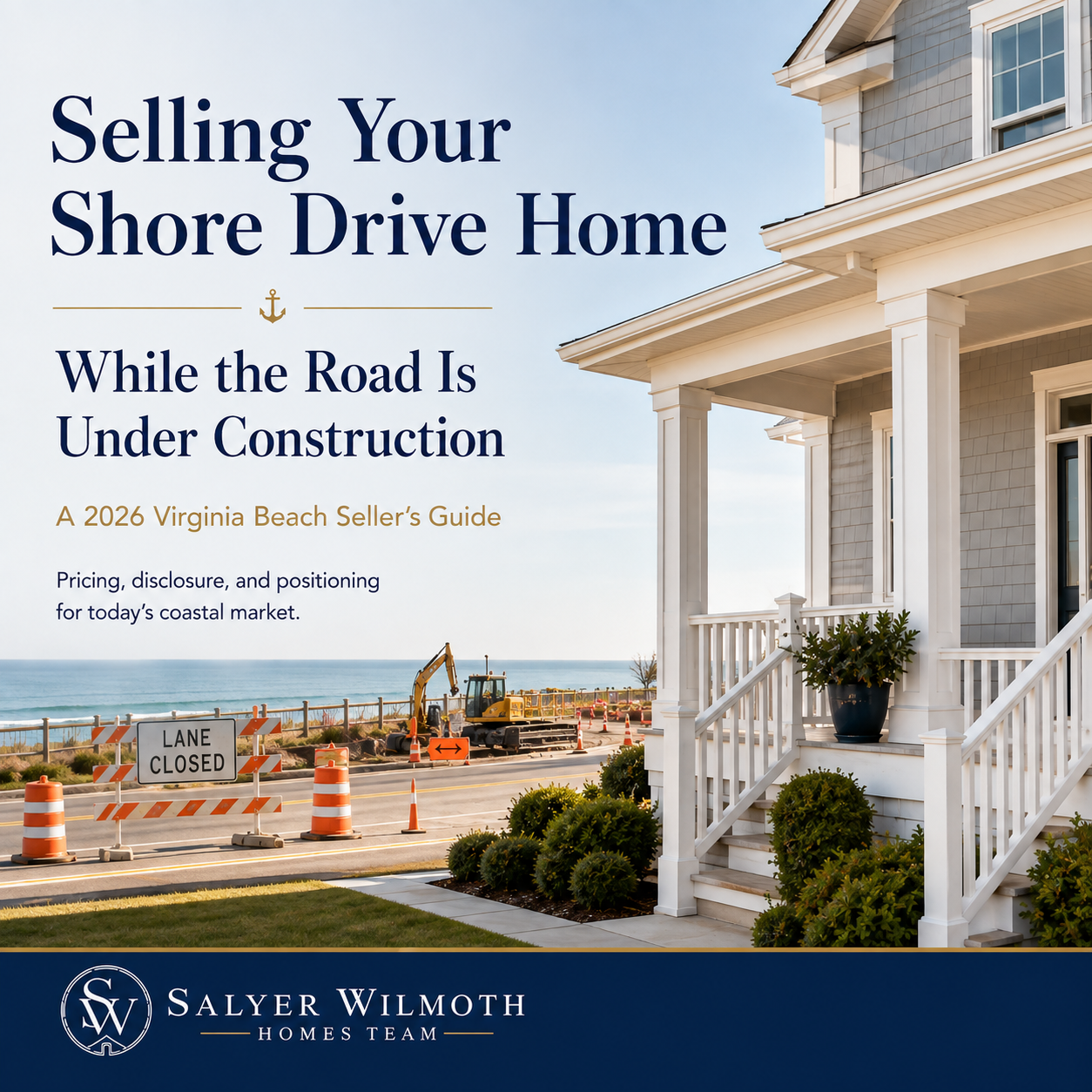
Shore Drive Phase III is scheduled to continue through May 24, 2029, so sellers should approach it as a known corridor condition rather than something likely to disappear immediately after the listing goes live. Buyers touring Shore Drive today may see construction equipment, temporary access changes, sidewalk work, lane restrictions, or other visible signs of the project.
A buyer who encounters those conditions unexpectedly may perceive them as a problem. A buyer who understands what is happening, how long the project is expected to last, and what improvements are being made can evaluate the property with much better context.
That is especially important in a coastal market where buyers are often evaluating much more than the house itself. If you want to understand the questions buyers are already considering before they even reach the seller side of the transaction, the Shore Drive Virginia Beach: Oceanfront Buying Guide provides a useful look at flood exposure, insurance, elevation, Chesapeake Bay Preservation Area considerations, association rules, and other issues that can shape a buyer's decision along this corridor.
What the Shore Drive Phase III Project Actually Involves
Understanding the project yourself is the first step toward explaining it accurately to prospective buyers.
According to the City of Virginia Beach project information reflected in the source material for this article, Phase III extends from Vista Circle near the eastern end of the Lesner Bridge east toward Beech Street, with work continuing through the Great Neck Road intersection.
The project includes road construction, stormwater improvements, and installation or improvement of curbs, gutters, and sidewalks.
As of August 2026, the eastbound sidewalk between Vista Circle and Starfish Road is closed for demolition and grading work.
Construction timing also matters. During the summer construction window from May 1 through September 30, lane closures are anticipated primarily during night-shift work, while daytime lane closures are not expected to resume until October 1, 2026.
For a seller, these details are useful because buyer concerns are usually practical: How difficult will it be to reach the property? Will showings be affected? Will daytime traffic be disrupted? Is this temporary road resurfacing or part of a larger project?
Being able to answer those questions accurately is much more effective than simply saying, “There is some construction nearby.”
Why This Is More Than a Road-Repaving Project
The Shore Drive work should not be described as roadwork alone.
The broader infrastructure effort includes stormwater improvements, canal widening and deepening, and upgrades involving water and sewer infrastructure. Resident and business access is intended to remain available while construction continues.
That larger context matters because Shore Drive sits within a coastal environment where flooding, drainage, sea-level rise, stormwater capacity, and long-term infrastructure resilience are legitimate ownership considerations.
Virginia Beach's broader planning framework also addresses flood and sea-level-rise resilience, while statewide coastal-resilience planning has focused on reducing long-term exposure to coastal flooding.
That does not mean sellers should tell buyers that the project will eliminate flood risk or guarantee future property appreciation. Neither would be appropriate.
It does mean sellers can accurately explain that the visible disruption is connected to a larger public infrastructure investment rather than an isolated repaving project.
For more context on why water exposure can affect buyer decision-making even within the same city, What Buyers Should Know About Flood Risk in Different Parts of Virginia Beach explains why flood zone, elevation, drainage, tidal influence, insurance requirements, and property-specific conditions matter more than broad assumptions about an entire neighborhood.
Price the Home for the Market Buyers Are Actually Seeing
Active construction can create hesitation.
That does not necessarily mean you need to dramatically discount the property, but it does mean the list price should reflect the home buyers can evaluate today—not an idealized version of what the corridor might look like years from now.
Overpricing a home because you expect buyers to ignore nearby construction can create a difficult cycle. Showings occur without offers, buyers begin wondering why the property has been sitting, and the seller eventually begins chasing the market through price reductions.
A well-supported launch price gives the property a stronger starting position.
The AIM-generated source for this article cites area-level Zillow data showing a median sale price of approximately $742,000 and a median of 60 days on market for the referenced area. Those numbers provide general context, but they should never be used as a shortcut for valuing an individual Shore Drive property.
The home's specific market value depends on factors such as exact street, proximity to the Chesapeake Bay, lot size, views, condition, age, renovations, property type, flood-zone designation, elevation, parking, association obligations, immediate construction impact, and available comparable sales.
A current comparative market analysis is therefore far more useful than applying a broad regional median.
Get Ahead of Buyer Questions With Proactive Disclosure
Transparency matters even more when buyers can physically see a condition affecting the surrounding area.
Virginia's residential disclosure system does not operate like a comprehensive seller warranty covering every condition associated with a property. Sellers should understand which disclosure documents apply and complete the required documentation accurately.
If you want a more detailed explanation of that process, Virginia's 2026 Residential Property Disclosure Statement: What Coastal Virginia Buyers and Sellers Need to Know explains what the updated statement does, what it does not tell buyers, and why coastal properties often require additional due diligence.
Beyond statutory disclosure requirements, a seller near active public construction should be prepared to provide accurate information about the known project scope and anticipated timeline rather than forcing buyers to discover it independently after contract ratification.
That difference can affect how a buyer responds.
A buyer who learns about a multi-year project after going under contract may begin questioning what else they were not told. A buyer who understands the situation before making an offer has already factored that information into the decision.
That does not require predicting future construction conditions or guaranteeing city schedules. It simply means providing accurate information from appropriate public sources and allowing buyers to evaluate it themselves.
Owners of older Shore Drive homes should also confirm the property's construction date early in the listing process. Homes built before 1978 may be subject to federal lead-based paint disclosure requirements, including delivery of the required EPA information and signed acknowledgments for covered transactions.
Position the Construction Honestly as Part of the Coastal Investment Story
Marketing a Shore Drive property during construction requires balance.
Pretending the roadwork does not exist can undermine buyer confidence. Overpromising what the infrastructure project will accomplish creates a different problem.
The better strategy is factual positioning.
Stormwater improvements, canal work, utility upgrades, roads, curbs, gutters, and sidewalks represent investments in the infrastructure serving the corridor. In a coastal environment, buyers often understand that public improvements involving drainage and resilience can carry long-term significance.
That makes the conversation broader than inconvenience alone.
A seller can acknowledge that construction is occurring today while also helping buyers understand why the work is taking place.
The same principle applies to the home's water proximity. Shore Drive's coastal setting can be one of its strongest lifestyle advantages while simultaneously introducing questions involving insurance, flooding, maintenance, and long-term ownership. Waterfront Proximity Near Norfolk or Virginia Beach: A Buyer's Guide to Risk, Cost, and Lifestyle provides additional context on why buyers often weigh those benefits and responsibilities together rather than treating water proximity as purely positive or negative.
A well-prepared listing should help buyers understand the complete picture instead of forcing them to piece it together after the showing.
Think About Showing Access Before the Listing Goes Live
Roadwork can also affect something much more immediate: the showing experience.
Before your home goes live, determine whether current work affects the most common route to the property, street parking, driveway access, pedestrian access, nearby sidewalks, or the route buyers will likely take from the main corridor.
If an alternate route makes access easier, your agent should know it.
Showing instructions should also be updated when construction patterns change rather than remaining static throughout the listing.
Small logistical frustrations can influence a buyer's first impression more than sellers expect. If a buyer arrives late because of a lane closure, struggles to identify where to turn, or assumes the property cannot be accessed easily, their reaction to the home begins before they ever walk through the front door.
The goal is not to control construction. It is to make the parts of the showing experience that you can control as smooth as possible.
Understand the Coastal Concerns Buyers May Bring Into the Showing
Many Shore Drive buyers are already thinking about flood zones, insurance costs, storm exposure, elevation, drainage, associations, exterior maintenance, and future resale before they schedule a tour.
That means construction is rarely the only question.
A buyer may see stormwater work outside the neighborhood and immediately connect it to flooding. Another may be comparing a higher-elevation property with one closer to the water. Someone else may be considering whether a condo reduces exterior maintenance while adding association obligations.
These are not necessarily objections. They are due-diligence questions.
Sellers are better positioned when the home's own documentation is organized before the listing begins. Depending on the property, useful records may include surveys, elevation certificates, association documents, repair receipts, renovation permits, warranties, flood-related documentation, insurance information, or other records relevant to the home.
The cleaner the information trail, the easier it is for serious buyers to evaluate the property on facts rather than uncertainty.
Understand What Closing Costs May Look Like for a Virginia Beach Seller
Road construction may influence how the property is marketed, but the financial mechanics of the sale remain equally important.
Virginia real estate transfers can involve state recordation or transfer-related taxes, settlement charges, deed preparation, prorated property taxes, mortgage payoff amounts, association-related fees, negotiated broker compensation, seller concessions, repairs, and other transaction-specific expenses.
Broker fees and commissions are negotiable and are not set by law. Compensation agreed upon with the listing brokerage and any amount a seller may negotiate toward a buyer's representation should be evaluated according to the actual listing agreement and purchase contract.
If you are estimating what you may walk away with rather than focusing only on the sale price, Cost to Sell a House in Hampton Roads in 2026 breaks down the expenses that can affect a seller's final proceeds and explains why a personalized seller net sheet is more useful than relying on a generic percentage.
For Virginia Beach properties, the deed is recorded through the appropriate circuit court clerk as part of the transfer process, and ownership records are subsequently updated based on the recorded instrument.
Your settlement professional or attorney should provide the actual figures and documents that apply to your transaction.
What Happens After You Accept an Offer?
Once a buyer makes an acceptable offer and the contract is ratified, the Shore Drive construction project becomes only one part of the transaction.
The buyer may still complete inspections, financing, appraisal, title review, association-document review, insurance research, a final walkthrough, and other due diligence allowed under the contract.
For sellers, this is where good preparation before listing begins to pay off.
If buyers already understand the construction environment, access conditions, property documentation, and relevant coastal considerations, fewer surprises are introduced after ratification.
The broader Hampton Roads contract-to-closing process commonly involves several simultaneous deadlines. If you want to see how those pieces fit together after the offer is accepted, What Happens After Accepting an Offer? Hampton Roads Seller Timeline walks through inspections, appraisal, financing, title work, final walkthrough, and settlement in more detail.
Recent Hampton Roads Market Context
The AIM source also provides broader August 2026 area-level market figures:
| Area | Median Sale Price | Median Days on Market |
|---|---|---|
| Greenbrier | $742,000 | 60 |
| Great Bridge | $552,000 | 54 |
| Deep Creek | $357,500 | 57 |
These figures illustrate how much pricing can vary even within the broader Hampton Roads region. They should not be treated as direct comparables for Shore Drive.
The Shore Drive and Virginia Beach coastal corridor operates within its own pricing environment, influenced by proximity to the Chesapeake Bay, water views, property type, lot size, flood-zone designation, elevation, condition, association structure, parking, exact block, and current competition.
The only useful answer to “What is my Shore Drive home worth?” comes from evaluating the actual property against current local competition and recent comparable sales.
Frequently asked questions
Is Shore Drive still under construction in Virginia Beach right now?
Yes. Shore Drive Phase III remains an active City of Virginia Beach public-works project based on the August 2026 information used for this article. The project extends from the Vista Circle area east toward Beech Street and includes road, stormwater, sidewalk, curb, gutter, and related infrastructure work. The current project schedule cited in the source places completion at May 24, 2029, so buyers and sellers should view the work as a multi-year corridor condition rather than a short-term project.
Does Shore Drive construction hurt home values or buyer interest?
Construction can create hesitation, particularly when buyers encounter it unexpectedly or believe access will be difficult. That does not mean every nearby property automatically loses value. The effect can vary according to the home's exact location, access, condition, pricing, views, flood characteristics, property type, and how the listing compares with alternatives. The infrastructure work also includes stormwater and other long-term improvements, which gives buyers additional context beyond the immediate disruption. If you are thinking about selling near Shore Drive, Michele can prepare a property-specific market analysis rather than relying on generalized assumptions about what the construction is doing to values.
What disclosures should Virginia sellers prepare before listing near Shore Drive?
Virginia sellers should determine which Residential Property Disclosure Act forms and other property-specific disclosures apply to their transaction and complete them accurately and on time. Properties built before 1978 may also be subject to federal lead-based paint disclosure requirements. Depending on the property, additional information involving associations, flooding, prior work, permits, or other conditions may also be relevant. Sellers near active roadwork should also be prepared to provide buyers with accurate public information about the construction project rather than allowing speculation to fill the gap.
Who records the deed after a Virginia Beach home sale?
The deed transferring ownership is recorded with the Virginia Beach Circuit Court Clerk's office as part of the closing process. Settlement professionals coordinate the required documentation, funds, taxes, recording, and other transfer-related items according to the transaction. Once the deed is recorded, public ownership records are updated based on the recorded instrument.
Do I need an attorney to sell a home near Shore Drive in Virginia Beach?
Virginia sellers should rely on the appropriately licensed settlement and legal professionals required for their particular transaction. A real estate attorney can be especially valuable when questions involve title, unusual contract provisions, easements, waterfront or coastal matters, estate issues, or other legal complications. Your real estate agent does not replace legal counsel. If you are preparing to sell near Shore Drive, Michele can help you organize the real-estate side of the transaction and identify questions that should be directed to your attorney, settlement professional, insurance provider, or other qualified specialist.
Selling near Shore Drive during an active infrastructure project requires more preparation than simply putting the home on the market and hoping buyers overlook the construction. If you are considering selling along Shore Drive, Chic's Beach, Bayfront, Lynnhaven Shores, or the surrounding Virginia Beach coastal corridor, Michele Salyer can help you evaluate the property's current market position, anticipate buyer questions, and build a listing strategy around the facts buyers are seeing today.
Michele Salyer, REALTOR® | Team Leader, Salyer Wilmoth Homes
Atlantic Sotheby's International Realty
4416 Expressway Drive, Virginia Beach, VA 23452
757-502-3671
michele@salyerwilmothhomes.com
www.salyerwilmothhomes.com
Virginia License #0225238875 | North Carolina License #322300
Equal Housing Opportunity
This article is provided for general informational purposes only and does not constitute legal, tax, engineering, environmental, insurance, or financial advice. Construction schedules and public-project conditions can change. Sellers and buyers should confirm current project information with the City of Virginia Beach and confirm property-specific transaction, legal, tax, insurance, and settlement questions with the appropriate qualified professionals.