TL;DR
Standing water after an unusually heavy Coastal Virginia rain does not automatically mean a property has a major defect, but recurring puddles, water that remains long after nearby areas have dried, runoff flowing toward the foundation, saturated soil beside a crawl space, erosion, damaged landscaping, overflowing drainage structures, or moisture appearing inside the home can point to grading, soil, downspout, stormwater, groundwater, or drainage-system problems that deserve closer investigation; buyers should observe the property during or shortly after rain, review the yard’s slope, gutters, downspouts, crawl space, foundation, low areas, drains, swales, neighboring runoff, flood information, permits, disclosures, insurance considerations, and inspection findings before assuming the issue is minor, while sellers should document known conditions, correct simple maintenance problems where appropriate, avoid cosmetic attempts to conceal wet areas, and consult qualified drainage, landscaping, structural, crawl-space, or engineering professionals when the source, severity, repair method, or effect on the home remains uncertain.
Is Standing Water After Rain Always a Serious Problem?
Not necessarily. Soil needs time to absorb water, and a very intense or prolonged storm can temporarily overwhelm even a generally functional yard. Low areas may hold shallow puddles for a short period, especially when the ground was already saturated before the rain began.
The important questions are how frequently the water appears, how long it remains, where it collects, and whether it affects the house or surrounding improvements.
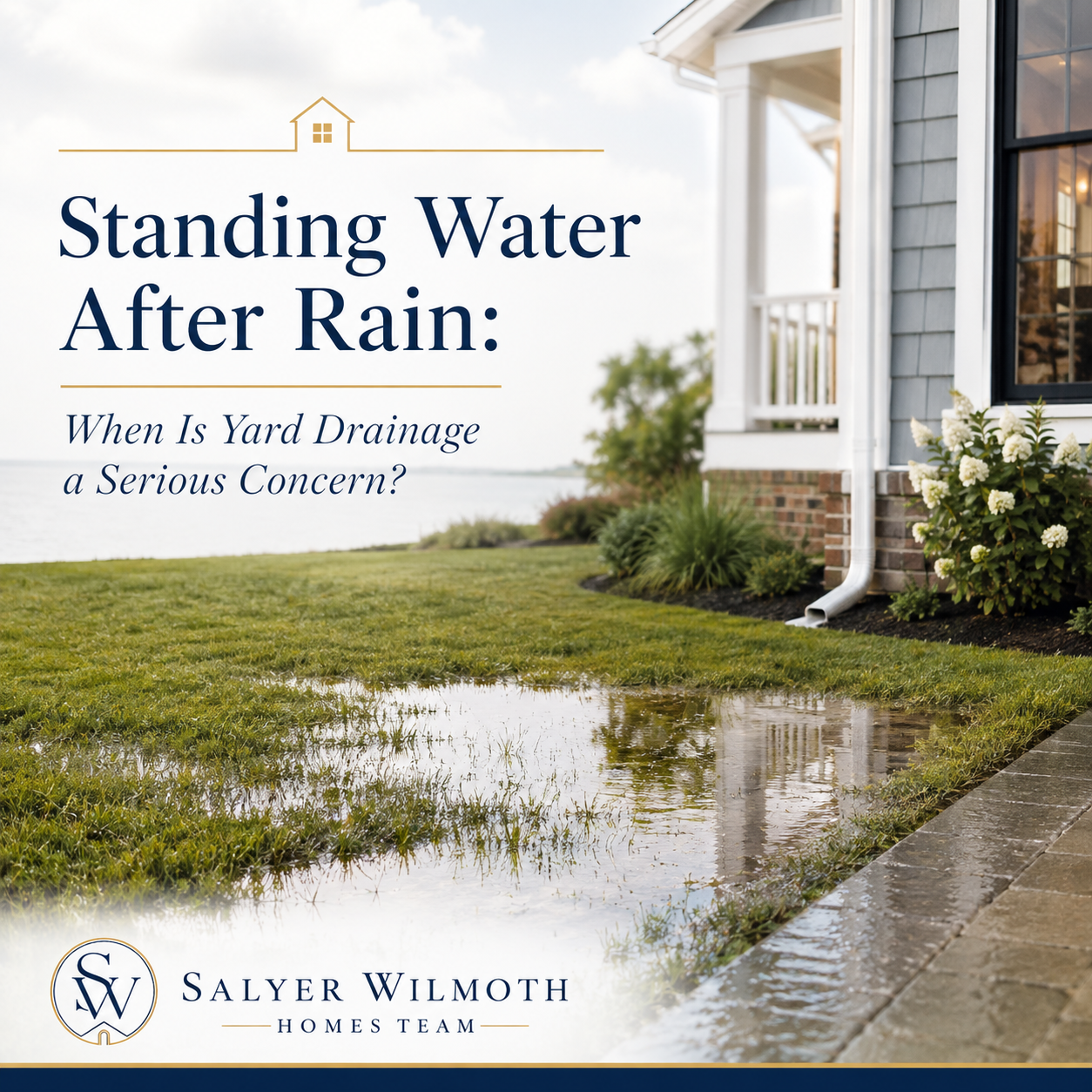
A small puddle in a distant part of the yard after an exceptional storm is different from water repeatedly collecting beside the foundation after ordinary rainfall. A low spot that dries later the same day is also different from a saturated area that remains soft, muddy, or covered with water for several days.
Well-designed rain gardens, which are intentionally constructed to hold and absorb runoff, are generally expected to drain within approximately 24 to 48 hours after a storm. An ordinary yard is not automatically subject to the same design standard, but that time frame can serve as a useful screening reference: water that remains beyond it, appears after moderate rain, or repeatedly affects the same location deserves closer evaluation.
How Long Is Too Long for Water to Stand in a Yard?
There is no single deadline that applies to every property because drainage depends on rainfall intensity, soil type, slope, groundwater, vegetation, temperature, previous saturation, and the amount of hard surface directing runoff into the yard.
As a practical starting point, buyers and homeowners should pay closer attention when visible water remains for more than 24 to 48 hours, especially when surrounding areas have already dried. Water that remains for several days may indicate slow infiltration, compacted soil, heavy clay, a blocked outlet, improper grading, a high seasonal water table, or more runoff entering the area than the yard can manage.
Virginia Cooperative Extension notes that standing water may indicate a wet site or slow drainage, while compacted soil can restrict the movement of water into the ground. Compaction reduces the larger pore spaces that normally help water infiltrate and drain.
The location matters as much as the duration. Even temporary water deserves attention when it reaches the foundation, crawl-space vents, exterior doors, garage, HVAC equipment, septic components, retaining walls, or neighboring property.
What Causes Standing Water After Rain?
Standing water is a symptom rather than a diagnosis. Several conditions may contribute to the same visible puddle.
The yard may contain a naturally low area where water collects. The soil may have been compacted by construction equipment, vehicles, repeated foot traffic, or previous landscaping work. Heavy or poorly draining soil may absorb water slowly. The lot may also have inadequate slope, or the ground may have settled over time and begun directing water toward the house.
Roof runoff is another common factor. Clogged gutters, disconnected downspouts, damaged underground drain lines, or downspouts that terminate too close to the structure can concentrate a large amount of water in one location.
Hard surfaces also change how water moves. Roofs, patios, driveways, walkways, pools, sheds, and additions prevent rainfall from soaking directly into the ground. If the property was altered without a corresponding drainage plan, more runoff may now reach the lawn or adjoining properties.
Runoff may also enter from neighboring lots, streets, alleys, common areas, drainage easements, ditches, or stormwater facilities. EPA guidance explains that grading, vegetation, soil conditions, and impervious surfaces all affect whether stormwater infiltrates, moves across the land, or becomes concentrated in a particular area.
When Does Yard Drainage Become a Serious Concern?
Standing water deserves prompt professional attention when it appears to be affecting the structure, creating erosion, damaging improvements, or becoming more frequent.
Water repeatedly collecting against the foundation is a stronger warning sign than a shallow puddle at the far edge of the property. Buyers should also investigate moisture or staining inside the crawl space, basement, garage, or lower-level rooms; musty odors; deteriorated wood; rusted components; efflorescence on masonry; damaged insulation; standing water beneath the home; or sump equipment that appears to operate continuously.
Other concerns may include soil washing away from the foundation, channels forming through the lawn, exposed roots, shifting pavers, cracked or leaning retaining walls, sinking areas, damaged fencing, soft ground around patios or decks, and water crossing a driveway or entrance route.
Repeated saturation can also affect lawns, shrubs, and trees because excess water fills soil air spaces and reduces the oxygen available to roots. Virginia Cooperative Extension explains that prolonged low-oxygen soil conditions can interrupt water and nutrient uptake and contribute to plant decline.
A visually attractive yard can still require expensive or ongoing drainage work. Buyers who want to evaluate appearance alongside future upkeep may find How to Spot a Home That Is Beautiful but High-Maintenance helpful, particularly when the property includes mature trees, retaining walls, extensive landscaping, irrigation, patios, drainage structures, or a crawl space.
Why Water Near the Foundation Requires More Attention
The ground immediately around a home should be evaluated carefully because water concentrated near the structure can interact with the foundation, crawl space, basement, slab edges, exterior materials, and mechanical systems.
A drainage concern does not automatically mean structural damage has occurred. However, repeated saturation near the foundation can create conditions that warrant a more detailed inspection, especially when water appears beneath the home or when the buyer observes movement, cracking, wood deterioration, moisture, mold-like growth, or persistent odors.
Gutters and downspouts should also be reviewed as part of the same system. A roof collects a substantial volume of water during a storm, and a blocked or poorly directed downspout may release that water beside the house rather than moving it to an appropriate discharge location.
Buyers should determine whether downspouts discharge onto splash blocks, extensions, underground pipes, rain barrels, landscaped areas, or another approved drainage feature. Underground drainage should not be assumed to function merely because a pipe disappears beneath the soil. Ask where it terminates and whether it has been inspected, cleaned, repaired, or replaced.
What Buyers Should Look for During a Showing
A dry-weather showing can conceal how a property behaves during rain. Buyers should therefore look for indirect evidence even when no water is visible.
Possible clues include bare or thin grass in low areas, moss, algae, mud lines, washed mulch, displaced gravel, eroded channels, water stains on fences or foundation walls, sediment around drains, unusually soft ground, multiple sump-pump discharge lines, recently added soil, new sod in one isolated section, or downspout extensions that appear temporary.
Check whether the yard slopes toward or away from the home. Observe whether nearby patios, driveways, walkways, and neighboring properties direct water toward the lot. Look into visible drains, swales, ditches, culverts, and catch basins for debris or signs of overflow.
The best opportunity may be a showing scheduled during or shortly after rainfall. Virginia Cooperative Extension recommends observing a landscape during or shortly after rain to see where runoff from roofs, driveways, patios, and other hard surfaces actually travels.
Buyers evaluating a Coastal Virginia property should not stop with the yard. They should also inspect the crawl space, foundation areas, garage, lower rooms, HVAC location, gutters, roof drainage, and accessible exterior walls. When the home sits near tidal water, a creek, canal, marsh, pond, or other water feature, What Buyers Should Know About Buying Near the Water in Deep Creek offers a broader framework for reviewing drainage, moisture, flood information, shoreline conditions, maintenance, permits, and insurance.
Does a Flood Zone Tell You Whether the Yard Drains Properly?
No. A FEMA flood-zone designation and a property’s everyday yard drainage are related topics, but they are not the same question.
Flood maps help describe mapped flood hazards. They do not show whether a particular downspout is clogged, whether a backyard low spot holds water after thunderstorms, whether an underground drain is broken, or whether recent landscaping changed the direction of runoff.
A property outside a higher-risk mapped flood zone may still experience standing water from rainfall, grading, soil conditions, storm-drain backup, or nearby runoff. Likewise, a property inside a mapped flood area may have well-maintained lot drainage but still face broader flood and insurance considerations.
An elevation certificate also does not substitute for drainage analysis. It may report surveyed elevations around the structure, but it does not normally determine whether the backyard ponds after rain, whether gutters work properly, or whether a ditch, culvert, or storm drain performs adequately. What an Elevation Certificate Tells a Coastal Virginia Buyer explains how buyers can use the document without mistaking it for a drainage study.
Buyers should evaluate both issues separately and then consider how they interact.
Could Standing Water Affect Insurance or Financing?
A puddle in the yard does not automatically create an insurance or financing problem. However, related conditions may influence a buyer’s decision, an insurer’s evaluation, required repairs, or the cost and availability of coverage.
For example, visible water intrusion, unresolved foundation concerns, damaged drainage systems, recurring crawl-space moisture, or a property’s mapped flood designation may lead to additional questions. The result depends on the specific property, insurance carrier, lender, loan program, inspection findings, and repair history.
A standard homeowners policy and a separate flood policy cover different risks, and neither should be assumed to pay for every form of water damage. Buyers should explain the property’s condition accurately to the insurance representative and ask what is covered, excluded, or subject to a deductible.
What Buyers Should Know About Flood Insurance Before Buying Near Norfolk or Chesapeake can help buyers connect flood-zone research with drainage observations, elevation information, lender requirements, and total monthly ownership cost.
What Should Sellers Do About Standing Water Before Listing?
Sellers should begin by observing the property during actual rain rather than guessing about the source from dry conditions.
Simple maintenance may resolve some concerns. Gutters may need cleaning, a downspout extension may have become disconnected, a drain may be covered with leaves, or a swale may be obstructed by accumulated soil or landscaping materials.
Other situations require professional evaluation. Regrading, installing underground drains, changing discharge locations, constructing swales, modifying retaining walls, connecting to stormwater infrastructure, or altering areas near easements and property lines can create technical, legal, permitting, and neighbor-related issues when performed incorrectly.
Sellers should avoid covering a wet area with new mulch, sod, gravel, or soil merely to improve photographs or hide the condition. Added material may conceal the symptom without correcting the direction or volume of water.
Virginia’s residential disclosure system also places significant responsibility on buyers to investigate the property, but sellers should not make false statements, actively conceal known defects, or assume that a disclaimer eliminates every obligation. Virginia’s 2026 Residential Property Disclosure Statement: What Coastal Virginia Buyers and Sellers Need to Know provides a broader explanation of why buyers should conduct independent due diligence and why sellers should answer direct questions carefully.
Before listing, organize any available invoices, warranties, permits, surveys, drainage plans, engineering reports, waterproofing documents, foundation records, crawl-space service reports, flood documentation, and photographs showing completed work.
Which Drainage Solutions May Be Considered?
The correct solution depends on the cause. Installing a French drain because water is visible may not solve a grading issue, and adding soil may redirect runoff toward the house or a neighboring property.
Possible approaches may include correcting gutter and downspout problems, cleaning or repairing underground drain lines, restoring a swale, relieving soil compaction, improving vegetation, modifying the grade, installing a catch basin or channel drain, creating a properly designed rain garden, using permeable materials, addressing retaining-wall drainage, or installing specialized foundation or crawl-space systems.
A rain garden is a planted shallow depression intentionally designed to hold runoff temporarily while water infiltrates, evaporates, or is used by vegetation. Virginia Cooperative Extension recommends evaluating the site and conducting a percolation test before selecting a location because every landscape, soil profile, and runoff pattern is different.
Drainage work should also account for buried utilities, septic systems, wells, easements, rights-of-way, property boundaries, local requirements, and the seasonal water table. Larger swales and more complex grading projects may require a contractor, engineer, landscape professional, or other qualified specialist.
The goal is not simply to move water out of one visible puddle. It is to manage runoff without damaging the house, neighboring land, public infrastructure, or another part of the same property.
Who Should Evaluate a Yard Drainage Problem?
The appropriate professional depends on the symptoms.
A licensed home inspector may identify visible drainage concerns and recommend further evaluation. A drainage or grading contractor may assess surface-water movement and possible correction methods. A landscape professional may evaluate soil, vegetation, swales, and rain-garden options.
A structural engineer may be appropriate when settlement, foundation movement, retaining-wall concerns, or structural damage is suspected. A crawl-space or waterproofing specialist may evaluate water beneath the home, although buyers should compare recommendations carefully when the evaluator also sells a specific repair system.
A licensed surveyor or civil engineer may be needed when elevations, lot grading, easements, drainage plans, or runoff between properties are central to the issue. Local stormwater or public-works staff may be able to clarify responsibility for public ditches, inlets, culverts, or drainage easements, but they may not repair conditions located entirely on private property.
Buyers should ask each professional to identify the suspected source, explain the proposed correction, describe what the work will and will not solve, identify permits or approvals that may be necessary, and provide a written estimate whenever possible.
How Buyers Can Protect Their Decision Before Closing
Begin with the purchase agreement and inspection deadlines. A buyer should not wait until the final walkthrough to investigate a drainage concern first observed during the home inspection.
Request available drainage documentation, seller disclosures, repair invoices, permits, surveys, flood information, elevation certificates, insurance records where appropriate, and reports from previous contractors. Ask whether standing water occurs only after exceptional storms or after routine rainfall, how long it typically lasts, and whether water has entered the home, crawl space, garage, or other structures.
Return to the property after rain when access and contract timing permit. Photograph the condition and note the approximate rainfall, time, location, depth, and duration. Those observations can help a professional distinguish between temporary saturation and recurring drainage failure.
Obtain estimates before assuming the repair will be minor. Even when a practical correction exists, buyers should consider the cost, disruption, maintenance, warranty, effect on landscaping, effect on neighboring properties, and possibility that more than one condition contributes to the problem.
Frequently asked questions
How long should water stand in a yard after rain?
Some temporary pooling can occur during heavy or prolonged rainfall, especially when the soil was already saturated. As a practical screening benchmark, water that remains for more than approximately 24 to 48 hours, repeatedly appears after moderate rain, or stays after nearby areas have dried should be evaluated more closely. Soil type, grading, rainfall intensity, groundwater, vegetation, and drainage systems all influence how quickly an individual yard should dry.
Is standing water near the foundation always a serious problem?
It does not automatically prove that the foundation is damaged, but repeated water beside the structure deserves prompt attention. Buyers should look for crawl-space moisture, staining, odors, wood deterioration, foundation movement, damaged insulation, clogged gutters, short downspouts, and soil sloping toward the home. Salyer Wilmoth Homes can help buyers organize the inspection questions and specialist evaluations that should be completed before important contract deadlines expire.
Can a home inspection identify yard drainage problems?
A home inspector can document visible grading, drainage, gutter, downspout, foundation, and moisture concerns, but a standard inspection may not determine the complete cause or design the final repair. Drainage conditions can also be difficult to evaluate when the property has been dry for an extended period. When concerns remain, Salyer Wilmoth Homes can help coordinate follow-up questions for a drainage contractor, engineer, surveyor, crawl-space specialist, or other appropriate professional.
Does being outside a flood zone mean the yard has good drainage?
No. Flood-zone mapping and lot drainage address different issues. A property outside a higher-risk mapped flood area may still have standing water caused by poor grading, compacted soil, blocked drains, roof runoff, groundwater, stormwater backup, or runoff from nearby land. Buyers should review the flood designation and the property’s actual drainage performance separately.
Who should fix standing water in a yard?
The right professional depends on the source. A gutter contractor may address roof discharge, while a grading or drainage contractor may evaluate surface water. A landscape professional may assess soil, vegetation, swales, or rain-garden options. A surveyor, civil engineer, structural engineer, crawl-space specialist, or local stormwater office may be appropriate for more complex conditions. Salyer Wilmoth Homes can help buyers and sellers identify which questions need answers before comparing repair proposals.
This article provides general real estate information and is not engineering, structural, landscaping, insurance, legal, environmental, or drainage advice. Conditions and requirements vary by property and jurisdiction. Buyers and sellers should consult appropriately licensed professionals about the specific home and proposed work.
Concerned about standing water around a Coastal Virginia property? Let’s review what is visible, what documents are available, which questions should be raised, and which professionals may need to evaluate the condition before you make your next decision.
Michele Salyer, REALTOR®
📞 757-502-3671
🌐 www.salyerwilmothhomes.com
“If you are looking to sell, Call Michele! If you are looking to acquire, I’m your hire!”
Atlantic Sotheby's International Realty
Equal Housing Opportunity