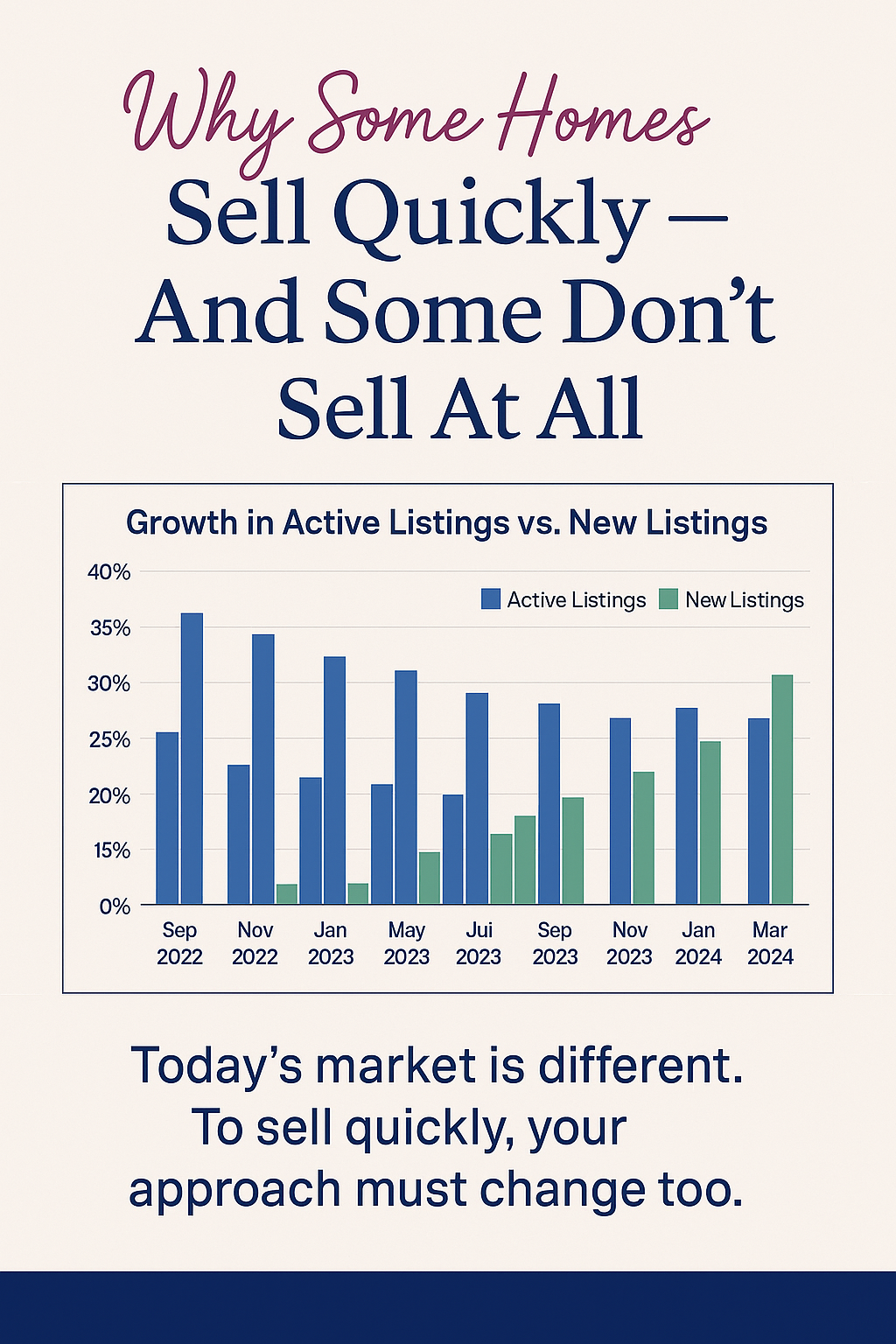

Why Some Homes Sell Fast — and Others Sit on the Market

A few years ago, homes were flying off the market. With record-low inventory, nearly anything sold — and fast. But today’s real estate landscape looks different. Inventory is up nearly 20% compared to last year, and in many areas, supply has returned to pre-2020 levels.

So, what does that mean for sellers?
👉 Your home needs to stand out from the moment it hits the market.

🔍 Why Homes Sit on the Market

Most of today’s inventory growth comes from homes that are still active — the ones that haven’t sold yet — rather than new listings. According to Realtor.com, many of these homes are taking longer to sell, which tells us something important:
It’s not just about listing your home — it’s about how you list it.

Common reasons homes linger on the market include:

  • Pricing too high based on old market conditions
  • Skipping essential repairs or updates
  • Poor listing photos or staging
  • Limited showing availability
  • Weak marketing strategies

A few years ago, sellers could list “as-is” and still attract multiple offers. Not anymore. Today’s buyers are choosier, more informed, and have more options.

💡 What Makes a Home Sell Quickly

Selling quickly in this market isn’t about luck — it’s about strategy.
Here’s what successful sellers have in common:

  1. Pricing Realistically – A competitive price based on today’s market, not yesterday’s headlines.
  2. Curb Appeal and Condition – Small upgrades and clean presentation go a long way.
  3. Professional Marketing – High-quality photos, social media visibility, and listing optimization matter.
  4. Accessibility – The easier it is to show, the faster it sells.

Remember: your first few weeks on the market are crucial. That’s when your listing gets the most exposure online. Nail your presentation early, and buyers will act fast.

🤝 Why the Right Agent Makes All the Difference

Working with an experienced REALTOR® means having someone who understands local trends, buyer behavior, and pricing strategy. According to the National Association of REALTORS® (NAR), sellers who work with agents are twice as likely to get an offer within a month compared to those who list on their own.

An expert agent will:

  • Recommend the right listing price using local comparable sales
  • Help you prep and stage for maximum impact
  • Use professional marketing that reaches buyers where they’re searching

Bottom Line

Even with more homes for sale, your property can still sell quickly — if it’s priced right, presented beautifully, and marketed strategically.

If you’re thinking about selling in Hampton Roads, Chesapeake, or Newport News, let’s connect! I’ll help you position your home to attract attention — and offers — from day one.

If you’re looking to sell, call Michele! If you’re looking to acquire — I’m your hire!

Michele Salyer, REALTOR®
Salyer Wilmoth Homes | A Better Way Realty
📞 7575023671 | 🌐 www.salyerwilmothhomes.com

July 1, 2026

What Sellers in Culpepper Landing Should Know Before Listing Their Home

TL;DR

Selling a home in Culpepper Landing takes more than choosing a price, taking photos, and waiting for buyers to notice the neighborhood; sellers need to understand how their home compares with other Chesapeake listings, how the planned-community setting should be positioned, what exterior and HOA-related details may need to be reviewed before going live, how buyers may evaluate layout, privacy, storage, updates, condition, commute, and total cost of ownership, and why the strongest listing strategy should make the property feel polished, accurate, easy to understand, and compelling from the first online impression through the showing, offer, inspection, and closing process.

Start with what makes Culpepper Landing different

Culpepper Landing is not just another Chesapeake neighborhood where sellers can rely on square footage, bedroom count, and a few basic listing remarks to carry the marketing. Because the community has a planned, cohesive feel, buyers may pay close attention to curb appeal, exterior maintenance, amenities, street presentation, and how each home compares with nearby options. Sellers should think about how the home fits into the larger neighborhood story while still focusing on the specific property’s strongest features. If buyers are still deciding whether the area itself fits their search, a natural companion resource like What Is It Like to Live in Culpepper Landing in Chesapeake, VA?can help them understand the community context while your listing shows them why your particular home deserves a closer look.

Price against the real competition, not just the neighborhood name

A Culpepper Landing address may help attract attention, but buyers will still compare your home against active, pending, and recently sold homes across Chesapeake. Pricing should reflect the specific property, not just the community. A home with stronger updates, a better layout, cleaner presentation, functional outdoor space, or a more polished showing experience may need a different pricing strategy than a home with deferred maintenance or dated finishes. Before choosing a list price, sellers should review recent comparable sales, current competition, buyer activity, days on market, and price reductions in the surrounding area. This is where a pricing conversation becomes more strategic than emotional, and sellers who want a deeper look at that mindset may also find How to Price Your Chesapeake Home to Attract Serious Buyers Early helpful before listing.

Prepare the exterior before buyers form an opinion

In a planned community like Culpepper Landing, exterior presentation matters because buyers may notice how the home fits visually within the surrounding streetscape. Before listing, sellers should walk the property from a buyer’s point of view and look at the front elevation, landscaping, porch, shutters, trim, siding, walkway, driveway, fencing, lighting, and any visible wear from the curb. Small exterior details can influence whether buyers feel confident before they even step inside. Sellers do not need to make the home perfect, but they should fix the distractions that make the property feel less cared for. For a more general seller-prep guide that pairs well with this step, What Chesapeake Sellers Should Fix Before Listing — and What Can Wait can help sellers prioritize what is worth addressing before going live.

Review HOA-related details before listing

Sellers should gather HOA documents, fee information, amenity details, architectural guidelines, resale package requirements, and any known approval history before the home hits the market. Buyers may ask about fees, exterior restrictions, parking rules, fencing guidelines, community amenities, or what changes may need approval. Having accurate information ready can make the listing feel more organized and help reduce delays once a buyer is interested. Sellers do not need to turn the listing description into an HOA summary, but they should be prepared to answer questions clearly and consistently.

Make the home easy to understand online

Many buyers will first experience your Culpepper Landing home through photos, listing copy, search filters, map views, and quick online comparisons. That means the online presentation needs to explain the home clearly. Professional photos should show the flow of the property, not just the prettiest rooms. Listing remarks should highlight meaningful features such as flexible spaces, storage, updated systems, garage function, outdoor areas, kitchen layout, natural light, and community context. This is also why staging and photo preparation matter. If the home needs help feeling more intentional on camera, Why Home Staging Matters When Selling Your Home is a helpful follow-up because buyers often decide whether a home feels worth touring before they ever schedule a showing.

Focus on layout, storage, and daily function

Buyers in Chesapeake often compare homes based on how they imagine daily life working inside the property. In Culpepper Landing, where several homes may offer a polished planned-community look, the details inside the home can become the difference-maker. Sellers should make each room’s purpose clear, especially if the home has a flex space, loft, dining room, office, guest room, or finished area that may not be obvious in photos. Closets, garages, pantries, laundry areas, and storage spaces should feel organized enough for buyers to understand their usefulness. A home that feels easy to understand often feels easier to choose.

Do not ignore small maintenance issues

Small repairs can create outsized doubt during a showing. Loose handles, stained caulk, scuffed walls, worn paint, dripping faucets, damaged trim, fogged windows, dirty vents, and tired landscaping may lead buyers to wonder what else has been overlooked. Sellers do not always need major renovations before listing, but they should address visible distractions that make the home feel less maintained. In a neighborhood where buyers may be comparing similar homes, clean maintenance can help your listing feel more credible and move-in ready.

Think carefully about updates versus over-improving

Before spending money on updates, sellers should ask which improvements are most likely to support marketability. Fresh paint, updated lighting, landscaping touch-ups, deep cleaning, minor repairs, and strategic staging may have more impact than expensive renovations completed right before listing. Not every kitchen or bathroom needs to be remodeled before selling. The better question is whether an update will help the home compete, photograph better, reduce buyer objections, or support the pricing strategy. A local listing consultation can help sellers decide what is worth doing and what can wait.

Be ready for buyer feedback after showings

Once your Culpepper Landing home is live, buyer feedback can help reveal whether the market understands the value of the property. If buyers like the neighborhood but hesitate on price, layout, condition, or updates, that feedback should be taken seriously. If the home gets online views but few showings, the issue may be pricing, photos, competition, or how the listing is positioned. If showings happen but offers do not follow, sellers may need to look more closely at presentation, buyer objections, or market timing. For sellers who want to better understand what early reactions may mean, What Sellers Should Expect From Buyer Feedback After the First Weekend on Market can help make that part of the process less confusing.

Be strategic with listing timing and launch

A successful listing launch is not only about the day the home appears online. It is about making sure pricing, photos, showing access, disclosures, HOA information, property prep, and marketing are ready before buyers start forming opinions. Sellers in Culpepper Landing should avoid going live before the home is truly ready, especially if the property will be competing against polished listings nearby. The first few days on the market can shape buyer perception, so the listing should feel complete, accurate, and easy to act on from the beginning.

Market the neighborhood carefully and fairly

When marketing a Culpepper Landing home, sellers and agents should focus on property features, community amenities, location, design, and practical benefits without making assumptions about who should live there. Fair-housing-safe language avoids references to protected classes and avoids steering buyers based on personal characteristics. Instead of describing the “type” of buyer the neighborhood is for, the listing should focus on objective features such as sidewalks, trails, clubhouse access, nearby routes, home layout, outdoor areas, garage space, storage, updates, and community design. This keeps the marketing professional, inclusive, and compliant.

Work with local market context

Culpepper Landing sellers benefit from pricing and marketing advice that understands both the neighborhood and the larger Chesapeake market. A strong listing strategy should compare your home against nearby active listings, recent sales, competing Chesapeake communities, buyer expectations, and current market conditions. It should also anticipate the questions buyers may ask about HOA rules, property condition, commute, amenities, and resale value. The right preparation can help the home stand out for the right reasons instead of relying on generic listing language.

Frequently asked questions

How much is my Culpepper Landing home worth in Chesapeake, VA?

Your Culpepper Landing home’s value depends on recent comparable sales, active competition, property condition, layout, updates, lot placement, square footage, garage space, outdoor function, HOA considerations, and current buyer demand in Chesapeake. A neighborhood name can influence buyer interest, but the final pricing strategy should be based on the specific home and the market at the time you list.

What should I do before listing my Culpepper Landing home for sale?

Before listing, review your pricing position, complete visible repairs, improve curb appeal, organize storage areas, prepare HOA information, clean thoroughly, and make sure the home photographs well. Sellers should also confirm whether any exterior changes or improvements need HOA documentation before going live. If you are preparing to sell in Culpepper Landing, a pre-listing consultation can help you decide which tasks matter most before spending money on unnecessary updates.

Do HOA rules affect selling a home in Culpepper Landing?

Yes, HOA rules can affect the selling process because buyers may review fees, guidelines, amenities, exterior restrictions, resale documents, and approval requirements before closing. Sellers should gather accurate HOA information early so buyers can review it without unnecessary delays. Having this information ready can make the transaction feel more organized and reduce last-minute questions.

Should I renovate before selling my Culpepper Landing home?

Not every Culpepper Landing seller needs to renovate before listing. In many cases, smaller improvements such as paint, lighting, landscaping, repairs, cleaning, and staging can make the home more marketable without the cost of a major remodel. Before starting expensive projects, ask a local real estate agent to compare your home with current competition so you can focus on updates that are most likely to support your sale.

How can I make my Culpepper Landing listing stand out from other Chesapeake homes?

Your listing can stand out by combining accurate pricing, polished photography, strong curb appeal, clear listing copy, organized interiors, and a marketing strategy that explains both the home and the community context. Buyers should be able to understand the layout, condition, features, HOA considerations, and location benefits quickly. If you want your Culpepper Landing home positioned clearly against other Chesapeake listings, working with a local listing agent can help you prepare and market the property more strategically.

If you are thinking about selling your Culpepper Landing home, start with a thoughtful pre-listing review so your pricing, preparation, and marketing strategy are aligned before buyers ever see it online.

Michele Salyer, REALTOR®

📞 757-502-3671

🌐 www.salyerwilmothhomes.com

“If you are looking to sell, Call Michele! If you are looking to acquire, I’m your hire!”

Atlantic Sotheby's International Realty

Equal Housing Opportunity


```html

June 30, 2026

How to Decide if Culpepper Landing Is the Right Fit for Your Chesapeake Home Search

TL;DR

Culpepper Landing may be the right fit for your Chesapeake home search if you want a planned community with a more cohesive neighborhood layout, sidewalks, amenities, newer-style homes, and access to the Deep Creek side of Chesapeake, but the best decision comes down to how the specific home, commute, HOA expectations, layout, privacy, budget, and day-to-day routine work for you beyond the listing photos. Buyers should look at more than curb appeal or online impressions and think carefully about how the neighborhood feels during an ordinary weekday, how the home functions room by room, how the HOA guidelines align with their plans, and whether the location supports the way they actually live, work, commute, and spend time across Coastal Virginia.

Start with how you want daily life to feel

Deciding whether Culpepper Landing is the right fit should start with a practical question: would this location and home support your actual routine? A neighborhood may look beautiful online, but the better test is how it feels when you are driving to work, running errands, parking at the end of the day, using the outdoor space, storing your belongings, or moving through the home during a normal week. Culpepper Landing can appeal to buyers who like a planned community feel, sidewalks, neighborhood amenities, and a more organized residential layout, but that does not automatically make it the right match for every buyer. If you are still learning the area, it can help to first read more about what it is like to live in Culpepper Landing in Chesapeake, VA so you can understand the neighborhood from a lifestyle and location perspective before narrowing your search.

Understand the Deep Creek location

Culpepper Landing is located in the Deep Creek area of Chesapeake, which gives buyers a different experience from areas such as Greenbrier, Great Bridge, Hickory, or other parts of the city. For some buyers, Deep Creek may offer the type of setting they want within Chesapeake, while others may need to compare commute patterns, road access, shopping convenience, and proximity to other parts of Hampton Roads. The location may feel different depending on where you work, how often you travel to Norfolk or Virginia Beach, and what routes you use during peak traffic times. If you are not fully familiar with this side of Chesapeake yet, A Buyer’s Guide to Deep Creek in Chesapeake, VAcan give helpful context before you decide whether Culpepper Landing belongs on your shortlist.

Decide whether a planned community fits your ownership style

One of the biggest questions buyers should ask about Culpepper Landing is whether they want the structure of a planned community. Planned communities can offer consistency, neighborhood amenities, and shared maintenance standards, but they can also come with HOA fees, architectural guidelines, and rules about exterior changes. Before getting too emotionally attached to a home, review the HOA documents, fee structure, amenity access, exterior requirements, parking rules, fencing guidelines, and approval process for future updates. This step matters because the neighborhood’s appeal is connected to the same guidelines that help preserve its appearance. For a deeper breakdown of what to review, What Buyers Should Know About HOA Rules Before Buying in Chesapeake is a strong follow-up read before making an offer.

Look closely at the home’s layout, not just the neighborhood

Culpepper Landing may attract attention because of its curb appeal, community design, and newer-style homes, but the individual floor plan still matters. Buyers should look at how the rooms connect, where the bedrooms are located, how much storage the home offers, whether the kitchen works for daily use, how the garage functions, and whether there is enough flexibility for work, guests, hobbies, or changing needs. A home can look polished in photos but still feel awkward in person if the layout does not support how you live. Before deciding that a Culpepper Landing home is the one, it may help to compare it against The Floor Plan Test Most Buyers Don’t Realize They Need, especially if you are choosing between homes that look similar online but feel very different during a tour.

Pay attention to privacy, spacing, and outdoor function

Because Culpepper Landing has a planned community layout, buyers should look carefully at lot placement, window views, fencing possibilities, driveway space, rear yard use, and how close neighboring homes feel. Privacy is not only about distance between houses. It can also depend on the angle of the home, where windows face, whether outdoor areas feel usable, and how traffic moves through the street. This is especially important if the home has a porch, patio, deck, or backyard space you expect to use often. Buyers who want to understand this more deeply may find What Buyers Should Notice About Privacy Before They Make an Offer useful because privacy can be easy to overlook during a short showing.

Think about calm versus chaotic home features

A home in a beautiful community can still feel busy if the layout, lighting, traffic flow, storage, or noise patterns do not match your preferences. When touring Culpepper Landing homes, pay attention to how the home feels from the moment you walk in. Are there places to set things down? Does the kitchen flow naturally? Is the main living area comfortable or crowded? Do the bedrooms feel separated enough from active areas? Is the garage practical? Does the outdoor space feel relaxing or exposed? These details often shape whether a home feels good after move-in. For more guidance, How to Tell if a House Will Feel Calm or Chaotic Once You Move In  pairs well with this search because it helps buyers evaluate the experience of living in a home, not just the appearance of buying one.

Compare Culpepper Landing with other Chesapeake options

Culpepper Landing may be a strong option, but it should not be evaluated in isolation. Compare it with other Chesapeake communities based on commute, price point, HOA structure, home size, lot size, age of construction, amenities, and overall convenience. Some buyers may prioritize a planned neighborhood with amenities and a cohesive look. Others may prefer fewer HOA restrictions, a larger lot, an older home with more character, or a different location within Chesapeake. The goal is not to decide whether Culpepper Landing is objectively “better.” The goal is to decide whether it is better for your specific search.

Review the full cost of ownership

Before choosing Culpepper Landing, buyers should look beyond the purchase price. HOA fees, insurance, property taxes, utilities, maintenance, commuting costs, and future updates can all affect the overall affordability of a home. A property that fits your budget on paper may feel different once all monthly and occasional expenses are included. It is also smart to ask about the age and condition of major systems, the roof, appliances, exterior materials, and any upcoming HOA or community-related considerations. The strongest home decisions are made when buyers understand both the emotional appeal and the financial responsibility.

Know what to verify before making an offer

Before making an offer on a Culpepper Landing home, verify the details that matter most to your decision. Review disclosures, HOA documents, property condition, recent comparable sales, commute routes, estimated monthly payment, inspection considerations, and any specific questions about the property. Buyers should also independently verify school assignments, flood information, insurance details, and community rules rather than relying only on listing remarks. This helps keep the decision grounded, accurate, and fair.

Why local guidance matters in Culpepper Landing

Culpepper Landing is the kind of neighborhood where local guidance can make the home search more strategic. A local real estate agent can help you compare homes within the community, review recent sales, understand HOA considerations, evaluate resale factors, and compare Culpepper Landing with other Chesapeake areas that may fit your needs. The right guidance should help you slow down, ask better questions, and decide based on both lifestyle and long-term practicality.

Frequently asked questions

Is Culpepper Landing in Chesapeake, VA a good place to live?

Culpepper Landing may be a good fit for buyers who want a planned community feel, neighborhood amenities, and access to the Deep Creek area of Chesapeake. Whether it is right for you depends on your budget, commute, preferred home style, HOA comfort level, and daily routine. Buyers should evaluate the specific home, location, HOA documents, and total cost of ownership before deciding.

What should I know before buying a home in Culpepper Landing?

Before buying in Culpepper Landing, review the HOA documents, fees, amenity access, architectural guidelines, parking rules, exterior restrictions, property condition, recent comparable sales, commute routes, and estimated monthly costs. It is also helpful to compare Culpepper Landing with other Chesapeake communities so you can understand what you may be gaining or trading off. If Culpepper Landing is on your shortlist, a local Chesapeake real estate agent can help you review the details before you make an offer.

Does Culpepper Landing have an HOA?

Yes, Culpepper Landing is generally associated with a planned community structure, so buyers should expect to review HOA information as part of the purchase process. HOA fees, rules, amenities, and responsibilities can vary, so it is important to read the current documents for the specific property you are considering. Before making an offer, ask what the HOA covers, how approvals work, and whether any restrictions could affect your plans for the home.

What types of buyers may want to consider Culpepper Landing?

Culpepper Landing may appeal to buyers who like a planned neighborhood layout, community amenities, sidewalks, and homes with a more cohesive community setting. It may also be worth considering for buyers comparing Chesapeake neighborhoods and looking closely at Deep Creek as part of their search. To decide if it truly fits, compare commute, budget, home layout, HOA expectations, and long-term ownership needs with other available homes in Chesapeake.

How do I decide between Culpepper Landing and other Chesapeake neighborhoods?

Start by comparing what matters most to your daily life: commute, location, home size, layout, HOA rules, outdoor space, amenities, price, and resale considerations. Culpepper Landing may stand out if you value a planned community atmosphere, while other Chesapeake neighborhoods may offer different advantages such as larger lots, fewer HOA rules, or a different commute. A local agent can help you compare Culpepper Landing side by side with other Chesapeake options so you can make a confident, informed decision.

If you are considering Culpepper Landing as part of your Chesapeake home search, take time to compare the neighborhood, the specific home, and the ownership details before deciding whether it is the right fit.

Michele Salyer, REALTOR®

📞 757-502-3671

🌐 www.salyerwilmothhomes.com

“If you are looking to sell, Call Michele! If you are looking to acquire, I’m your hire!”

Atlantic Sotheby's International Realty

Equal Housing Opportunity


Posted in Buyer Guides
June 29, 2026

What Is It Like to Live in Culpepper Landing in Chesapeake, VA?

Culpepper Landing is one of Deep Creek’s most recognizable planned communities in Chesapeake, Virginia. Known for its front-porch architecture, sidewalks, clubhouse, pool, trails, dog parks, ponds, and newer homes, Culpepper Landing appeals to buyers looking for a neighborhood with charm, amenities, and convenient access to major Hampton Roads corridors.

Located in the Deep Creek area of Chesapeake, VA 23323, Culpepper Landing offers a blend of suburban comfort, community-focused design, and access to natural surroundings near the Great Dismal Swamp area.

For buyers comparing Chesapeake neighborhoods, Culpepper Landing often stands out because it feels intentional. The homes, streetscapes, green spaces, and amenities were designed to create a neighborhood identity — not just a collection of houses.

Where Is Culpepper Landing in Chesapeake, VA?

Culpepper Landing is located in Deep Creek, a southeastern section of Chesapeake, Virginia. The neighborhood sits near major routes connecting residents to Greenbrier, Portsmouth, Norfolk, Suffolk, military installations, shipyard employment centers, and the broader Hampton Roads region.

Deep Creek is known for having a quieter, more residential feel than some busier parts of Chesapeake. Culpepper Landing adds a more modern planned-community lifestyle to that setting.

Residents often like the neighborhood because it feels tucked away, but not disconnected. Depending on traffic and time of day, Culpepper Landing can offer reasonable access to employment centers in Chesapeake, Norfolk, Portsmouth, and Suffolk.

For commuters, it is always smart to test the actual drive during your normal commute time. In Hampton Roads, the route can matter almost as much as the mileage.

What Types of Homes Are in Culpepper Landing?

Culpepper Landing includes a mix of single-family homes, townhomes, condominiums, apartments, and villa-style residences. This variety gives the neighborhood appeal for different stages of life, from first-time buyers and move-up buyers to downsizers and those seeking lower-maintenance living.

The community was designed with a cohesive architectural style. Many homes feature craftsman, cottage, or Tidewater-inspired details.

Common features may include:

  • Front porches
  • Sidewalk-lined streets
  • Open-concept floor plans
  • Attached or detached garages
  • Modern kitchens
  • Larger primary suites
  • Community green spaces nearby
  • Newer construction or newer resale inventory

Because Culpepper Landing has multiple property types, pricing can vary significantly. A condo or townhome may offer a lower entry point, while larger detached homes typically command higher prices.

What Are the Amenities in Culpepper Landing?

Culpepper Landing offers the type of amenities many buyers expect from a planned Chesapeake community, including a clubhouse, pool, fitness center, playgrounds, dog parks, walking trails, green spaces, ponds, and community gathering areas.

These amenities are a major part of the neighborhood’s appeal. Buyers are not just purchasing a home; they are buying into a neighborhood lifestyle.

Common Culpepper Landing Amenities

Amenity Why Buyers Like It
Clubhouse Community events, gatherings, and neighborhood connection
Pool / aquatic area Summer recreation and family-friendly appeal
Fitness center Convenient exercise option close to home
Walking trails Outdoor lifestyle and neighborhood walkability
Dog parks Helpful for pet owners
Playgrounds Family-friendly neighborhood feature
Ponds and green spaces Adds scenery and open-space appeal
Sidewalks Supports walking, biking, and neighborhood interaction

For sellers, these amenities should be highlighted in listing descriptions, social media posts, and buyer-facing marketing. They are part of what separates Culpepper Landing from older neighborhoods without shared amenities.

Is Culpepper Landing a Good Neighborhood for Buyers Who Want Newer Homes?

Yes, Culpepper Landing is a strong option for buyers who want newer homes, modern layouts, neighborhood amenities, and a planned-community feel in Chesapeake’s Deep Creek area.

Many buyers are drawn to Culpepper Landing because it offers a more updated housing option compared with some older parts of Deep Creek.

Instead of older floor plans, smaller closets, and more renovation needs, buyers may find homes with open kitchens, larger living spaces, updated finishes, and modern primary suites.

That said, not every home will have the same condition, updates, or maintenance history. Buyers should compare age, upgrades, systems, HOA information, and resale value before making an offer.

What Schools Serve Culpepper Landing?

Culpepper Landing is associated with Chesapeake Public Schools in the Deep Creek area, but school assignments should always be verified directly with Chesapeake Public Schools because attendance zones can change. A new elementary school in the Culpepper Landing neighborhood is scheduled to open in Fall 2027.

Current online real estate sources commonly associate Culpepper Landing with Deep Creek-area schools, including Deep Creek Central Elementary, Deep Creek Middle, and Deep Creek High.

However, Chesapeake Public Schools has announced a new elementary school in the Culpepper Landing neighborhood, with attendance zone changes expected to take effect in September 2027.

Buyer Tip

Before writing an offer, buyers should verify:

  • Current school assignment

  • Future school assignment

  • Approved rezoning changes

  • Transportation availability

  • Any grandfathering rules, if applicable

This is especially important for buyers purchasing with a specific school in mind.

How Is the Real Estate Market in Culpepper Landing?

Culpepper Landing is generally positioned as a mid-to-upper price point neighborhood within Deep Creek, with many homes appealing to buyers looking for newer construction, amenities, and Chesapeake location. Recent online market data has shown median list prices in the mid-$500,000 range, but pricing changes with inventory, condition, size, and property type.

Because Culpepper Landing includes condos, townhomes, and larger detached homes, buyers should not rely on one neighborhood-wide number. A detached home with a larger floor plan may price very differently from a condo or townhome.

Factors That Affect Home Value in Culpepper Landing

Factor Impact on Value
Property type Detached homes, townhomes, condos, and villas can vary widely
Square footage Larger homes typically command higher prices
Lot location Pond views, corner lots, and green-space proximity may matter
Condition Updated homes often compete more strongly
Layout Open floor plans and functional spaces are highly marketable
Garage type Attached or detached garage setup can influence buyer preference
HOA amenities Amenities can support buyer demand
School zoning Current and future school assignments can affect interest

For sellers, preparation matters. Since many homes share similar neighborhood features, condition, photography, pricing, staging, and launch strategy can make a meaningful difference.

What Do Buyers Like Most About Culpepper Landing?

Buyers often like Culpepper Landing because it combines newer homes, neighborhood amenities, sidewalks, front-porch charm, green spaces, and access to Deep Creek and major Hampton Roads corridors.

The neighborhood has a clear lifestyle story, which makes it easier for buyers to imagine living there.

Top Reasons Buyers Like Culpepper Landing

  • Planned-community design

  • Newer homes and modern layouts

  • Clubhouse and pool

  • Trails and outdoor space

  • Dog parks and playgrounds

  • Front-porch neighborhood feel

  • Deep Creek location

  • Access to Chesapeake, Norfolk, Portsmouth, and Suffolk

  • Variety of home styles and price points

For many buyers, Culpepper Landing offers a balance between charm and convenience. It feels polished without feeling overly formal.

What Should Buyers Know Before Moving to Culpepper Landing?

Buyers should review HOA rules, school zoning, commute routes, flood zone information, property condition, and resale trends before purchasing in Culpepper Landing. Like many planned communities, the same features that protect neighborhood appeal may also come with rules and fees.

Culpepper Landing is a strong neighborhood option for many buyers, but no community is one-size-fits-all.

Things to Review Before Buying

Item to Review Why It Matters
HOA documents Rules, fees, rental restrictions, exterior guidelines
Resale disclosure packet Required for many Virginia HOA communities
Flood zone Important due to the broader Deep Creek and waterway environment
Commute route Hampton Roads traffic can change the daily experience
School zoning Especially important with the future elementary school opening
Property condition Newer does not always mean maintenance-free
Comparable sales Helps determine fair offer strategy

A strong buyer agent will help review these details before you are too far into the process.

Is Culpepper Landing Good for Sellers?

Yes, Culpepper Landing can be a very marketable neighborhood for sellers because it offers buyers a clear combination of lifestyle, amenities, newer homes, and Chesapeake location. To stand out, sellers should focus on presentation, pricing, staging, photography, and a strategic launch plan.

In a neighborhood where many homes may offer similar community benefits, the individual home needs to shine.

Sellers should highlight:

  • Community amenities

  • Modern floor plan

  • Front porch or outdoor living spaces

  • Kitchen and bathroom updates

  • Storage and garage space

  • Proximity to trails, ponds, clubhouse, or pool

  • Deep Creek location

  • Access to Hampton Roads employment corridors

The goal is to sell both the home and the lifestyle.

How Does Culpepper Landing Compare to Other Chesapeake Neighborhoods?

Culpepper Landing is different from many Chesapeake neighborhoods because it offers a planned-community lifestyle in Deep Creek, with newer homes, sidewalks, amenities, and a cohesive architectural style. Buyers comparing it to Great Bridge, Hickory, Greenbrier, or Western Branch should focus on lifestyle, commute, schools, price point, and home style.

Each Chesapeake area has its own identity.

Culpepper Landing Compared to Nearby Chesapeake Areas

Area General Buyer Appeal
Culpepper Landing Planned community, newer homes, amenities, Deep Creek location
Great Bridge Established Chesapeake demand, strong local name recognition
Hickory Larger lots, rural-suburban feel, often higher price points
Greenbrier Shopping, dining, business access, central convenience
Western Branch Access to Portsmouth, Suffolk, Norfolk, and military/shipyard routes
Deep Creek outside Culpepper Landing More traditional neighborhoods, varied home ages and lot sizes

Culpepper Landing is especially appealing to buyers who want newer construction and amenities without losing the neighborhood feel.

What Is the Lifestyle Like in Culpepper Landing?

Life in Culpepper Landing is centered around neighborhood connection, outdoor space, sidewalks, amenities, and a more relaxed Deep Creek setting. The community was designed to encourage front-porch living, walking, biking, and use of shared neighborhood spaces.

This is the type of neighborhood where curb appeal matters.

Front porches, sidewalks, ponds, trails, and playgrounds help create a connected feel. Buyers who want a neighborhood where people walk dogs, visit the pool, and enjoy community green spaces may find Culpepper Landing attractive.

It is not the right fit for every buyer. Someone wanting acreage, no HOA, or a highly rural setting may prefer another part of Chesapeake.

Who Is Culpepper Landing Best For?

Culpepper Landing may be a good fit for buyers who want newer homes, community amenities, sidewalks, architectural charm, and access to Deep Creek, Greenbrier, Portsmouth, Norfolk, and Suffolk.

The neighborhood may work well for:

  • Move-up buyers

  • First-time buyers seeking townhome or condo options

  • Buyers relocating to Chesapeake

  • Military and shipyard-related buyers

  • Pet owners

  • Buyers who want amenities

  • Buyers who prefer newer construction

  • Sellers who want a neighborhood with strong marketing appeal

The best way to know if Culpepper Landing is the right fit is to compare it with other Chesapeake neighborhoods based on lifestyle, commute, budget, and home preferences.

Frequently Asked Questions About Culpepper Landing in Chesapeake, VA

Is Culpepper Landing in Deep Creek?

Yes. Culpepper Landing is located in the Deep Creek area of Chesapeake, Virginia. It is part of the 23323 ZIP code and is known for its planned-community design, newer homes, and neighborhood amenities.

Does Culpepper Landing have an HOA?

Yes, Culpepper Landing is a planned community with HOA-style rules, amenities, and architectural standards. Buyers should review the current HOA documents, resale disclosure packet, fees, and restrictions before purchasing.

What amenities does Culpepper Landing offer?

Culpepper Landing offers amenities such as a clubhouse, pool, fitness center, trails, playgrounds, dog parks, ponds, sidewalks, green spaces, and community gathering areas. Amenities may vary by section, so buyers should verify what applies to a specific property.

What types of homes are in Culpepper Landing?

Culpepper Landing includes single-family detached homes, townhomes, condominiums, apartments, and villa-style homes. This gives buyers multiple options depending on budget, lifestyle, and maintenance preferences.

Is Culpepper Landing good for commuters?

Culpepper Landing can be convenient for buyers commuting to parts of Chesapeake, Portsmouth, Norfolk, Suffolk, shipyard employment centers, and military-related destinations. However, commute times in Hampton Roads can vary heavily by route, bridge, tunnel, and time of day.

Are there schools near Culpepper Landing?

Yes. Culpepper Landing is served by Chesapeake Public Schools, and a new elementary school in the Culpepper Landing neighborhood is scheduled to open in Fall 2027. Buyers should verify current and future school assignments directly with Chesapeake Public Schools.

Is Culpepper Landing a good place to buy a home?

Culpepper Landing may be a good place to buy if you want a newer Chesapeake neighborhood with amenities, sidewalks, trails, community design, and Deep Creek access. Buyers should compare HOA rules, commute, school zoning, flood zone details, and resale trends before making a decision.

Final Thoughts: Should You Consider Culpepper Landing?

Culpepper Landing is one of Deep Creek’s most distinctive planned communities, offering newer homes, neighborhood amenities, trails, sidewalks, green space, and a strong sense of community design. For buyers and sellers in Chesapeake, it is a neighborhood worth understanding and watching closely.

For buyers, Culpepper Landing offers lifestyle and convenience.

For sellers, it offers a strong marketing story — but presentation, pricing, and strategy matter.

If you are thinking about buying or selling in Culpepper Landing or another Chesapeake neighborhood, working with a local real estate professional who understands the Deep Creek market can help you make a smarter move.


Thinking about buying or selling in Culpepper Landing, Deep Creek, or another Chesapeake neighborhood?

Reach out to Michele Salyer, Realtor® and Team Lead of Salyer Wilmoth Homes Team Powered by Atlantic Sotheby’s International Realty. With 20+ years of combined real estate and legal-related experience, over 300 homes sold, and deep knowledge of the Hampton Roads market, Michele helps buyers and sellers make confident real estate decisions in Chesapeake, Virginia Beach, Norfolk, Suffolk, Portsmouth, Hampton, and Newport News.

Michele Salyer, REALTOR®

📞 757-502-3671

🌐 www.salyerwilmothhomes.com

“If you are looking to sell, Call Michele! If you are looking to acquire, I’m your hire!”

Atlantic Sotheby's International Realty

Equal Housing Opportunity


```html

Posted in Buyer Guides
June 26, 2026

What Buyers Should Notice About Privacy Before They Make an Offer

TL;DR

Before buyers make an offer on a home, they should look beyond the listing photos and pay close attention to how private the property actually feels in real life. Privacy is not just about whether a home has a fence or a large backyard. It can be shaped by window placement, neighboring sightlines, street exposure, shared walls, outdoor visibility, traffic patterns, sound, landscaping, lot position, HOA rules, and even the way the home sits in relation to nearby homes, sidewalks, driveways, parking areas, and future development. A house can look beautiful online but feel exposed during everyday life if the living room faces a busy sidewalk, the backyard is overlooked from several directions, the bedrooms sit close to a neighboring driveway, or the patio does not feel comfortable to use. Buyers in Virginia Beach, Chesapeake, Norfolk, and surrounding Coastal Virginia areas should evaluate privacy before writing an offer so they can decide whether the concern is easy to solve, worth negotiating around, or a sign that the home may not fit their lifestyle long term.

Why Privacy Should Be Part of Your Home Search

Privacy is one of those home features buyers often feel immediately, but do not always know how to evaluate clearly. A house may photograph beautifully, have the right number of bedrooms, and check many of the major boxes, but still feel more exposed than expected once you are standing in the kitchen, sitting on the patio, or looking out of the primary bedroom window. This is one reason buyers should be careful not to rely only on online presentation. As discussed in Listing Photos Shape the First Homes Buyers Choose to Tour, photos can help buyers decide what to see first, but they cannot always show how a home feels once you are inside it.

For buyers in Virginia Beach, Chesapeake, Norfolk, and nearby Coastal Virginia communities, privacy can vary widely from one property to another. A home in an established area may have mature trees and deeper lot placement, while another may have closer neighboring homes but better window orientation. A townhome or condo may have less outdoor separation but offer convenience, lower exterior maintenance, and a layout that still feels comfortable. A newer construction home may have modern finishes but sit on a smaller lot with more visible sightlines. None of these are automatically good or bad. The key is understanding what privacy means for your daily life before you write the offer.

Look at the Windows From Both Sides

One of the simplest privacy checks is also one buyers often skip: look through the windows, then look back at the house from outside. Inside the home, notice whether the main living areas face neighboring windows, a sidewalk, a parking area, a driveway, or a busy street. A large front window may bring in beautiful natural light, but it may also make the living room feel more visible from the street. A kitchen window may feel charming until you realize it looks directly toward another home’s kitchen, patio, or backyard.

From the outside, walk around the front, side, and rear of the home when possible. Notice which rooms appear most exposed. Bedrooms, bathrooms, home offices, and main living areas tend to matter most because they are tied to daily comfort. Privacy concerns are not always deal breakers, but they should be identified before the offer so buyers can decide whether window treatments, landscaping, fencing, or layout adjustments would realistically solve the issue.

Notice How the Floor Plan Affects Privacy

Privacy is not only about what happens outside the home. The floor plan can also affect how private or exposed a home feels from the inside. Some layouts naturally separate bedrooms from gathering spaces, while others place bedrooms close to the entry, garage, street-facing windows, or main living area. A home office may look useful online, but it may not feel practical if it sits beside the front door or faces a high-visibility area. A guest room may feel less comfortable if it shares a wall with the main living space or sits near the most active part of the home.

This is where buyers should think carefully about how the home functions, not just how it looks. If layout is already part of your home search, The Floor Plan Test Most Buyers Don’t Realize They Need is a helpful next read because privacy, flow, and daily convenience often overlap. A property may have enough square footage, but the way that square footage is arranged can change whether the home feels restful, exposed, efficient, or frustrating after closing.

Pay Attention to Backyard Exposure

Backyard privacy can strongly affect how a buyer uses a property after closing. A yard may look spacious in photos, but the feeling can change if several neighboring homes overlook it from second-story windows, decks, raised porches, or close rear lots. Before making an offer, buyers should stand in the backyard and notice what they can see and what others may be able to see. Look at the height and condition of the fence, the distance to neighboring homes, the presence of trees or shrubs, and whether the outdoor area feels naturally buffered or fully open.

This is especially important for buyers who imagine using the backyard for quiet evenings, outdoor dining, gardening, pets, or hosting. A property does not need to feel secluded to be comfortable, but the outdoor space should match the buyer’s expectations. If the yard feels exposed during a showing, it will probably still feel exposed after closing unless there is a realistic plan to improve it.

Consider Street, Sidewalk, and Front Yard Visibility

Some homes feel private from the backyard but very exposed from the front. Before making an offer, buyers should spend a few minutes observing the street. Is there a sidewalk close to the front windows? Is the front porch visible from multiple directions? Are headlights likely to shine into the home at night because of the street angle? Does the front door open directly into the main living area? Is there enough landscaping or setback to create a comfortable buffer?

A home on a corner lot may offer more light, presence, and access, but it may also have more visibility from multiple sides. A home near a community entrance may be convenient, but it may also have more passing traffic. A property near a bend, intersection, or through-street may have a different privacy feel depending on how the home is positioned. Buyers should evaluate the actual experience, not just the address or neighborhood description.

Listen for Sound Privacy

Privacy is not only visual. Sound privacy matters, too. During a showing, buyers should pause and listen. Can you hear road noise, nearby commercial activity, outdoor equipment, aircraft, trains, or frequent traffic? Can you hear conversations from nearby outdoor spaces? Inside the home, notice whether sound carries between rooms, from the street, or from attached walls if the property is a condo, townhome, or duplex-style layout.

This is one of the reasons buyers should think about privacy together with overall livability. A home may be visually appealing but still feel busy if noise travels easily or if daily movement around the property is hard to tune out. For a deeper look at how noise, access, and daily movement can affect the way a property lives, Norfolk Homebuying Beyond the Listing: Noise, Access, and Daily Flow offers a useful perspective that applies well beyond Norfolk, especially for buyers comparing different parts of Coastal Virginia.

Review Fencing, Landscaping, and Natural Barriers

Fences, hedges, trees, berms, and landscaping can all help create privacy, but buyers should look closely at their condition and permanence. A fence may provide immediate privacy, but if it is aging, leaning, shared with a neighbor, or subject to HOA rules, it may not be as simple as it looks. Mature trees can provide beautiful screening, but they may also require maintenance, trimming, or professional evaluation. Shrubs and hedges may help soften sightlines, but they can take time to grow if they are newly planted.

Buyers should also ask whether privacy features are located fully within the property line and whether any HOA or city rules affect fence height, materials, placement, or landscaping changes. A privacy solution that seems simple during a showing may involve cost, approval, or limitations after closing.

Think About Whether the Home Feels Calm or Exposed

Privacy is closely connected to the emotional feel of a home. Some homes feel calm because the windows are positioned well, the living spaces are buffered from traffic, the bedrooms sit in quieter areas of the layout, and the outdoor space feels usable. Other homes may feel busy even if they are attractive, updated, and well priced. Buyers should pay attention to that feeling instead of dismissing it too quickly.

A practical way to evaluate this is to ask: would you feel comfortable reading in the living room, working from home, opening the blinds, sitting outside, or walking from the bedroom to the kitchen without feeling overly exposed? If the answer is uncertain, the home may deserve a slower second look. This connects closely to the ideas in How to Tell if a House Will Feel Calm or Chaotic Once You Move In, because privacy, noise, layout, and daily movement often work together to shape whether a home feels peaceful or overstimulating.

Think About Future Changes Around the Property

A home may feel private today, but buyers should consider whether that privacy could change. Adjacent vacant lots, wooded areas, open land, commercial parcels, drainage areas, or undeveloped property may not always remain the same. Before making an offer, buyers should ask questions about nearby land use, zoning, easements, community plans, and any visible signs of future construction or development.

This is especially relevant when a home’s privacy depends heavily on land the buyer does not own. If a wooded area behind the home creates the feeling of separation, it is important to know whether that land is protected, privately owned, developable, or part of a drainage or utility area. Buyers do not need to become zoning experts, but they should avoid assuming that today’s view or buffer will automatically remain unchanged.

Evaluate Privacy in Condos and Townhomes

Privacy matters in condos and townhomes, but it looks different than it does in detached homes. Instead of focusing only on yard space, buyers should evaluate shared walls, balcony placement, parking areas, stairwells, entry points, elevators, hallways, patios, and window exposure. A unit may feel private because it sits on an upper floor, faces a quieter side of the building, or has fewer shared access points. Another unit may feel more exposed because it faces a parking lot, common walkway, or neighboring balcony.

For townhomes, buyers should look at patio fencing, rear access, window alignment, driveway location, and whether the main living areas feel comfortable with nearby homes. Shared living does not mean privacy is impossible. It simply means buyers should evaluate privacy through layout, orientation, sound control, and common-area design.

Visit at Different Times When Possible

A showing gives buyers a snapshot, not the full picture. When possible, buyers should drive by or revisit the area at different times of day before making an offer. Morning traffic, evening headlights, weekend activity, commute patterns, nearby business hours, and general street movement can all affect how private a home feels. This is not about making assumptions about who lives nearby. It is about observing the property’s physical setting and daily activity patterns.

Even a short second visit can reveal important details. A street that felt quiet at midday may be busier during commute hours. A backyard that felt peaceful in the morning may receive more exposure in the afternoon. A parking area that looked empty during a showing may be active in the evening. These observations help buyers make a more informed decision before they commit.

Questions Buyers Can Ask Before Making an Offer

Before writing an offer, buyers can ask practical, property-specific questions such as: Are there HOA rules about fences or landscaping? Is the fence on the property line? Are there easements on the lot? What is behind or beside the property? Are there known plans for nearby construction? Are there shared walls, shared driveways, or common areas? Are exterior changes restricted? Are there floodplain, drainage, or utility considerations that affect where fencing or landscaping can be placed?

The goal is not to find a perfect home with no exposure at all. The goal is to understand whether the privacy level fits the buyer’s lifestyle, expectations, and budget. Some privacy concerns can be solved easily. Others may be expensive, restricted, or impossible to fully change. Knowing the difference before making an offer can prevent regret later.

Why a Local Real Estate Agent Can Help Buyers See Privacy More Clearly

An experienced local real estate agent can help buyers evaluate privacy beyond the obvious. Listing photos are designed to show a home at its best, but a strategic walkthrough looks at how the home actually functions. That means noticing sightlines, lot placement, neighboring structures, outdoor exposure, road orientation, shared boundaries, HOA limitations, future land-use questions, and resale considerations.

For buyers in Virginia Beach, Chesapeake, Norfolk, and surrounding Coastal Virginia areas, local context matters. Privacy can feel very different depending on the age of the neighborhood, lot sizes, housing style, nearby roads, waterfront proximity, military commute routes, commercial corridors, and community design. If you want to understand why this kind of detail can change the way buyers compare homes, Why Local Knowledge Matters More Than Buyers Realize When Choosing an Agent explains why the best guidance often happens in the details buyers do not know to look for yet.

Frequently asked questions

What should buyers look for before making an offer on a house?

Before making an offer, buyers should look beyond price, photos, and basic features. They should evaluate the home’s condition, layout, location, privacy, noise, natural light, storage, maintenance needs, property boundaries, potential restrictions, and whether the home supports their daily routines. For privacy specifically, buyers should notice window exposure, backyard sightlines, fencing, neighboring homes, street visibility, shared spaces, and whether the home feels comfortable from both inside and outside.

How can I tell if a house has enough privacy?

A house may have enough privacy if the main living areas, bedrooms, outdoor spaces, and entry points feel comfortable for the way you expect to use the home. During a showing, stand in the rooms where you would spend the most time and notice what you can see through the windows. Then step outside and look back at the home from the yard, driveway, sidewalk, and street. If you are comparing homes in Virginia Beach, Chesapeake, or Norfolk, working with a local real estate agent can help you evaluate whether privacy concerns are simple fixes or long-term limitations.

Should I worry if the backyard is visible from neighboring homes?

Backyard visibility is not automatically a problem, but it is worth noticing before making an offer. Some buyers are comfortable with a more open backyard, while others want a stronger sense of separation for outdoor routines. The key is to determine whether fencing, landscaping, trees, or layout can improve the space in a realistic way. Before you offer, ask about fence rules, property lines, HOA restrictions, and whether any improvements would require approval.

Can privacy issues affect resale value?

Privacy can affect how future buyers respond to a home, especially if the property has direct window-to-window sightlines, limited yard screening, heavy street exposure, shared walls, or outdoor spaces that feel difficult to use. However, privacy is only one part of resale appeal. Location, condition, layout, pricing, updates, and overall presentation also matter. A local agent can help you weigh whether a privacy concern is minor, manageable, or something that could narrow the future buyer pool.

What privacy questions should I ask before buying a home?

Buyers can ask whether there are HOA fence rules, easements, shared driveways, common areas, setback limitations, nearby development plans, property line questions, or restrictions on landscaping and exterior changes. They can also ask what land sits behind or beside the property and whether the current privacy depends on trees, fencing, or open land outside the buyer’s control. If you are unsure what to look for during showings, reach out before making an offer so you can evaluate privacy with a clearer strategy instead of relying only on first impressions.

Ready to Look Beyond the Listing?

If you are buying in Virginia Beach, Chesapeake, Norfolk, or the surrounding Coastal Virginia area, privacy is one of the details worth noticing before you make an offer, not after you move in.

Michele Salyer, REALTOR®

📞 757-502-3671

🌐 www.salyerwilmothhomes.com

“If you are looking to sell, Call Michele! If you are looking to acquire, I’m your hire!”

Atlantic Sotheby's International Realty

Equal Housing Opportunity


Posted in Buyer Guides
June 25, 2026

A Buyer’s Guide to Deep Creek in Chesapeake, VA

TL;DR

Deep Creek in Chesapeake, VA is often worth a closer look for buyers who want a more residential Chesapeake setting with access to outdoor recreation, a variety of home styles, and a location that can still connect them to other parts of Hampton Roads, but the smartest search should go deeper than price, square footage, and listing photos by comparing commute routes, road access, property condition, flood and drainage considerations, insurance costs, HOA rules when applicable, yard maintenance, layout, storage, parking, and how each specific street supports daily life after closing.

Why buyers look at Deep Creek in Chesapeake, VA

Deep Creek is one of the Chesapeake areas buyers often notice when they want a home search that feels a little more grounded than simply scrolling through listings. It can appeal to buyers who are considering Chesapeake for more space, a residential setting, outdoor access, and a different pace than some busier parts of Coastal Virginia. For buyers searching “homes for sale in Deep Creek Chesapeake VA,” the appeal is usually not just the home itself. It is the combination of location, layout, lot size, commute, property condition, and how the area may fit their everyday rhythm.

Deep Creek should not be evaluated as one identical market. Some homes may sit in more established residential areas, while others may be closer to larger roads, newer construction pockets, wooded surroundings, canals, parks, or open stretches. That is why buyers should compare the actual property, street, commute pattern, and maintenance responsibilities instead of relying on broad neighborhood impressions.

If you are relocating or still learning how Chesapeake functions from one area to another, it may help to also read What Relocating Buyers Often Miss About Chesapeake, VA, because Deep Creek is exactly the kind of area where buyers need to think beyond the listing and understand how commute flow, daily convenience, and property-specific details can shape the decision.

Where Deep Creek is located and why location matters

Deep Creek is located in Chesapeake, with access to local routes that connect buyers to other parts of the city and the larger Hampton Roads region. For some buyers, that access may be a major advantage. For others, the area may require a closer look at commute times, bridge activity, work schedules, school-year traffic, toll routes, and how often they travel to Norfolk, Virginia Beach, Portsmouth, Suffolk, or other nearby destinations.

A smart buyer should not rely only on mileage. A home can look close on a map but feel different during a weekday morning drive, after-work traffic, or weekend errands. Before making an offer, buyers should test common routes at the times they would actually use them. This is especially important for buyers comparing Deep Creek with Great Bridge, Greenbrier, Western Branch, Hickory, or Virginia Beach.

If you are deciding whether Chesapeake makes more sense than Virginia Beach for your daily routine, Choosing Between Virginia Beach and Chesapeake Based on Your Daily Routine is a helpful companion read because it focuses on the real-life details buyers often feel after move-in: errands, commute, weekends, maintenance, and how the city you choose affects ordinary days.

What types of homes buyers may find in Deep Creek

Deep Creek can offer a mix of home types depending on current inventory. Buyers may find established single-family homes, ranch-style layouts, two-story homes, homes with larger yards, updated resale properties, newer construction opportunities, and properties with garages, sheds, decks, or flexible outdoor space. The variety can be useful, but it also means buyers need to compare condition carefully.

Older homes may offer established surroundings, mature yards, and practical layouts, but buyers should look closely at roof age, HVAC, plumbing, electrical systems, windows, crawl space condition, drainage, and prior updates. Newer homes may offer modern finishes, open layouts, and newer systems, but buyers should still review builder quality, warranty details, HOA documents if applicable, drainage, lot grading, and how the home compares to nearby resale options.

For buyers still deciding whether they want a townhome, single-family home, or lower-maintenance property, Townhome or Single-Family Home in Chesapeake? Choosing the Better Fit can help frame the decision before narrowing the search in Deep Creek. The right property type is not always the largest home or the lowest list price. It is the one that fits your budget, maintenance comfort level, parking needs, storage needs, and long-term plans.

Lifestyle considerations for buying in Deep Creek

A Deep Creek home search should include more than asking whether the house is attractive. Buyers should ask how the home will function on a normal weekday. Where do groceries come in? Is there enough storage? Does the driveway work for the household’s vehicles? Is the yard manageable? Does the layout support work-from-home needs, guests, hobbies, pets, or future changes? Does the home feel practical once the excitement of the showing wears off?

This is where layout becomes important. A home may have the right number of bedrooms and still feel awkward if the rooms do not connect well, if the main living areas lack usable furniture placement, or if storage is limited. Before falling in love with finishes, buyers should consider whether the home actually supports daily life. For a deeper way to evaluate this, The Floor Plan Test Most Buyers Don’t Realize They Need is a strong next read because it helps buyers look past surface appeal and focus on how a home truly lives.

Deep Creek may also interest buyers who value access to outdoor spaces. Nearby parks, trails, wooded areas, and water-connected features can add appeal for buyers who enjoy walking, biking, kayaking, or spending time outside. Still, outdoor access should be balanced with practical due diligence. A property near wooded areas, canals, or low-lying sections may require closer review of drainage, insects, yard maintenance, flood maps, insurance, and long-term upkeep.

Commute, access, and daily convenience

Deep Creek can be convenient for some buyers, but commute and access should be tested before making assumptions. Buyers should map their actual daily destinations, including work, selected schools or childcare, grocery stores, medical offices, fitness routines, military installations if relevant, and frequent weekend stops. Then they should compare each home against those routes.

Daily convenience is personal. Some buyers want to be closer to shopping corridors, restaurants, and commercial centers. Others prefer more residential surroundings and are comfortable driving a little farther for errands. The right fit depends on routine, not general labels. This is one reason Deep Creek may work well for one buyer and feel less practical for another.

A buyer who wants a quieter residential feel may value different things than a buyer who wants quick access to nightlife, retail, or the beach. If you are weighing that larger lifestyle tradeoff, Virginia Beach Condo or Chesapeake House? The Lifestyle Tradeoff Buyers Feel Later can help you think through the difference between convenience, space, maintenance, privacy, and how a home may feel months after closing.

Property condition and inspection priorities in Deep Creek

Because Deep Creek includes different home ages and property types, inspections matter. Buyers should look past cosmetic updates and focus on the systems that affect long-term ownership. Roof, HVAC, water heater, electrical panel, plumbing, windows, siding, foundation, crawl space, attic ventilation, drainage, and lot grading should all be reviewed carefully.

Crawl spaces deserve special attention in many Coastal Virginia homes. Moisture, insulation, vapor barriers, ventilation, pests, and standing water concerns should be evaluated by qualified inspectors. Buyers should also ask about repair permits, termite treatment history, prior moisture issues, and whether major updates were completed professionally.

More land or outdoor space can be a real advantage, but it can also mean more maintenance. Before choosing a Deep Creek home because of the yard, buyers should think about lawn care, fencing, drainage, tree maintenance, decks, sheds, detached garages, and future repair costs. The goal is not to avoid maintenance entirely. Every home requires it. The goal is to choose the kind of maintenance you are prepared to manage.

Flood, drainage, and insurance questions buyers should ask

In Chesapeake, buyers should take flood and drainage due diligence seriously, including in Deep Creek. This does not mean every property carries the same level of risk. It means buyers should evaluate the exact address, not just the neighborhood name. Flood zone status, elevation, drainage patterns, past water intrusion, nearby waterways, grading, and lender insurance requirements can vary from property to property.

Before making an offer, buyers should ask whether flood insurance is required, whether the current owner carries flood insurance, whether there have been prior claims, whether an elevation certificate is available, and whether the property has experienced standing water or drainage issues. Buyers should also review the seller disclosure, local maps, insurance quotes, inspection findings, and any relevant documentation during the contingency period.

This is an area where the full monthly cost matters. A home can look affordable online, but the true cost may change once taxes, homeowners insurance, flood insurance, HOA dues, utilities, and repairs are included. For a deeper breakdown of this topic, What Buyers Should Know About Flood Insurance Before Buying Near Norfolk or Chesapeake is worth reading before you get emotionally attached to a home with possible flood or drainage considerations.

How to compare Deep Creek with other Chesapeake areas

Buyers often compare Deep Creek with Great Bridge, Greenbrier, Western Branch, Hickory, South Norfolk, and Indian River. Each area can offer different tradeoffs in commute, home age, lot size, price point, road access, commercial convenience, and overall setting. The right choice is not about declaring one area better than another. It is about identifying which location supports your actual needs.

Deep Creek may stand out for buyers who want a residential Chesapeake setting with outdoor access and a variety of home styles. Greenbrier may appeal to buyers who want closer proximity to shopping, dining, and commercial corridors. Great Bridge may be considered by buyers who are looking at a different Chesapeake layout and commute pattern. Western Branch may come up for buyers comparing access toward Portsmouth, Suffolk, Norfolk, or other regional routes.

A strong comparison should include the home, the street, the commute, the condition, the monthly cost, the layout, and the likely maintenance responsibilities. Buyers who slow down and compare these details usually make clearer decisions than buyers who choose based only on photos or general area reputation.

Smart questions to ask before buying in Deep Creek

Before making an offer on a Deep Creek home, buyers should ask practical questions. How old are the major systems? What repairs may be likely within the next five years? Is there an HOA, and if so, what rules, fees, and restrictions apply? How does the home sit on the lot? Are there drainage concerns? What does the commute feel like during normal work hours? How close is the home to the buyer’s preferred services, routes, and routines?

Buyers should also ask whether the layout supports daily life. Is there enough storage? Is the kitchen positioned well for the way the buyer uses the home? Do bedrooms offer the privacy or separation the buyer prefers? Is the yard manageable? Are there stairs, narrow transitions, or awkward spaces that may become frustrating later?

This is also where strong local guidance matters. Online listings can show the house, but they rarely explain how the property, road access, condition, flood considerations, and daily rhythm work together. If you want to understand why that matters, Why Local Knowledge Matters More Than Buyers Realize When Choosing an Agent is a natural follow-up because it explains why local context can help buyers make more confident, property-specific decisions.

Frequently asked questions

Is Deep Creek in Chesapeake, VA a good place to live?

Deep Creek can be a good fit for buyers who want a more residential part of Chesapeake with access to outdoor spaces, a range of home styles, and connections to other parts of Hampton Roads. Whether it is the right fit depends on the buyer’s budget, commute, property preferences, maintenance comfort level, and daily routine.

Buyers should avoid choosing Deep Creek based only on general descriptions. The better approach is to compare specific homes, streets, commute routes, inspection results, flood and drainage considerations, and total monthly costs.

What should buyers know before buying a home in Deep Creek Chesapeake VA?

Buyers should know that Deep Creek is not one-size-fits-all. Homes can vary by age, condition, lot size, layout, drainage, updates, HOA rules, and proximity to main roads or outdoor areas. A buyer should review inspection findings carefully and compare the full cost of ownership, not just the list price.

If you are considering Deep Creek, Salyer Wilmoth Homes Team can help you compare homes, ask the right property-specific questions, and decide whether a listing truly fits your needs before you make an offer.

What types of homes are for sale in Deep Creek Chesapeake VA?

Deep Creek may include established single-family homes, updated resale homes, ranch-style layouts, two-story homes, properties with larger yards, and newer construction opportunities depending on current inventory. Availability changes with the market, so buyers should review active listings and recent comparable sales before setting expectations.

The right home type depends on how you want to live day to day. A larger yard, newer finishes, extra storage, or a certain floor plan may all matter differently depending on your priorities.

How does Deep Creek compare with other areas of Chesapeake VA?

Deep Creek may feel more residential and outdoors-oriented than some busier commercial corridors, while other parts of Chesapeake may offer different commute patterns, shopping access, home styles, or price points. The best comparison depends on where you work, how you spend your weekends, and what kind of property you want to maintain.

If you are comparing Deep Creek with Great Bridge, Greenbrier, Western Branch, Hickory, or other Chesapeake areas, a local consultation can help you narrow the search before you spend time touring homes that may not match your lifestyle or budget.

Is Deep Creek a good fit for buyers who want outdoor access in Chesapeake VA?

Deep Creek may be a good option for buyers who value nearby parks, trails, wooded surroundings, and access to outdoor recreation. Buyers who are drawn to this part of Chesapeake should still evaluate the specific property, route access, yard maintenance, drainage, flood zone information, insurance, and distance to the amenities they plan to use.

For help comparing those details, reach out to Salyer Wilmoth Homes Team for local guidance before you decide whether a Deep Creek home is the right fit.

If you are thinking about buying in Deep Creek or comparing it with other parts of Chesapeake, thoughtful local guidance can help you move beyond the listing photos and choose with more clarity.

Michele Salyer, REALTOR®

📞 757-502-3671

🌐 www.salyerwilmothhomes.com

“If you are looking to sell, Call Michele! If you are looking to acquire, I’m your hire!”

Atlantic Sotheby's International Realty

Equal Housing Opportunity


Posted in Buyer Guides
June 24, 2026

What Buyers Should Know About Split Bedroom Layouts Before They Buy

TL;DR

A split bedroom layout can be one of the most appealing floor plan features for buyers who want more privacy, flexible room use, and better separation between sleeping areas, but it should never be judged by the label alone. Before buying a home with this type of layout, buyers should look closely at how the bedrooms connect to bathrooms, laundry, living spaces, storage, natural light, and daily routines. A primary suite on one side of the home may feel peaceful and private, while secondary bedrooms on the opposite side may work well for guests, office space, hobbies, or other flexible uses. However, some split bedroom homes can also feel disconnected, noisy, or awkward if the layout places bedrooms near garages, kitchens, laundry rooms, or high-traffic living areas. The real question is not simply whether a home has a split bedroom floor plan, but whether that floor plan supports the way you want to live after closing. Buyers in Virginia Beach, Chesapeake, Norfolk, and the surrounding Coastal Virginia area should compare split bedroom layouts with practical questions about comfort, resale appeal, furniture placement, noise, privacy, and long-term flexibility before making an offer.

What is a split bedroom layout?

A split bedroom layout is a floor plan where the primary bedroom is separated from the other bedrooms, often with the kitchen, living room, dining area, hallway, or common space placed between them. Instead of having all bedrooms grouped together along one hallway, the sleeping areas are divided into different parts of the home. Buyers may see this layout in ranch-style homes, newer construction, condos, townhomes, and single-family properties throughout Virginia Beach, Chesapeake, Norfolk, and nearby Coastal Virginia communities. The main appeal is separation. For some buyers, that separation can make the home feel more private, quiet, and flexible. For others, it may create distance that feels less convenient depending on how they use the rooms. Like any floor plan feature, a split bedroom layout is not automatically good or bad. It depends on the home’s full design, room placement, and how the layout supports daily life.

Why buyers often like split bedroom floor plans

Buyers often like split bedroom floor plans because they can create more privacy between the primary suite and the other bedrooms. When the primary bedroom is located away from the secondary bedrooms, the space can feel more like a retreat instead of just another room off the same hallway. This can be especially appealing for buyers who want a quieter sleeping area, host overnight guests, work from home, need flexible room use, or simply prefer more separation between private and shared spaces. A split layout can also help a home feel more balanced because the bedrooms are not all concentrated in one part of the property. However, buyers should still test the layout carefully. As discussed in The Floor Plan Test Most Buyers Don’t Realize They Need, a floor plan should be judged by how it works in real life, not only by how it looks online or sounds in the listing description.

What buyers should check before choosing a split bedroom layout

Before buying a home with a split bedroom layout, buyers should walk through the property slowly and imagine ordinary daily routines. Look at how far the secondary bedrooms are from the primary suite, whether each bedroom has practical access to a bathroom, and whether the hallway flow feels natural. Buyers should also check whether any bedroom shares a wall with a noisy area, such as a garage, laundry room, kitchen, living room, or outdoor entertaining space. A bedroom may be technically separated but still not feel peaceful if it sits beside a high-traffic area. Storage should also be part of the evaluation. Some split bedroom homes look appealing at first but may have limited closets, awkward room shapes, or secondary bedrooms that work better as office or flex space than as full-time sleeping areas. A good split bedroom layout should feel intentional, not scattered.

Split bedroom layouts and privacy

Privacy is one of the biggest reasons buyers search for homes with split bedroom floor plans. When the primary suite is placed on one side of the home and the other bedrooms are located elsewhere, the layout can create more separation between private spaces. However, privacy depends on more than distance. Buyers should listen for sound transfer between rooms, notice whether bedroom doors open directly into busy living spaces, and check whether bathrooms are shared with common areas. A primary suite that is separated from the other bedrooms but located directly behind the kitchen or living room may not feel as quiet as expected. A secondary bedroom placed near the front entry may work well as an office but may feel less private as a bedroom. Buyers should focus on objective property features and personal preferences rather than assumptions about who should use each room.

Split bedroom layouts and daily flow

A split bedroom layout can be very functional, but only if the daily flow makes sense. Buyers should think about how they move through the home in the morning, at night, while doing laundry, when bringing in groceries, or when using rooms for work, guests, storage, hobbies, or relaxation. If the laundry room is far from every bedroom, the layout may create more back-and-forth than expected. If the primary suite is tucked away behind the living room, it may offer privacy but also pick up noise from shared spaces. If the secondary bedrooms are near the garage, front entry, or kitchen, the buyer should consider how that placement may feel during normal routines. This connects closely with the idea in How to Tell if a House Will Feel Calm or Chaotic Once You Move In, because a home’s layout can quietly shape whether daily life feels smooth or frustrating after the boxes are unpacked.

Does a split bedroom layout affect resale value?

A split bedroom layout can support resale appeal when it is well designed, but it does not automatically increase a home’s value on its own. Many buyers appreciate privacy, flexible space, and separation between the primary suite and other bedrooms. However, resale value still depends on the full picture, including location, condition, updates, square footage, natural light, storage, parking, lot features, and overall buyer demand in the local market. In Coastal Virginia, where buyers may compare homes across Virginia Beach, Chesapeake, Norfolk, and nearby areas, two properties with similar square footage can live very differently because of layout. A split bedroom home may stand out if the floor plan feels practical and comfortable. It may be less appealing if the layout creates awkward traffic patterns, isolates certain rooms, or makes the home feel smaller than it is.

Split bedroom layout vs. traditional bedroom layout

A traditional bedroom layout usually groups bedrooms in one area of the home, often along the same hallway. This can make the sleeping areas feel more connected and may simplify access between bedrooms and bathrooms. A split bedroom layout separates the primary bedroom from the other bedrooms, creating more distance and often more privacy. Neither layout is automatically better. A traditional layout may feel more convenient for buyers who prefer bedrooms close together, while a split layout may feel better for buyers who want more separation and flexibility. Buyers comparing property types may also want to think beyond the bedroom arrangement itself. For example, Virginia Beach Condo or Chesapeake House? The Lifestyle Tradeoff Buyers Feel Later is a helpful companion read because it looks at how space, maintenance, rules, storage, and daily routines can affect the way a home feels long after closing.

How split bedroom layouts can support flexible room use

One of the strongest advantages of a split bedroom layout is flexibility. A secondary bedroom that is separated from the primary suite may work well as a guest room, office, hobby space, fitness area, or quiet retreat, depending on the buyer’s needs. The separation can make those rooms feel more distinct from the main sleeping area and may allow the home to adapt as priorities change. Buyers should still think carefully about room size, closet space, window placement, and access to bathrooms. A room that looks flexible in photos may feel less practical if it has limited wall space, poor lighting, or an awkward shape. The best split bedroom layouts give buyers options without making the home feel disconnected.

What to ask when touring a split bedroom home

When touring a home with a split bedroom layout, buyers should ask practical questions about privacy, sound, storage, and movement. Where are the bathrooms located? Is the primary suite separated in a way that feels comfortable? Are the secondary bedrooms near noisy spaces? Is the laundry room conveniently placed? Can each bedroom fit realistic furniture? Are there enough closets, linen storage, and practical drop zones? Does the layout support more than one possible use over time? Buyers should also think about how the home sits within its surroundings. For buyers considering Norfolk properties, Norfolk Homebuying Beyond the Listing: Noise, Access, and Daily Flow offers a helpful reminder that the way a home lives is shaped not only by the interior layout, but also by parking, access, street rhythm, and nearby activity.

Common mistakes buyers make with split bedroom layouts

One common mistake buyers make is assuming every split bedroom layout is equally functional. Some are thoughtfully designed, while others simply place bedrooms far apart without improving the way the home lives. Another mistake is focusing only on the primary suite and overlooking the secondary bedrooms. Buyers should make sure each bedroom has practical access, usable space, natural light, storage, and a reasonable connection to a bathroom. Buyers may also forget to think about noise. A separated bedroom near a garage, kitchen, laundry room, or open living area may not feel as quiet as expected. Another mistake is ignoring long-term flexibility. A layout that works for one use today should still make sense if a room later becomes an office, guest room, workout space, hobby room, or resale consideration.

How a local real estate agent can help buyers evaluate layout

A local real estate agent can help buyers look beyond the listing description and evaluate how a split bedroom layout actually functions. Online photos and floor plan labels can be helpful, but they do not always reveal traffic flow, sound transfer, hallway placement, privacy, furniture challenges, storage limits, or the way a home feels in person. A knowledgeable agent can help buyers compare homes more strategically, especially when the decision is not just about square footage but about daily comfort and long-term fit. In areas like Virginia Beach, Chesapeake, Norfolk, and nearby Coastal Virginia communities, layout preferences may vary by property type, neighborhood style, price point, and buyer demand. If you want a deeper look at why local guidance matters during the search, Why Local Knowledge Matters More Than Buyers Realize When Choosing an Agent explains how market context can help buyers make clearer, more confident decisions.

Frequently asked questions

What is a split bedroom layout in a house?

A split bedroom layout is a floor plan where the primary bedroom is separated from the other bedrooms, often with shared living spaces placed between them. Instead of having all bedrooms grouped together in one hallway, the bedrooms are divided into different areas of the home. This layout is often designed to create more privacy and separation between sleeping spaces.

Is a split bedroom floor plan good for resale?

A split bedroom floor plan can be good for resale when the layout feels practical, private, and well designed. Many buyers appreciate separation between the primary suite and secondary bedrooms, especially when the home also offers good storage, natural light, functional bathrooms, and comfortable flow. However, resale appeal still depends on the full property, including location, condition, price, updates, square footage, and local buyer demand. If you are comparing homes in Coastal Virginia, Salyer Wilmoth Homes Team can help you look at layout as part of the bigger resale and lifestyle picture.

Are split bedroom layouts better than traditional layouts?

Split bedroom layouts are not automatically better than traditional layouts. They simply organize the bedrooms differently. A split layout may appeal to buyers who want more privacy and flexible room use, while a traditional layout may appeal to buyers who prefer bedrooms closer together. The better choice depends on your routines, privacy preferences, furniture needs, storage expectations, and how the home feels during an in-person tour.

What should buyers look for in a split bedroom floor plan?

Buyers should look at bedroom placement, bathroom access, laundry location, hallway flow, noise levels, closet space, natural light, furniture placement, and whether each room can serve more than one purpose over time. A strong split bedroom layout should create useful separation without making the home feel inconvenient or disconnected. Before making an offer, it helps to walk through the home as if you already live there and notice how the layout supports everyday movement.

Do split bedroom layouts make a home feel bigger?

Split bedroom layouts can make a home feel bigger because the rooms are spread out and the shared living areas may feel more open. However, this depends on the actual design. If the hallways are long, the bedrooms are awkwardly placed, or storage is limited, the home may not feel as spacious as the square footage suggests. For help evaluating whether a home’s layout truly fits your search, connect with Salyer Wilmoth Homes Team before your next showing.

If you are buying in Virginia Beach, Chesapeake, Norfolk, or the surrounding Coastal Virginia area, Salyer Wilmoth Homes Team can help you look beyond the listing photos and understand whether a home’s layout truly fits the way you want to live.

Michele Salyer, REALTOR®

📞 757-502-3671

🌐 www.salyerwilmothhomes.com

“If you are looking to sell, Call Michele! If you are looking to acquire, I’m your hire!”

Atlantic Sotheby's International Realty

Equal Housing Opportunity

```html

Posted in Buyer Guides
June 23, 2026

How to Search for a Home That Works for Unpredictable Military Schedules

TL;DR

When your military schedule can change quickly, your home search needs to be more strategic than simply saving attractive listings online. Buyers should focus on homes that support flexible routines, realistic commute options, manageable maintenance, strong resale potential, and a clear financial plan before the search becomes urgent. This means getting pre-approved early, understanding how much cash to keep after closing, using virtual tools wisely, comparing daily-life fit instead of only price or square footage, and working with a local real estate agent who can help narrow the search when timing is tight. The right home does not have to be perfect, but it should make life easier when schedules shift, showing windows are limited, or future orders require another move.

Why military home searches need a different kind of strategy

Searching for a home while balancing an unpredictable military schedule is not the same as casually browsing listings on the weekend. A shift change, deployment timeline, training requirement, temporary duty, PCS window, or last-minute obligation can quickly affect when you are available to tour, make decisions, review documents, or close. That does not mean the process has to feel chaotic. It simply means the search needs to be built around preparation, communication, and flexibility from the beginning. If you are already feeling pressure from a changing timeline, it may also help to read Don’t Let a PCS Rush Your Home Purchase: What Can Go Wrong When You Buy Too Fast, because the best decisions usually come from structure, not panic. For buyers looking in Chesapeake, Virginia Beach, Norfolk, or nearby Coastal Virginia communities, the goal is not just to find a home that looks good online. The goal is to find a home that fits daily life, commute patterns, financial comfort, maintenance capacity, and the reality that schedules may not always be predictable.

Start with your non-negotiables before looking at listings

Before you start saving homes, it helps to separate what you need from what would simply be nice to have. This is especially important when your time to tour may be limited. Your non-negotiables may include budget, number of bedrooms, parking needs, commute range, property type, storage, yard maintenance, or whether the home is move-in ready. Your flexible items may include paint color, flooring style, cosmetic updates, or certain layout preferences. When your schedule changes quickly, a clear list helps prevent decision fatigue and keeps you from spending limited showing time on homes that were never a practical fit. It also helps your real estate agent identify better options faster, especially when new listings hit the market and require a timely response.

Think beyond distance and study the actual commute

For buyers with unpredictable military schedules, commute planning should go beyond simply asking how many miles a home is from work. In Coastal Virginia, bridges, tunnels, base access points, seasonal traffic, school-year congestion, and weekend travel patterns can all affect daily movement. A home may look close on a map but feel very different during peak travel times. Instead of focusing only on distance, consider multiple route options, typical drive times at the hours you are most likely to travel, and whether the location still works if your reporting time changes. This is also why Base Proximity Isn’t Everything: How Military Buyers Can Balance Access, Space, and Resale is such a useful companion topic: being close may matter, but it should be weighed against layout, condition, neighborhood access, future marketability, and daily comfort. This is not about steering buyers toward or away from any specific area. It is about helping you evaluate lifestyle fit, transportation practicality, and daily convenience based on your own needs.

Prioritize homes that are easier to maintain

A beautiful home can become stressful if it requires more upkeep than your schedule allows. If your availability is unpredictable, it may be worth paying close attention to roof age, HVAC age, exterior materials, yard size, drainage, flooring durability, appliance condition, and whether major systems appear well maintained. Some buyers may prefer a newer home, condo, townhome, or property with less exterior maintenance. Others may be comfortable with a larger yard or an older home if they have the time, budget, and support to manage repairs. The important part is to be honest about what your schedule can realistically handle after closing. For a deeper look at this exact issue, What Makes a Home Easier to Maintain for Busy Military Families can help buyers think through the practical features that may reduce stress after move-in. A home that works well for military life is not always the biggest or newest home. Sometimes, it is the one that allows you to live comfortably without constant maintenance pressure.

Get financially prepared before the search becomes urgent

When military timelines shift, buyers who are already financially prepared are in a stronger position. This includes getting pre-approved, understanding VA loan eligibility if applicable, estimating monthly payment comfort, reviewing closing costs, and knowing how much cash you want to keep after closing. A pre-approval does not mean you have to rush into a purchase. It simply gives you a clearer understanding of what is realistic before the right home appears. It also helps you move faster if a strong option becomes available while your schedule is tight. If you are using a VA loan, it is helpful to work with professionals who understand how VA financing, appraisals, property condition standards, and closing timelines can affect the process. Buyers who want to feel more prepared before making an offer may also want to read How Much Cash Should First-Time Buyers Keep After Closing?, because the money you keep after closing can matter just as much as the money you bring to closing.

Use virtual tools, but do not rely on photos alone

Virtual tours, listing videos, floor plans, map tools, and live video showings can be extremely helpful when your schedule limits your ability to tour in person. They can help narrow your list, compare layouts, and rule out homes that do not fit. However, photos alone do not always show noise, traffic flow, natural light, storage, room proportions, odors, exterior condition, or how the layout feels in real life. If you cannot attend a showing, ask your agent for practical observations, not just a visual walkthrough. Helpful details may include how the home feels when entering, whether rooms connect naturally, how much storage is available, what the surrounding street feels like, and whether anything looks different from the listing photos. For buyers who may be relocating, deployed, traveling, or simply unavailable during key showing windows, What Buyers Should Ask During a Virtual Tour When Relocating From Out of State offers smart questions that can make remote home shopping more useful and less surface-level.

Build a decision process before emotions take over

A fast-moving home search can make buyers feel like they have to decide immediately. That pressure can be especially intense when work schedules, reporting dates, or relocation timelines are involved. One way to reduce stress is to create a decision process before you fall in love with a home. After each showing, ask: Does this home fit the budget? Does the location work for daily life? Are the maintenance needs manageable? Does the layout support our routine? Are there any concerns that require more information? Would we still like this home if our schedule became more demanding? This kind of process helps you stay grounded and avoid choosing a home based only on urgency or appearance.

Make communication simple and predictable

When your availability changes, communication matters. Let your agent know the best way to reach you, who should be included in decision-making, and whether there are times when you may be unavailable. If another decision-maker needs to be involved, clarify that early. You may also want to discuss how offers will be reviewed, how documents will be signed, and what happens if you are unavailable during a key step. A smooth search does not require you to be available every minute. It does require a plan for how information will move quickly and clearly when something important happens.

Consider resale and long-term flexibility

Even if you are focused on solving an immediate housing need, it is wise to think about long-term flexibility. Military buyers may not always know how long they will stay in one place, so resale potential and rental practicality may be worth considering. This does not mean every home has to be purchased as an investment. It means paying attention to factors that may matter later, such as condition, layout, parking, location convenience, neighborhood demand, and overall marketability. A home that fits your life now and still makes sense if plans change can give you more confidence in the decision.

Work with a local real estate agent who understands timing pressure

A strong local agent can help you filter homes more efficiently, compare neighborhoods without making assumptions, coordinate showings around limited availability, explain contract timelines, and point out practical details that may not be obvious online. For buyers searching in Chesapeake, Virginia Beach, Norfolk, and surrounding Coastal Virginia areas, local insight can make a major difference because the search is not just about finding available listings. It is about understanding how each home may fit the rhythm of your life. When your schedule is unpredictable, you need more than a list of homes. You need a search strategy that respects your time, protects your energy, and helps you make a decision with clarity.

Frequently asked questions

What should military buyers look for when searching for a home?

Military buyers should look for a home that fits their budget, commute needs, maintenance comfort level, timeline, and daily routine. It is also important to consider financing readiness, property condition, storage, parking, and whether the home still works if schedules or orders change. The best home is not always the one that looks perfect online. It is the one that supports real life after moving day.

How can I search for a home if my military schedule keeps changing?

Start by getting pre-approved, narrowing your must-haves, and using virtual tools to preview homes before touring. Share your availability and communication preferences with your agent early so showings, documents, and decisions can be handled efficiently. If you are searching in Chesapeake, Virginia Beach, or Norfolk, Salyer Wilmoth Homes Team can help you create a focused search plan that works around limited availability.

Is a VA loan helpful when buying a home with a military schedule?

A VA loan can be helpful for eligible buyers, but it is still important to understand the full process before you are under time pressure. You should know your purchasing power, expected monthly payment, closing cost estimate, appraisal considerations, and property condition requirements. If you are planning to use a VA loan in Coastal Virginia, working with a team familiar with local timelines and VA-financed purchases can make the process feel more organized.

Should I buy a move-in ready home if my schedule is unpredictable?

A move-in ready home may be a good fit if you have limited time for repairs, renovations, or contractor coordination. However, it depends on your budget, comfort level, and long-term plans. Some buyers are comfortable taking on updates, while others prefer a home that requires less immediate work. Before deciding, ask whether the home’s maintenance needs match your actual schedule, not just your ideal schedule. If you want help comparing move-in ready homes with homes that may need updates, reach out to Salyer Wilmoth Homes Team for local guidance.

How do I avoid rushing into the wrong home during a PCS or schedule change?

The best way to avoid rushing is to prepare before the search becomes urgent. Know your budget, must-haves, commute needs, financing plan, and decision process before touring homes. A clear plan helps you move quickly without skipping important details. If you are navigating a tight timeline in Chesapeake, Virginia Beach, Norfolk, or nearby areas, Salyer Wilmoth Homes Team can help you search with more structure and less stress.

When your schedule is unpredictable, your home search should feel organized, practical, and built around your real life. For local guidance in Chesapeake, Virginia Beach, Norfolk, and the surrounding Coastal Virginia market, connect with Salyer Wilmoth Homes Team.

Michele Salyer, REALTOR®

📞 757-502-3671

🌐 www.salyerwilmothhomes.com

“If you are looking to sell, Call Michele! If you are looking to acquire, I’m your hire!”

Atlantic Sotheby's International Realty

Equal Housing Opportunity


Posted in Buyer Guides
June 22, 2026

What Sellers Should Know About Coastal Buyer Concerns Before Listing in Virginia Beach

TL;DR

Before listing a home in Virginia Beach, sellers should understand that coastal buyers are often evaluating more than price, bedrooms, and listing photos. They may be thinking about flood risk, insurance, drainage, storm exposure, exterior maintenance, humidity, commute patterns, neighborhood convenience, and whether the home will still feel practical after the excitement of the showing wears off. Sellers who prepare ahead of time can reduce hesitation by organizing maintenance records, addressing visible repairs, presenting the home clearly, and using honest, fair-housing-safe marketing that focuses on property features instead of assumptions about who the buyer should be. In a coastal market, confidence matters. The more clearly a listing answers buyer concerns before they become objections, the easier it may be for buyers to understand the home’s value and take the next step.

Why Coastal Buyer Concerns Matter Before You List

Selling a home in Virginia Beach is different from selling in a more inland market because many buyers are evaluating more than curb appeal and interior finishes. Coastal living is a major draw, but it also comes with practical questions about water exposure, drainage, insurance, exterior upkeep, wind, humidity, parking, and how the location functions during different seasons. This does not mean sellers should feel discouraged. It means sellers should understand what buyers may be wondering before those concerns become objections. A well-prepared listing can help answer buyer questions early, reduce uncertainty, and position the home more clearly in a competitive Coastal Virginia market.

Buyers May Ask About Flood Zones and Insurance

One of the most common concerns for Virginia Beach buyers is whether a property is in or near a flood zone. Even buyers who love the idea of coastal living may want to understand whether flood insurance may be required, what the elevation looks like, how water moves around the property, and whether there have been past drainage concerns. Sellers should avoid guessing or minimizing risk. Instead, it is better to gather helpful documents before listing, such as elevation certificates if available, prior flood insurance information, recent insurance details, improvement records, and any drainage or mitigation work completed on the property. For sellers who want to better understand what today’s buyers may already be researching, this guide on what buyers should know about flood risk in different parts of Virginia Beach can offer helpful perspective before the home goes live.

Exterior Condition Can Matter More Near the Coast

Homes in Virginia Beach may experience added exposure from humidity, salt air, wind, storms, and changing weather patterns depending on location and property type. Buyers may look closely at roofing, siding, decks, windows, crawl spaces, fencing, HVAC age, exterior paint, and landscaping drainage. Before listing, sellers should walk through the home with a buyer’s eye and look for visible maintenance issues that could raise questions. Small repairs, fresh caulking, cleaned gutters, trimmed landscaping, pressure washing, and organized maintenance records can help buyers see that the home has been cared for. This is especially important because many buyers are trying to avoid a home that feels beautiful online but costly after closing, which is why sellers may also benefit from understanding the buyer mindset behind how to spot a home that is beautiful but high-maintenance.

Drainage, Yard Use, and Moisture Questions Can Come Up Quickly

In coastal and low-lying areas, buyers may pay attention to how the yard feels, whether water appears to pool, how the crawl space smells, whether the lot slopes toward or away from the home, and whether downspouts direct water properly. Sellers should be prepared for questions about past water intrusion, sump pumps, vapor barriers, crawl space work, grading, French drains, and landscaping improvements. If there have been repairs, it helps to have receipts, warranties, and contractor information ready. If there are known concerns, sellers should speak with their real estate professional about proper disclosure requirements and how to present the property accurately.

Location Benefits Should Be Presented Without Overpromising

Virginia Beach buyers may be drawn to beach access, military commute routes, shopping, parks, restaurants, and neighborhood amenities, but sellers should keep listing language objective and fair-housing compliant. Instead of saying a home is “perfect for families,” “ideal for young professionals,” or “safe for children,” listing language should focus on property features and location facts. Examples include “near local parks,” “convenient access to major routes,” “close to dining and retail,” or “minutes from the Oceanfront area.” This keeps the marketing focused on the home and the lifestyle features without making assumptions about who the buyer should be. Because location details can shape buyer perception quickly, sellers may also want to read more about why local knowledge matters more than buyers realize when choosing an agent before deciding how to position their home.

Buyers May Be Comparing Lifestyle Fit, Not Just Price

A buyer may love the photos but still wonder what daily life will feel like. In Virginia Beach, that can include commute timing, seasonal traffic, parking, noise, beach activity, storm preparation, and how the home functions after work or on weekends. Sellers can help by making sure the listing highlights practical strengths, such as storage, outdoor living space, garage use, driveway parking, updated systems, flexible rooms, natural light, and easy access to key areas. These details help buyers imagine how the home may support daily life without relying on vague or overly emotional claims.

Some Buyer Concerns Are Not Dealbreakers When They Are Positioned Well

Not every concern makes a home harder to sell. Sometimes, the issue is less about the concern itself and more about whether the listing helps buyers understand the tradeoff. A home on a busier road, for example, may still appeal to the right buyer if the pricing, photography, showing strategy, parking, interior comfort, and location benefits are presented clearly. Sellers facing a specific location challenge may find helpful ideas in this related post on what sellers should do if their home has a busy street location. The same principle applies to coastal considerations: buyers can often work through practical concerns when the listing feels transparent, well-prepared, and properly positioned.

Pre-Listing Preparation Can Help Reduce Buyer Hesitation

Before going live, sellers should consider completing a pre-listing walkthrough with their agent. This can help identify which updates are worth doing, which repairs may matter most, and which documents should be organized before showings begin. A seller may not need major renovations to make the home more appealing. Sometimes, the best preparation is simple: clean presentation, honest disclosures, strong photos, clear descriptions, and easy access to maintenance history. Buyers often feel more comfortable when the home appears cared for and the seller is prepared to answer reasonable questions.

Listing Photos Should Support Buyer Confidence

Strong photos do more than make a home look attractive. They help buyers decide whether a property is worth touring, especially if they are relocating, comparing several homes online, or trying to understand how the home functions before seeing it in person. In a coastal market, photos should show the home’s strongest features clearly, including natural light, outdoor areas, storage, parking, updated spaces, and practical layout details. Sellers who want to understand why this matters can read more about how listing photos shape the first homes buyers choose to tour. When photos are clean, accurate, and intentional, they can help buyers focus on the home’s strengths instead of filling in the blanks with assumptions.

Pricing Should Reflect Both Appeal and Buyer Questions

Coastal homes can attract strong interest, but pricing still needs to account for condition, location, flood considerations, insurance realities, updates, and comparable sales. A home with excellent presentation and strong documentation may feel easier for buyers to evaluate, while a home with unanswered concerns may face slower feedback or more negotiation. Sellers should not price based only on emotional value or nearby asking prices. A strong pricing strategy should consider how today’s buyers compare risk, convenience, condition, and long-term cost.

How Sellers Can Build Buyer Confidence

The best way to address buyer concerns is not to hide them, ignore them, or over-explain them. The best approach is to prepare. Sellers can gather records, complete practical repairs, disclose accurately, use objective listing language, and work with an agent who understands how buyers evaluate homes in Virginia Beach. When a listing feels clear, honest, and well-positioned, buyers are more likely to focus on the home’s strengths instead of getting stuck on unanswered questions.

Frequently asked questions

What should I do before listing my house for sale in Virginia Beach?

Before listing your house in Virginia Beach, focus on preparation that helps buyers feel informed and confident. This may include cleaning and decluttering, addressing visible maintenance issues, organizing repair and improvement records, reviewing flood zone or insurance-related documents, and working with a local real estate professional to decide which updates are worth completing before the home goes live. The goal is to reduce buyer hesitation before showings begin.

Do buyers care about flood zones when buying a home in Virginia Beach?

Yes, many buyers do care about flood zones, drainage, and insurance considerations when buying in Virginia Beach. Sellers should not try to guess what a buyer will think or promise that a property will not have future risk. Instead, it is better to provide accurate information, available documentation, and proper disclosures. If you are preparing to sell, Salyer Wilmoth Homes Team can help you think through which documents and property details may be helpful before listing.

How can I make my Virginia Beach home more appealing to coastal buyers?

You can make your Virginia Beach home more appealing by improving presentation, addressing visible maintenance, highlighting practical property features, and preparing clear information about updates, systems, exterior condition, and location benefits. Buyers often respond well to homes that feel clean, cared for, and easy to evaluate. A local listing strategy can help you decide what to emphasize so the home is marketed clearly without overpromising.

Should I repair exterior issues before selling a coastal home?

In many cases, yes, exterior repairs can matter because buyers may look closely at roofing, siding, decks, windows, gutters, drainage, fencing, and landscaping in a coastal market. Not every repair will be worth the cost, so it is important to prioritize items that affect first impressions, buyer confidence, or inspection concerns. Before spending heavily, consider asking a local real estate professional which repairs are most likely to support your listing strategy.

What should sellers disclose about water, drainage, or moisture issues?

Sellers should disclose known material issues according to applicable requirements and should avoid hiding or minimizing past water, drainage, or moisture concerns. If repairs were completed, having receipts, warranties, contractor details, or improvement records can be helpful. For a stronger pre-listing plan, Salyer Wilmoth Homes Team can help you organize the right questions to ask before going live and guide you on how to position the home clearly for today’s Virginia Beach buyers.

If you are thinking about selling in Virginia Beach, a thoughtful pre-listing strategy can help you understand what coastal buyers may notice first and how to prepare your home with confidence.

Michele Salyer, REALTOR®

📞 757-502-3671

🌐 www.salyerwilmothhomes.com

“If you are looking to sell, Call Michele! If you are looking to acquire, I’m your hire!”

Atlantic Sotheby's International Realty

Equal Housing Opportunity


June 20, 2026

A Buyer’s Guide to Kempsville for Buyers Who Want Virginia Beach Without Waterfront Pricing

TL;DR

For buyers who want the convenience, lifestyle access, and local appeal of Virginia Beach without making waterfront pricing the center of their search, Kempsville can be a smart area to consider because it offers a more central, practical, and residential side of the city. Instead of paying primarily for water views, beach proximity, or a resort-adjacent location, buyers can often focus more on the things that affect everyday living: layout, commute, maintenance, neighborhood feel, monthly payment, and how well the home supports their routine. Kempsville is not the right fit for every buyer, and every property still needs to be evaluated carefully, but for those who want Virginia Beach access with a more grounded approach to value, it can be worth comparing alongside other parts of the city before narrowing the search too quickly.

Why Kempsville Appeals to Virginia Beach Buyers

For many buyers, Virginia Beach is appealing because it offers coastal access, established neighborhoods, shopping, dining, recreation, and regional convenience. But not every buyer wants or needs to pay a premium for a waterfront home, beach-adjacent location, or property where the view becomes one of the biggest pricing factors. Kempsville gives buyers another way to think about Virginia Beach. It is more central, more residential in feel, and often more focused on daily convenience than postcard-style coastal living. Buyers who are drawn to Kempsville may be looking for a home that works well Monday through Friday, not just one that sounds exciting on a weekend. That means paying attention to commute routes, grocery access, school assignments if applicable, nearby services, road noise, home condition, and the overall flow of daily life. If you are still weighing whether waterfront proximity is worth the tradeoff, this guide pairs well with Waterfront Proximity Near Norfolk or Virginia Beach: A Buyer’s Guide to Risk, Cost, and Lifestyle, which helps buyers think beyond the appeal of being near the water.

What Buyers Should Know About Kempsville’s Location

Kempsville is located in a central part of Virginia Beach, which can make it attractive to buyers who want access to the city without feeling tied to the higher pricing often associated with waterfront or resort-adjacent areas. For some buyers, the value of Kempsville is not just where it sits on the map, but how it connects to the places they already go. Depending on the specific address, buyers may compare access to Town Center, the Oceanfront, Chesapeake, Norfolk, military installations, medical centers, retail areas, and major roadways. This is why a home search in Kempsville should go beyond asking, “How far is it from the beach?” A better question is, “How does this location work on a normal day?” Buyers should test drive routes during commute hours, visit the area at different times, and consider whether the home’s location supports their actual routine. For more on how small location details can shape a home search, Why Local Knowledge Matters More Than Buyers Realize When Choosing an Agent is a helpful next read.

Why Kempsville May Offer Value Compared With Waterfront Areas

Waterfront and water-proximity homes in Virginia Beach can come with pricing premiums because of location, views, scarcity, lifestyle appeal, and buyer demand. They may also require buyers to think more carefully about flood zones, insurance, exterior maintenance, and long-term ownership costs. Kempsville may appeal to buyers who want to stay within Virginia Beach while putting more of their budget toward the home itself rather than the water-adjacent setting. That does not mean every Kempsville home is inexpensive or that waterfront homes are not worth the investment. It simply means the tradeoffs are different. In Kempsville, buyers may be able to focus more on usable square footage, bedroom count, floor plan, garage space, yard function, updates, and condition. For buyers who are comparing lifestyle appeal against long-term costs, What Buyers Should Know About Flood Risk in Different Parts of Virginia Beach can help explain why location, insurance, and risk should be part of the conversation before making an offer.

What Types of Homes Buyers May See in Kempsville

Kempsville includes a mix of established residential areas, single-family homes, townhomes, and properties with different ages, layouts, and renovation histories. Because many homes in established areas may have older systems or updates completed over time, buyers should avoid judging a property only by listing photos. A home may look polished online but still need careful review of the roof, HVAC, windows, electrical updates, plumbing, drainage, crawl space, foundation, and renovation quality. On the other hand, a home that looks less trendy may have strong bones, a practical layout, and better long-term potential. This is where buyers should think carefully about how the home will actually live once the furniture, daily routines, pets, work schedules, and household needs are inside. If layout and livability are major priorities, The Floor Plan Test Most Buyers Don’t Realize They Need can help buyers look past the surface and evaluate how a home may function day to day.

How to Compare Kempsville to Other Virginia Beach Areas

When comparing Kempsville to other parts of Virginia Beach, buyers should focus on their own priorities instead of relying on broad assumptions about one area being “better” than another. Some buyers may prefer being closer to the beach, while others may value a shorter commute, a quieter residential setting, more interior space, or a more manageable monthly payment. A buyer considering Kempsville may also be looking at areas near Town Center, Lynnhaven, Great Neck, Bayside, Princess Anne, or even parts of Chesapeake. Each area can offer a different balance of price, home style, traffic pattern, lot size, commute, and lifestyle access. Kempsville may stand out for buyers who want a central Virginia Beach location with a more everyday residential feel, but the right choice depends on the specific property. Before deciding, buyers should tour more than one area, compare actual listings in their budget, and think carefully about whether the home will feel comfortable after the excitement of the purchase fades. For a deeper look at that kind of decision-making, How to Tell if a House Will Feel Calm or Chaotic Once You Move In is a useful companion piece.

What Buyers Should Check Before Making an Offer in Kempsville

Before making an offer on a Kempsville home, buyers should review more than the list price. Important factors include comparable sales, days on market, seller disclosures, property condition, major system ages, renovation quality, inspection concerns, insurance costs, HOA rules if applicable, flood zone information, and how the location works for daily life. Buyers should also consider the full cost of ownership after closing. A home that stretches the budget too far may create stress even if the location is appealing, while a slightly less flashy home with stronger condition and better monthly affordability may be the smarter long-term choice. Visiting the property and surrounding area at different times of day can also help buyers understand traffic, parking, noise, and the general street environment. A strong offer is not just about winning the house. It is about knowing what you are buying before you commit.

Is Kempsville Right for Buyers Who Do Not Need Waterfront Living?

Kempsville may be a strong fit for buyers who like the idea of Virginia Beach but do not need their home search to revolve around water access. For some buyers, being close to the beach or waterfront is worth the premium. For others, a practical layout, manageable commute, comfortable payment, and well-maintained home matter more than being near the water. Kempsville gives those buyers a way to consider Virginia Beach from a more functional perspective. It can offer access to the broader city while allowing buyers to focus on the details that shape daily life: how the home feels, how the location works, what maintenance may cost, and whether the property supports their next chapter. The best decision is not based on a neighborhood name alone. It comes from comparing the right homes, understanding the tradeoffs, and choosing the property that fits your real life.

Frequently asked questions

Is Kempsville a good place to live in Virginia Beach?

Kempsville may be a good fit for buyers who want a central Virginia Beach location, established residential areas, and access to shopping, services, recreation, and regional routes. The best way to evaluate it is by comparing specific homes, streets, commute patterns, property condition, and monthly costs rather than relying on broad neighborhood labels. Buyers should also verify details that matter to them, such as school assignments, HOA rules, insurance needs, and daily drive times.

Is Kempsville more affordable than waterfront areas in Virginia Beach?

Kempsville is often considered by buyers who want Virginia Beach without making waterfront pricing the focus of their search. Waterfront and water-proximity homes may carry premiums because of views, location, scarcity, flood considerations, and lifestyle appeal, while Kempsville may allow buyers to compare homes based more on layout, condition, lot utility, and convenience. If you are trying to decide whether Kempsville fits your budget, Salyer Wilmoth Homes Team can help you compare current listings and recent sales across Virginia Beach.

What should buyers look for when buying a home in Kempsville?

Buyers should look closely at the home’s condition, age of major systems, renovation quality, crawl space or foundation condition, drainage, roof age, HVAC, windows, electrical updates, and overall maintenance history. They should also compare the home’s price to nearby recent sales and consider how the location works for commuting, errands, recreation, and daily routines. In an established area like Kempsville, the right home is not always the one with the most updated photos; it is often the one with the best balance of condition, price, and long-term usability.

How far is Kempsville from the beach in Virginia Beach?

Kempsville is inland and central within Virginia Beach, so it is not a waterfront or Oceanfront neighborhood. Drive time to the beach can vary depending on the exact address, traffic, season, and time of day. Buyers who want occasional beach access but do not need to live near the water may find Kempsville worth considering. For a more accurate comparison, ask for a home search that maps Kempsville listings against your preferred commute routes, beach access points, and everyday destinations.

Is Kempsville a good option for first-time home buyers in Virginia Beach?

Kempsville can be worth exploring for first-time buyers who want to compare Virginia Beach homes without focusing only on higher-priced waterfront or resort-adjacent locations. Because the area includes established homes, buyers should budget carefully for inspections, repairs, insurance, closing costs, and future maintenance. A local buyer consultation can help you understand what your budget may realistically buy in Kempsville compared with other Virginia Beach and Chesapeake options.

If you are thinking about buying in Kempsville or comparing it with other parts of Virginia Beach, reach out for local guidance before you narrow your search too quickly.

Michele Salyer, REALTOR®

📞 757-502-3671

🌐 www.salyerwilmothhomes.com

“If you are looking to sell, Call Michele! If you are looking to acquire, I’m your hire!”

Atlantic Sotheby's International Realty

Equal Housing Opportunity


Posted in Buyer Guides
June 18, 2026

What Buyers Should Know About Flood Risk in Different Parts of Virginia Beach

TL;DR

Flood risk in Virginia Beach is not limited to homes directly on the oceanfront, and it should never be judged by neighborhood assumptions alone. Buyers should look at the exact property, its FEMA flood zone, elevation, lot grading, drainage patterns, proximity to tidal water, insurance requirements, and long-term maintenance needs before making an offer. A home near the beach, bay, canal, creek, marsh, or low-lying inland area may come with different considerations, but even homes outside high-risk flood zones can still be affected by heavy rain, stormwater runoff, or poor drainage. The goal is not to avoid every home with possible flood exposure, but to understand the real cost, responsibility, and comfort level attached to that specific property so you can buy with clearer expectations.

Why flood risk matters when buying in Virginia Beach

Buying a home in Virginia Beach comes with many lifestyle advantages, from coastal access and established residential areas to waterfront homes, suburban neighborhoods, and convenient routes throughout Hampton Roads. But because Virginia Beach is a coastal city with bays, canals, creeks, low-lying land, stormwater systems, tidal influence, and areas affected by heavy rain, flood risk should be part of every buyer’s due diligence. Flood risk does not mean a home is automatically a bad choice, and it should not be used to label one area as “good” or “bad.” Instead, buyers should treat it as a property-specific factor that can affect insurance costs, maintenance planning, financing, resale considerations, and long-term comfort. If you are still learning how water access can shape both lifestyle and long-term responsibility, the guide on Waterfront Proximity Near Norfolk or Virginia Beach: A Buyer’s Guide to Risk, Cost, and Lifestyle is a helpful next read because it expands on how being near the water can influence more than just the view.

Flood risk is not the same everywhere in Virginia Beach

One of the biggest mistakes buyers can make is assuming that flood risk only applies to homes directly on the beach or waterfront. In Virginia Beach, risk can come from several sources, including storm surge near coastal and tidal areas, tidal flooding near waterways, heavy rainfall that overwhelms drainage, low elevation, poor lot grading, and standing water around older streets or yards. A home closer to the Oceanfront, Chesapeake Bay, Lynnhaven River, Rudee Inlet, Back Bay, canals, marshes, or other water-connected areas may have a different type of risk than a home farther inland. However, inland properties can still experience flooding if stormwater has nowhere to drain. That is why buyers should evaluate the exact property address rather than relying on broad assumptions about a neighborhood or zip code. This is also where local guidance matters, because the best questions are often not obvious from the listing alone; if you want to understand why that matters during a home search, Why Local Knowledge Matters More Than Buyers Realize When Choosing an Agent explains how local context can shape better buyer decisions.

What flood zones mean for buyers

Flood zones are mapped areas that help identify the likelihood and type of flooding for a property. Buyers may see terms such as AE, VE, X, or shaded X when reviewing a property’s flood information. In general, Special Flood Hazard Areas are considered higher-risk areas, and lenders may require flood insurance when a buyer is using a mortgage for a property located in one of those zones. A VE zone may involve coastal wave action, while an AE zone generally indicates a high-risk flood area with a base flood elevation. An X zone may indicate lower mapped risk, but lower mapped risk does not mean no risk. Flood maps are important, but they are only one tool. Buyers should also look at elevation certificates, insurance quotes, property disclosures, drainage patterns, local flood history, and whether the home has flood mitigation features.

Coastal areas, bayfront areas, and homes near tidal water

Homes near the Oceanfront, Chesapeake Bay, Lynnhaven water systems, Rudee Inlet, or other tidal waterways may offer beautiful views and convenient water access, but buyers should carefully review how the property handles coastal conditions. Important questions include whether the home sits in a high-risk flood zone, whether it has an elevation certificate, whether flood insurance is required, and whether past owners made improvements such as elevated mechanical systems, flood vents, raised foundations, proper grading, or drainage upgrades. Buyers should also ask how tides, storms, and wind-driven water may affect access, driveways, crawl spaces, garages, and outdoor living areas. For waterfront or water-adjacent properties, the conversation should go beyond “Is it in a flood zone?” and include “What type of flooding is most relevant to this property?”

Inland areas can still have drainage concerns

Not every flood concern in Virginia Beach comes from oceanfront or bayfront exposure. Some inland properties may experience drainage issues after heavy rain, especially if the lot is low, the yard slopes toward the home, the crawl space lacks proper moisture protection, or nearby stormwater systems are under pressure. Buyers touring homes should look for practical signs such as standing water in the yard, damp crawl spaces, musty odors, water staining, sump pumps, raised HVAC equipment, fresh grading work, or landscaping that appears designed to redirect water. These details do not automatically mean a home has a serious issue, but they are worth discussing with a home inspector, insurance professional, and local real estate advisor before moving forward. If a property looks beautiful online but seems to come with extra maintenance clues during the showing, How to Spot a Home That Is Beautiful but High-Maintenance is a smart companion read because flood-related upkeep is often part of the bigger maintenance picture.

Why flood insurance should be researched early

Flood insurance can affect a buyer’s monthly budget, closing timeline, and long-term cost of ownership. If a lender requires flood insurance, the buyer will usually need a policy in place before closing. Even when flood insurance is not required, some buyers choose to price coverage anyway for added protection. Buyers should ask for flood insurance quotes early in the process rather than waiting until the final days before closing. A quote may depend on the home’s flood zone, elevation, foundation type, replacement cost, prior claims, coverage amount, and other property-specific details. For homes in Virginia Beach, it is smart to compare both National Flood Insurance Program options and private flood insurance options where available. This is also why your post-closing cash cushion matters; the blog How Much Cash Should First-Time Buyers Keep After Closing? gives buyers a broader look at why keeping money available after closing can make homeownership feel less stressful when insurance, maintenance, or repair needs come up.

What buyers should ask before making an offer

Before making an offer on a Virginia Beach home, buyers should ask whether the property is in a mapped flood zone, whether the seller has an elevation certificate, whether flood insurance is currently carried, whether the seller is aware of prior water intrusion, and whether any flood mitigation improvements have been made. Buyers should also review the seller disclosure, ask their lender about insurance requirements, consult an insurance agent, and make sure the home inspection includes careful attention to crawl spaces, drainage, grading, foundation conditions, and mechanical systems. Buyers should also think about how the home’s layout supports daily life if flooding or heavy rain affects certain parts of the property, such as the garage, entryway, driveway, storage areas, or first-floor spaces. For a deeper way to think about how a home actually lives beyond the photos, The Floor Plan Test Most Buyers Don’t Realize They Need can help buyers connect practical details with everyday comfort.

How flood risk can affect resale and long-term planning

Flood risk can influence resale because future buyers may ask the same questions about insurance, maintenance, elevation, drainage, and property history. A home with clear documentation, responsible maintenance, and thoughtful mitigation may be easier for buyers to understand than a home with unanswered flood questions. Buyers should think not only about whether they can purchase the home today, but also how comfortable they will feel maintaining it over time. This may include budgeting for insurance, monitoring drainage, maintaining gutters and grading, checking crawl space conditions, and understanding how major storms or heavy rain could affect access to the property.

A fair housing-minded way to compare Virginia Beach properties

When comparing homes in different parts of Virginia Beach, buyers should avoid broad statements about which areas are “safe,” “unsafe,” “better,” or “worse.” Flood risk should be evaluated through objective, property-specific information such as FEMA flood maps, elevation, insurance requirements, drainage, inspection findings, city flood resources, and the buyer’s personal budget and comfort level. A real estate professional can help buyers ask better questions, gather the right information, and compare properties based on facts rather than assumptions.

Frequently asked questions

Is Virginia Beach in a flood zone?

Parts of Virginia Beach are located in mapped flood zones, but not every property has the same level or type of risk. Because flood risk can change from one street or lot to another, buyers should check the exact property address through FEMA flood maps, review any available elevation certificate, and ask an insurance professional whether flood insurance is required or recommended.

Do I need flood insurance to buy a house in Virginia Beach?

You may need flood insurance if the home is located in a high-risk flood zone and you are using a mortgage, but requirements depend on the property, lender, and flood map designation. Even when it is not required, it may still be worth pricing a policy so you understand your options. Before you make an offer, ask your agent and insurance provider to help you estimate the full monthly cost of owning the home.

What parts of Virginia Beach have the highest flood risk?

Flood risk is usually more meaningful at the property level than at the broad neighborhood level. Homes near tidal water, low-lying land, canals, marshes, bays, inlets, or areas with drainage challenges may require closer review, but inland properties can also experience flooding from heavy rain or stormwater issues. If you are comparing homes, schedule a property-specific review instead of relying on general assumptions about an area.

What should I look for when touring a Virginia Beach home with possible flood risk?

Look for signs such as standing water, low yard areas, damp crawl spaces, water stains, musty smells, raised mechanical systems, flood vents, sump pumps, drainage improvements, and how the lot slopes around the home. These details should be reviewed with a qualified inspector and insurance professional. If you are unsure what to ask during a showing, work with a local agent who can help you slow down and evaluate the property carefully.

Can a home outside a FEMA high-risk flood zone still flood?

Yes. A home outside a high-risk flood zone can still experience flooding from heavy rain, poor drainage, clogged stormwater systems, or changing coastal conditions. Flood maps are helpful, but they do not replace inspections, insurance quotes, elevation review, and local property research. For buyers in Virginia Beach, the safest approach is to review both the official flood zone and the real-world condition of the specific home.

If you are buying in Virginia Beach and want help comparing homes beyond the listing photos, Salyer Wilmoth Homes Team can help you ask the right questions before you move forward.

Michele Salyer, REALTOR®

📞 757-502-3671

🌐 www.salyerwilmothhomes.com

“If you are looking to sell, Call Michele! If you are looking to acquire, I’m your hire!”

Atlantic Sotheby's International Realty

Equal Housing Opportunity


Posted in Buyer Guides