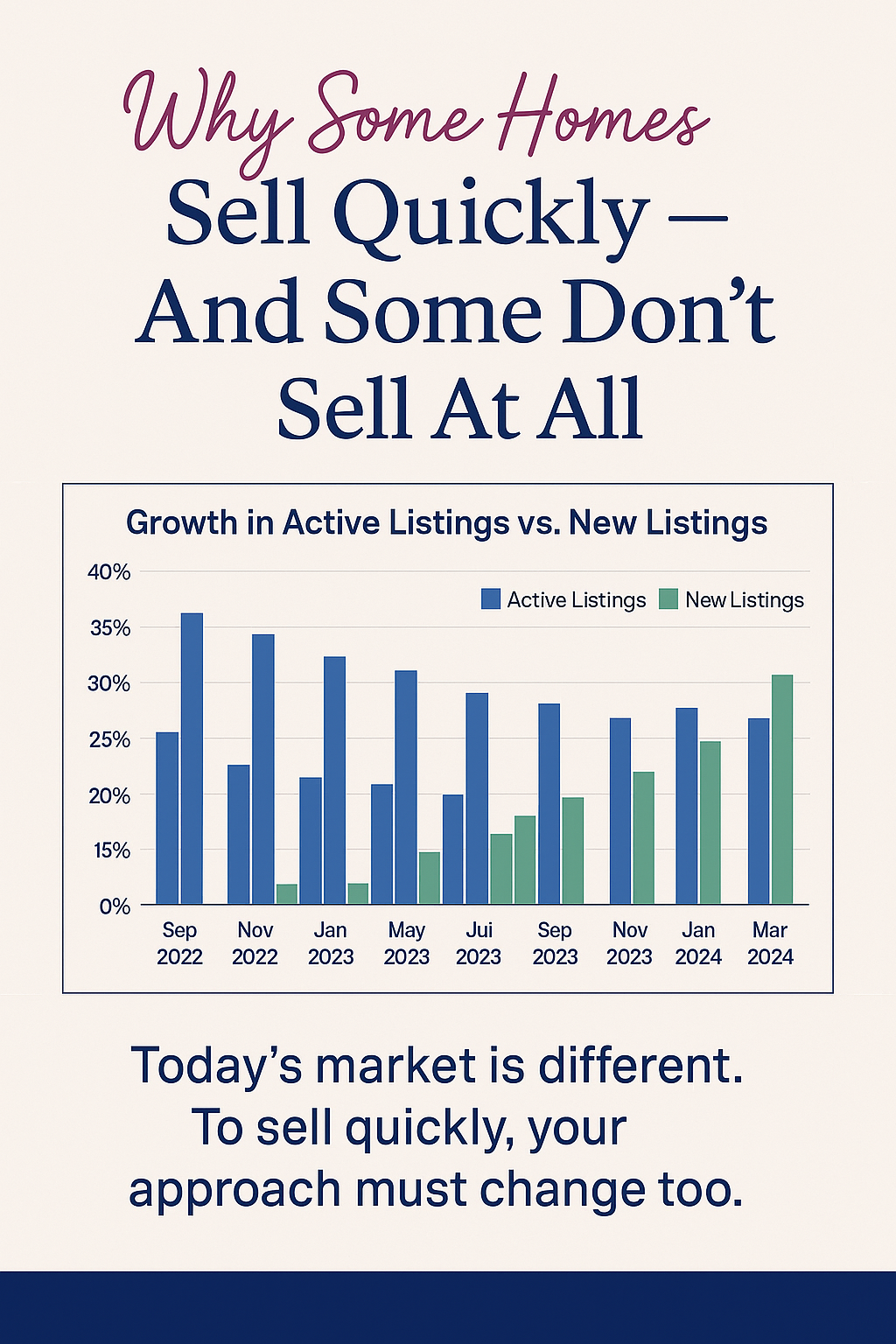

Why Some Homes Sell Fast — and Others Sit on the Market

A few years ago, homes were flying off the market. With record-low inventory, nearly anything sold — and fast. But today’s real estate landscape looks different. Inventory is up nearly 20% compared to last year, and in many areas, supply has returned to pre-2020 levels.

So, what does that mean for sellers?
👉 Your home needs to stand out from the moment it hits the market.

🔍 Why Homes Sit on the Market

Most of today’s inventory growth comes from homes that are still active — the ones that haven’t sold yet — rather than new listings. According to Realtor.com, many of these homes are taking longer to sell, which tells us something important:
It’s not just about listing your home — it’s about how you list it.

Common reasons homes linger on the market include:

  • Pricing too high based on old market conditions
  • Skipping essential repairs or updates
  • Poor listing photos or staging
  • Limited showing availability
  • Weak marketing strategies

A few years ago, sellers could list “as-is” and still attract multiple offers. Not anymore. Today’s buyers are choosier, more informed, and have more options.

💡 What Makes a Home Sell Quickly

Selling quickly in this market isn’t about luck — it’s about strategy.
Here’s what successful sellers have in common:

  1. Pricing Realistically – A competitive price based on today’s market, not yesterday’s headlines.
  2. Curb Appeal and Condition – Small upgrades and clean presentation go a long way.
  3. Professional Marketing – High-quality photos, social media visibility, and listing optimization matter.
  4. Accessibility – The easier it is to show, the faster it sells.

Remember: your first few weeks on the market are crucial. That’s when your listing gets the most exposure online. Nail your presentation early, and buyers will act fast.

🤝 Why the Right Agent Makes All the Difference

Working with an experienced REALTOR® means having someone who understands local trends, buyer behavior, and pricing strategy. According to the National Association of REALTORS® (NAR), sellers who work with agents are twice as likely to get an offer within a month compared to those who list on their own.

An expert agent will:

  • Recommend the right listing price using local comparable sales
  • Help you prep and stage for maximum impact
  • Use professional marketing that reaches buyers where they’re searching

Bottom Line

Even with more homes for sale, your property can still sell quickly — if it’s priced right, presented beautifully, and marketed strategically.

If you’re thinking about selling in Hampton Roads, Chesapeake, or Newport News, let’s connect! I’ll help you position your home to attract attention — and offers — from day one.

If you’re looking to sell, call Michele! If you’re looking to acquire — I’m your hire!

Michele Salyer, REALTOR®
Salyer Wilmoth Homes | A Better Way Realty
📞 7575023671 | 🌐 www.salyerwilmothhomes.com

April 3, 2026

New Construction or Resale in Chesapeake, VA? What Smart Relocating Buyers Should Know First

TL;DR

If you are moving to Chesapeake, VA and trying to decide between new construction and a resale home, the right choice often comes down to your priorities, timeline, budget, maintenance preferences, and how you want your home to function day to day. New construction may appeal to buyers who want modern finishes, lower initial maintenance, and a more move-in-ready feel, while resale homes may offer more established locations, mature surroundings, and a wider range of price points and property styles. Neither option is automatically better for every buyer. The smartest move is to compare how each type of home fits your routine, long-term plans, and overall comfort level before making a decision.

Why This Choice Matters When Moving to Chesapeake, VA

If you are relocating to Chesapeake, one of the biggest decisions you may face is whether to focus on new construction homes or resale homes. Both options can offer advantages, but they often serve different buyer priorities.

Some buyers are drawn to the idea of a brand-new home with updated finishes and fewer immediate repair concerns. Others prefer resale homes because they may offer more established surroundings, different architectural styles, or locations that feel more connected to the day-to-day rhythm they want.

When you are moving to a new area, it can be easy to assume that one option is clearly better than the other. In reality, the best fit usually depends on how you plan to live, what matters most in your search, and what kind of trade-offs you are comfortable making. That is also why reading What Relocating Buyers Often Miss About Chesapeake, VA can be helpful, since many buyers discover that the decision is about much more than the home itself.

What New Construction May Offer Buyers in Chesapeake

New construction often appeals to buyers who want a home that feels fresh, modern, and move-in ready. Many newer homes feature open layouts, updated kitchens, energy-efficient systems, and design choices that match current preferences.

For relocating buyers, this can feel especially appealing because a newer home may require less immediate attention after move-in. If you are juggling a move, work, family schedules, or a major transition, that lower-maintenance appeal can matter.

New construction can also be attractive for buyers who want features like larger primary suites, newer appliances, attached garages, flexible bonus spaces, or newer community layouts. In some cases, buyers also like having the opportunity to personalize finishes or choose from homes with more current design trends.

Still, it is important to look beyond the newness itself. A home being brand new does not automatically mean it is the best match for your routine, location preferences, or long-term plans.

What Resale Homes May Offer Buyers in Chesapeake

Resale homes can offer a very different kind of value. For some buyers, resale means more variety in neighborhood feel, home style, lot size, and location.

In Chesapeake, resale homes may appeal to buyers who want established surroundings, mature landscaping, or homes in areas that feel more settled. Some buyers also find that resale homes offer layouts or lot characteristics that differ from many newer builds.

Another advantage is that resale homes often give buyers a broader range of options across different parts of Chesapeake. That flexibility can be useful if your top priorities include being in a particular area, having a certain type of yard, or finding a home with features that are less common in newer communities. If neighborhood feel is a big part of your decision, What’s It Like Living in Chesapeake, Virginia? is a great related read to help buyers think beyond the house itself.

Resale homes may also give buyers more room to compare different price points, property ages, and neighborhood settings. That can make them especially useful for buyers who want more choices before narrowing down what fits best.

Think Beyond “Newer Is Better”

It is easy to assume that newer automatically means better, but that is not always how real-life homeownership works.

A newer home may offer convenience and updated finishes, but a resale home may offer a location, setting, or overall feel that suits your lifestyle more closely. The right comparison is not simply old versus new. It is about how each option supports your everyday life.

Ask yourself questions like:

Will this layout make daily routines easier?
Does the location fit how I want to live?
How much upkeep am I comfortable taking on?
Do I want a home that feels turnkey, or am I open to a home with older features if it offers something else I value more?

These questions often lead to a more practical decision than focusing on age alone.

Location Can Matter Just as Much as the Home Itself

When comparing new construction and resale homes in Chesapeake, location may matter just as much as what is inside the house.

Some buyers prioritize convenience to major roads, shopping, dining, and daily errands. Others may care more about lot size, neighborhood feel, or how the surrounding area fits their preferred pace of life.

This is one reason resale and new construction are not always interchangeable. Even if two homes have a similar number of bedrooms or square footage, the overall experience of living there may feel very different depending on where the home is located and how the area functions day to day.

If you are moving to Chesapeake from out of town, this part of the decision is especially important. A home that looks perfect online may not always line up with the kind of routine you want once you are living in the area. That is also why How Virtual Tours Help Military Buyers Relocating From Out of State can be a useful resource, especially for buyers trying to compare homes and areas before they arrive in person.

Maintenance, Updates, and Move-In Expectations

One of the biggest practical differences between new construction and resale often comes down to what you may need to handle after closing.

With new construction, buyers are often drawn to the idea of fewer immediate updates. That can be helpful if you want a smoother start after relocating. A newer roof, newer systems, and newer finishes may help reduce the number of projects you need to think about right away.

With resale, the condition and level of updates can vary widely from one home to another. Some resale homes may feel very move-in ready, while others may need cosmetic changes or future improvements depending on the property.

This does not make one category better than the other. It simply means buyers should go in with clear expectations. The key is to compare how much work you want to take on and whether that trade-off is worth it for the location, layout, or character of the home.

Your Budget Should Include More Than the Purchase Price

When deciding between new construction and resale in Chesapeake, it helps to think beyond the list price alone.

A lower-maintenance home may feel worth paying more for if it reduces short-term projects or unexpected costs. On the other hand, a resale home may offer better value to some buyers if it gives them the location, space, or features they care about most.

What matters is how the total picture fits your comfort level. That includes the likely upkeep, any updates you may want to make, and how confident you feel about the home supporting your needs after you move in. Buyers who are still working through affordability questions may also want to read Is Chesapeake, VA Affordable for First-Time Homebuyers? because budget decisions are often tied closely to whether a newer or older home feels realistic and sustainable.

A smart home search is not just about finding the newest home or the lowest price. It is about finding the right balance between condition, location, function, and long-term practicality.

The Best Choice Depends on How You Want to Live

For some buyers moving to Chesapeake, new construction will feel like the clear winner. For others, resale will offer the stronger fit. There is no universal answer because every move comes with different priorities.

The most important thing is to compare both options through the lens of your daily life. Think about how you want your home to function, how much upkeep feels manageable, what kind of surroundings you prefer, and what trade-offs feel worthwhile.

When you approach the decision that way, you are much more likely to choose a home that not only looks good on paper, but also feels right once you are actually living in it. For military and relocating buyers who are still early in the process, First-Time Military Buyers Guide to Buying a Home in Chesapeake, VA can also help build a stronger foundation before narrowing down home types.

Frequently asked questions

Is it better to buy new construction or resale when moving to Chesapeake, VA?

There is no one-size-fits-all answer. New construction may appeal to buyers who want modern finishes, newer systems, and a more move-in-ready feel. Resale homes may appeal to buyers who want more established locations, mature surroundings, or a wider variety of home styles and price points.

The better option depends on your lifestyle, budget, maintenance preferences, and what matters most in your day-to-day life.

Are new construction homes in Chesapeake, VA always more expensive than resale homes?

Not always. Pricing can vary depending on location, size, features, and the overall condition of the home. Some new construction homes may come at a higher price point, while some resale homes may also be priced competitively depending on what they offer.

If you want help comparing current options in Chesapeake, I would be happy to help you look at both categories and narrow down what may fit your goals best.

What are the pros and cons of buying a resale home in Chesapeake, VA?

Resale homes may offer established surroundings, more variety in location and home style, and sometimes features that are harder to find in newer builds. At the same time, some resale homes may need updates or future maintenance depending on the property.

The key is to evaluate each home individually and compare what you are gaining in location, layout, and character against any work you may need to take on.

Should relocating buyers in Chesapeake focus on location first or home condition first?

For many buyers, both matter, but location often has a long-term impact on how the home feels to live in every day. A beautiful home in the wrong setting may not feel as practical over time as a home that better fits your routine.

If you are relocating and unsure how to balance those priorities, reach out. I can help you compare homes in a way that makes the decision feel more clear and manageable.

Is new construction a good fit for buyers who want lower maintenance?

For many buyers, yes. New construction can be appealing if you want a home with newer systems, updated finishes, and fewer immediate projects after move-in. That can make the transition feel easier, especially during a relocation.

That said, the best fit still depends on your location preferences, budget, and how you want the home to function in real life. If you are weighing both options, I would be glad to help you explore what makes the most sense for your move.

If you are planning a move to Chesapeake and want help comparing new construction and resale homes based on your goals, I would love to help you explore your options.

Michele Salyer, REALTOR®

📞 757-502-3671

🌐 www.salyerwilmothhomes.com

“If you are looking to sell, Call Michele! If you are looking to acquire, I’m your hire!”

Salyer Wilmoth Homes | A Better Way Realty

Equal Housing Opportunity

April 2, 2026

What Makes a Home Practical for Military Life Near Naval Station Norfolk

TL;DR


When buying near Naval Station Norfolk, practicality often matters more than flashy features. A home that works well for military life is usually one that supports your routine, offers flexible space, provides useful storage, keeps upkeep manageable, and makes daily access to the base and other essentials easier. For many buyers, the most practical home is the one that helps reduce stress during busy seasons, adapts to changing needs, and still makes sense for the future if plans shift over time.

Why Practicality Matters for Military Buyers Near Naval Station Norfolk

When buying a home near Naval Station Norfolk, practicality often matters just as much as appearance. A home may look great in listing photos, but military life can bring unique demands that make function, flexibility, and convenience especially important.

Frequent moves, changing schedules, deployments, training demands, and transition periods can all affect what makes a home feel manageable on a day-to-day basis. Because of that, many buyers near Naval Station Norfolk focus on homes that make daily routines easier, reduce friction, and support long-term usability.

A practical home is not about finding a perfect one-size-fits-all property. It is about finding a home that works well for your routine, budget, commute preferences, and lifestyle goals while keeping future resale and adaptability in mind. If you are just starting your search in the area, Living and Buying a Home Near Naval Station Norfolk in Norfolk, VA can help give you a broader look at what buying near the base may involve.

A Functional Layout Can Make Everyday Life Easier

One of the first things that can make a home practical for military life is the layout. Square footage matters, but how the space is arranged can matter even more.

Many buyers appreciate layouts that make it easier to move through everyday routines without wasted space. This may include an open main living area, a clear separation between living and sleeping spaces, a first-floor bedroom or bath, or extra flex space that can be used for work, guests, hobbies, or storage.

For military households, flexible rooms can be especially useful. A bonus room, loft, or spare bedroom may serve different purposes over time depending on the season of life. A home that can adapt with you often feels more practical than one that only works for a narrow set of needs.


This can be especially important for buyers purchasing their first home in the area. First-Time Military Buyers Guide to Buying a Home in Chesapeake, VA is a helpful related resource for understanding how to evaluate a home beyond surface-level features.

Storage and Organization Matter More Than Buyers Sometimes Expect

Storage is one of the most overlooked features when evaluating a home near Naval Station Norfolk. During a move, it is easy to focus on visible design features and forget how much daily convenience depends on where everything goes.

Practical homes often offer storage that supports real life. This may include bedroom closets, pantry space, linen storage, garage storage, attic access, laundry room cabinets, or a layout that makes it easier to stay organized.

For military buyers who may move more often than civilian households, manageable storage can make packing, unpacking, and living in the home much easier. A property does not have to be oversized to work well, but it should give you room to function comfortably.

Commute and Daily Access Are a Big Part of Practicality

A home near Naval Station Norfolk should not only work inside the property. It should also make daily life outside the home easier.

Many buyers consider how practical a location feels based on access to the base, major roads, shopping, dining, routine errands, and other parts of Coastal Virginia. A home that helps simplify your daily routine may feel much more valuable over time than one that only stands out because of cosmetic features.

Commute preferences vary from buyer to buyer, which is why practicality should always be viewed through the lens of your own routine. Some buyers may prioritize easier access to Naval Station Norfolk, while others may value more separation from busier areas. The best fit depends on how you want your day-to-day life to function.


If you are also weighing whether it makes more sense to live on base or buy in the surrounding community, On Base vs Off Base Housing: Which Option Saves You More Money? is a strong related read that can help you compare the bigger picture.

Outdoor Space, Parking, and Low-Maintenance Features Can Add Real Value

Practicality is also about how much effort a home requires after move-in. Many military buyers appreciate homes with features that feel manageable, especially when schedules are busy.

That might include off-street parking, a garage, a fenced yard, limited exterior upkeep, durable finishes, or a yard size that fits your comfort level. A lower-maintenance property may help reduce stress and make homeownership feel more sustainable over time.

Parking can also be an important consideration, especially in areas where street parking may be more limited. Buyers often find that practical day-to-day features like driveway space, garage access, and entry flow matter more after move-in than they initially expected during the home search.

A Home Should Work for Today and Still Make Sense Later

Military buyers near Naval Station Norfolk often need to think beyond the immediate move. A practical home is not only one that works right now, but one that may still make sense if your timeline, assignment, or future plans shift.

That does not mean trying to predict everything. It means choosing a home with features that may remain useful over time. A flexible layout, appealing location, functional storage, and manageable upkeep can all contribute to a property that continues to work well if your needs evolve.

This is also where resale potential becomes part of practicality. Homes with broad everyday appeal often attract interest from a wider range of future buyers. That can be helpful if you later decide to sell.

For buyers still comparing where they may want to put down roots during a PCS move, Why Many Military Families Consider Chesapeake, VA During a Permanent Change of Station (PCS) is another helpful resource to explore alongside your Naval Station Norfolk home search.

Practical Homes Support Real Life, Not Just a Showing

The most practical home near Naval Station Norfolk is usually not the one with the flashiest listing photos. It is the one that helps support your routine, reduces daily friction, and gives you enough flexibility to handle the realities of military life.

That may look different for every buyer. For some, practicality means a shorter commute. For others, it means more storage, easier parking, a flexible floor plan, or a home that feels easier to maintain. The goal is to focus on what will actually help you live more comfortably and confidently once the move is complete.

A smart home search starts by identifying what matters most in real life, not just what looks good online.

Frequently asked questions

What should military buyers look for in a practical home near Naval Station Norfolk?

Military buyers often look for homes that support everyday function, flexibility, and convenience. Features like a workable layout, useful storage, parking, manageable upkeep, and access to major routes can all contribute to a more practical fit.

The right answer depends on your routine, priorities, and budget. A practical home is usually one that helps make daily life easier while still fitting your short-term and long-term goals.

Is it better to buy close to Naval Station Norfolk or a little farther away?

That depends on what matters most to you. Some buyers prioritize being closer to base for commute convenience, while others are comfortable living farther out if it gives them a layout, price point, or setting that better fits their needs.

There is no single best answer for every buyer. If you want help comparing nearby areas based on your goals, I would be happy to help you narrow down options that make sense for your move.

What home features help military life feel easier after move-in?

Many buyers find that flexible rooms, practical storage, good parking, efficient layouts, and lower-maintenance features make the biggest difference after they move in. These are the details that often support daily life more than cosmetic upgrades alone.

If you are house hunting near Naval Station Norfolk, I can help you look beyond listing photos and focus on features that may serve you well in the long run.

Are low-maintenance homes a good option for military buyers?

For many buyers, yes. A lower-maintenance home can help reduce stress and make ownership feel more manageable, especially when schedules are busy or future transitions are possible.

That does not mean every buyer needs the same type of property. The goal is to find a home that matches your comfort level with upkeep, space, and day-to-day responsibilities.

How do I know if a home will still work for me a few years from now?

A good place to start is by looking at flexibility. Consider whether the layout can adapt as your routine changes, whether the location remains practical for daily life, and whether the home has features that may continue to appeal over time.

If you are unsure how to evaluate that during your search, reach out. I can help you think through what may make a home practical not just for today, but for the next stage as well.


If you are exploring homes near Naval Station Norfolk and want help finding a property that feels practical for your day-to-day life, I would love to help you compare your options.

Michele Salyer, REALTOR®

📞 757-502-3671

🌐 www.salyerwilmothhomes.com

“If you are looking to sell, Call Michele! If you are looking to acquire, I’m your hire!”

Salyer Wilmoth Homes | A Better Way Realty

Equal Housing Opportunity

Posted in Buyer Guides
March 31, 2026

How First-Time Military Buyers Can Compare Chesapeake, Norfolk, and Virginia Beach

TL;DR

First-time military buyers comparing Chesapeake, Norfolk, and Virginia Beach should look at more than just home prices. The better approach is to compare commute patterns, lifestyle preferences, neighborhood feel, housing options, and how each city fits both your current PCS needs and your future goals. A smart comparison can help you use your VA loan more confidently, narrow down the right area faster, and make a decision that feels practical long after move-in day.

Why First-Time Military Buyers Compare Chesapeake, Norfolk, and Virginia Beach

For many first-time military buyers, the decision is not only about buying a home. It is also about choosing the area that best fits daily life, budget, commute needs, and long-term plans. Chesapeake, Norfolk, and Virginia Beach each offer different advantages, which is why many buyers relocating to Coastal Virginia spend time comparing all three before making an offer.

This comparison matters even more for military buyers using a VA loan for the first time. A first home purchase often comes with questions about affordability, convenience, resale potential, and how a move may affect future flexibility. Buyers who are still early in the process may also benefit from reading First-Time Military Buyers Guide to Buying a Home in Chesapeake, VA for a broader foundation before narrowing down specific cities.

Instead of asking which city is “best,” it is often more helpful to ask which city is the best fit for your routine, financial comfort level, and homeownership goals.

Start With Your Daily Routine and Commute

One of the most important parts of comparing Chesapeake, Norfolk, and Virginia Beach is understanding how each location may affect your day-to-day life. For military buyers, commute time is often a major factor, especially when considering access to installations, major roads, tunnels, bridges, and everyday errands.

Norfolk may appeal to buyers who want to be closer to many military-related hubs, urban conveniences, and established neighborhoods. Buyers specifically considering that city may want to also read Living and Buying a Home Near Naval Station Norfolk in Norfolk, VA for more location-specific insight. Virginia Beach may attract buyers looking for a wide range of residential areas, shopping, dining, and access to the coast. If Virginia Beach is on your list, Living in Virginia Beach: Pros and Cons in 2026 can help you compare the everyday tradeoffs. Chesapeake is often considered by buyers who want more variety in lot sizes, suburban-style neighborhoods, and a different pace of daily living.

The key is to compare how each area supports your actual routine. Think about how often you commute, what type of surroundings you prefer, how important nearby conveniences are, and what kind of daily flow will feel sustainable after the move.

Compare Price Points and Overall Affordability

Affordability is one of the biggest concerns for first-time military buyers, especially those trying to make the most of their VA loan benefit. While home prices can vary significantly by neighborhood and property type, comparing Chesapeake, Norfolk, and Virginia Beach can help buyers understand where their budget may go further.

Some buyers begin with a monthly payment target and then look at which city offers the most options within that range. Others begin with the kind of home they want, such as a single-family home, townhouse, condo, or property with more outdoor space, and then compare which city gives them more choices.

It is also helpful to look beyond the list price alone. Buyers should consider property taxes, homeowners association dues if applicable, insurance costs, maintenance expectations, and how different home types may affect monthly expenses. A lower-priced home is not always the better fit if it does not support the buyer’s overall goals.

For buyers looking closely at Chesapeake from a budget standpoint, Is Chesapeake, VA Affordable for First-Time Homebuyers? is a strong related resource. For first-time military buyers, a smart comparison is not just about finding the cheapest home. It is about finding the best overall value for the lifestyle and financial comfort you want.

Think About the Type of Environment You Want

Each buyer has a different idea of what feels comfortable and enjoyable in a home search. Some prefer a more urban setting with older established neighborhoods and quicker access to city amenities. Others want a more suburban feel, newer developments in some areas, or more space between homes. This is where comparing Chesapeake, Norfolk, and Virginia Beach becomes especially useful.

Norfolk may stand out for buyers who want a location with city character, established communities, and easier access to employment centers and waterfront areas. Virginia Beach often attracts buyers who want a broad mix of residential choices and lifestyle convenience. Chesapeake may feel like the right fit for buyers who prefer a more residential pace and want to explore neighborhoods with different space and layout options.

This does not mean one city is better than another. It simply means buyers should compare what type of environment feels most practical and comfortable for them. The goal is to choose an area that matches your needs without relying on broad assumptions.

Consider the Type of Home You Want to Buy

The kind of home you want can also influence whether Chesapeake, Norfolk, or Virginia Beach makes the most sense. Some buyers are looking for a starter home with manageable upkeep. Others want a home with extra bedrooms, a yard, or room to grow into over time.

In some parts of Norfolk, buyers may find older homes with character and established neighborhood settings. In Virginia Beach, buyers may see a broad mix of condos, townhomes, and single-family homes depending on the area. In Chesapeake, many buyers compare options based on space, neighborhood layout, and the kind of residential setting they want.

Military buyers should also think about how long they may realistically keep the home. If this is a first purchase, it helps to ask whether the property could still make sense in a few years, whether it may be easier to resell later, and whether it supports both present needs and possible future changes. Buyers who want to step back and think through the decision more carefully may also find Key Questions to Ask Before Buying a Home in Virginia helpful at this stage.

Use Your VA Loan Strategy Wisely

For first-time military buyers, the VA loan can be one of the most valuable tools in the buying process. But comparing cities is still important because eligibility does not automatically make every option equally practical.

Buyers should compare what their budget allows in Chesapeake, Norfolk, and Virginia Beach while also thinking about monthly comfort. Just because a buyer qualifies for a certain amount does not always mean that amount fits comfortably with their overall financial goals. A balanced approach can help prevent payment stress and make the home feel like a smart long-term decision.

It can also be helpful to compare how different property types may work with your financing strategy. A condo, townhome, or single-family home may all come with different considerations depending on the property and location. First-time buyers benefit from looking at the full picture before focusing only on the maximum price point.

Compare for Fit, Not Just Popularity

Many first-time buyers feel pressure to choose the city they hear about most often. But popularity alone is not a reliable way to decide where to buy. The better approach is to compare Chesapeake, Norfolk, and Virginia Beach based on personal fit.

Ask practical questions. Which area gives you the best balance of commute and comfort? Which one has homes that match what you want right now? Which city gives you options that feel sustainable for your budget? Which environment feels easiest to settle into?

This question often comes up during a PCS move, especially when buyers are unsure whether to act quickly or take more time. That is why PCSing to Naval Station Norfolk: Should You Buy Right Away? is another strong internal link for readers who are still deciding on timing as well as location.


When buyers compare cities through the lens of real-life needs, the decision usually becomes clearer. What works best for one military family or buyer may not be the same for another. That is why a side-by-side comparison is often one of the most helpful first steps in the process.

Frequently asked questions

Is Chesapeake, Norfolk, or Virginia Beach better for first-time military buyers?

There is not one answer that fits every buyer. Chesapeake, Norfolk, and Virginia Beach each offer different advantages depending on your budget, commute preferences, lifestyle, and the type of home you want. The best choice is usually the one that aligns most closely with your daily routine and long-term goals.

Is Chesapeake or Virginia Beach more affordable for military buyers using a VA loan?

Affordability depends on the specific neighborhood, home type, and current inventory, but many military buyers compare Chesapeake and Virginia Beach closely when looking for value and lifestyle fit. Some buyers find that one city offers more space for the price, while the other offers more convenience or a different mix of available homes. If you want help comparing what your budget may look like in each area, I would be happy to help you narrow down the options.

Should military buyers consider Norfolk for a first home purchase?

Yes, Norfolk can be worth considering for first-time military buyers, especially for those who want to stay closer to key work hubs, city conveniences, or established neighborhoods. The right home in Norfolk may offer a strong starting point depending on your goals, budget, and daily routine. Comparing Norfolk with Chesapeake and Virginia Beach can help you decide whether it feels like the best fit for your first purchase.

How do I choose between Chesapeake, Norfolk, and Virginia Beach during a PCS move?

A good way to choose is to compare commute, home style preferences, monthly comfort, and how each city fits your everyday life. Think beyond the house itself and focus on what will make the move easier and the homeownership experience more manageable. If you are planning a PCS move and want local guidance while comparing these areas, reach out and I can help you sort through the options.

What should first-time military buyers compare before making an offer?

Before making an offer, compare the location, commute, property type, monthly payment, upkeep expectations, and how well the home fits both current and future plans. It is also helpful to compare how confident you feel in the area itself, not just the home. A first purchase should feel practical as well as exciting.


If you are comparing Chesapeake, Norfolk, and Virginia Beach and want help narrowing down which area may fit your goals best, I would be glad to help you explore your options.

Michele Salyer, REALTOR®

📞 757-502-3671

🌐 www.salyerwilmothhomes.com

“If you are looking to sell, Call Michele! If you are looking to acquire, I’m your hire!”

Salyer Wilmoth Homes | A Better Way Realty

Equal Housing Opportunity


March 30, 2026

How Virtual Tours Help Military Buyers Relocating From Out of State

TL;DR


Virtual tours help military buyers relocating from out of state explore homes more efficiently, compare options with greater confidence, and make better-informed decisions even when an in-person visit is not possible. For buyers managing a PCS timeline or a long-distance move, virtual tours can make the home search feel more practical, focused, and manageable.

Why Virtual Tours Matter for Military Buyers

Military moves often come with tight timelines, changing orders, and a lot of uncertainty. For buyers relocating from out of state, traveling back and forth to tour homes in person is not always realistic.

Virtual tours can help make that process more manageable. Instead of relying only on listing photos, buyers can get a better sense of the home’s layout, room flow, and general condition before deciding whether it is worth pursuing further. This can save time, reduce unnecessary travel, and help buyers focus on homes that are more likely to fit their needs.


For military families balancing relocation logistics, financing, and a move to an unfamiliar area, virtual tours can be one of the most useful tools in the home search process.

What Virtual Tours Can Show That Photos Often Miss

Photos are helpful, but they do not always tell the full story. A virtual tour can give buyers a more complete view of the property and help them evaluate details that still images may not capture clearly.

For example, a virtual tour may help a buyer better understand:

  • how rooms connect to one another
  • whether the layout feels open or segmented
  • how much natural light the home appears to get
  • whether certain spaces feel smaller or larger than expected
  • how the home flows for everyday living


This can be especially valuable for buyers relocating from another state because they are often making decisions without being able to physically walk through the property first.

How Virtual Tours Help Buyers Narrow Down Their Options Faster

One of the biggest advantages of virtual tours is that they help buyers eliminate poor-fit homes earlier in the process.

Instead of spending time on homes that only look appealing in photos, military buyers can use virtual tours to quickly identify which properties deserve a closer look. This makes the search more efficient and helps buyers spend their energy on stronger options.

When buyers are working within a PCS timeline, that kind of efficiency matters. It can help them:

  • compare homes more effectively
  • avoid wasting time on listings that do not feel right
  • prepare better questions before moving forward
  • make decisions with more clarity

That does not mean a virtual tour replaces due diligence. It simply helps buyers get more informed earlier in the process.

Why Virtual Tours Work Best With Local Guidance

A virtual tour is most effective when it is combined with guidance from a local real estate professional who understands the area and the relocation process.

A buyer moving from out of state may be able to view the home online, but they may still need help understanding factors such as commute patterns, nearby conveniences, neighborhood feel, property resale potential, and how the home compares with others in the market.

That is where local guidance becomes important. An agent can help interpret what the buyer is seeing, point out practical considerations, and provide context that may not come through in a virtual showing.

We also offer virtual tours of our listed homes on our website, which can make it easier for military buyers relocating from out of state to begin exploring options before they arrive. That added convenience can help buyers narrow down homes more efficiently and feel more prepared as they move through the process.


This is especially helpful for military buyers who are purchasing in a market they may not know well and who want to make a decision that supports both their short-term move and longer-term goals.

Virtual Tours Can Improve Communication During a Long-Distance Move

Virtual tours also make it easier for buyers to stay aligned with everyone involved in the process.

Military buyers are often discussing options with a spouse, coordinating with lenders, comparing timelines, and weighing the move against work and family responsibilities. When everyone can view the same home more clearly, it becomes easier to have more productive conversations about what works and what does not.

A virtual tour can help buyers ask smarter follow-up questions such as:

  • Is this layout practical for our daily routine?
  • Does this home seem move-in ready?
  • Are there areas of the property we should ask about more closely?
  • Is this home worth scheduling an in-person showing or taking the next step on?

That kind of clarity can make a long-distance home search feel less overwhelming.

What Virtual Tours Do Not Replace

Even though virtual tours are helpful, they are still only one part of the decision-making process.

Buyers should still take appropriate steps such as reviewing disclosures, evaluating financing, asking detailed questions, and arranging inspections when needed. Depending on the situation, some buyers may still choose to visit in person before closing, while others may rely on a combination of virtual tools and trusted local support.

Virtual tours are not about removing careful decision-making. They are about giving military buyers a better starting point when buying from out of state.

Why This Matters in a Competitive Relocation Timeline

Military buyers often do not have the luxury of taking a slow, casual approach to the home search. Orders, reporting dates, school planning, household logistics, and moving timelines can all create pressure to act quickly.

Virtual tours help create structure in that process. They allow buyers to screen homes more effectively, stay engaged from another state, and move forward with greater confidence when the right property appears.

For buyers relocating to Chesapeake, Norfolk, Virginia Beach, and nearby Coastal Virginia areas, this can make a meaningful difference. A smart long-distance strategy can help reduce stress and make the move feel much more manageable.

Frequently asked questions

Can military buyers buy a house out of state using virtual tours?

Yes, many military buyers use virtual tours as part of an out-of-state home search. They can help buyers understand the layout and condition of a home more clearly than photos alone, which makes it easier to narrow down options and decide which homes are worth pursuing further.

Are virtual tours enough to make an offer on a house during a PCS move?

Virtual tours can be a strong part of the decision-making process, but they are usually most effective when paired with local guidance, strong communication, and proper due diligence. Buyers should still review disclosures, ask detailed questions, and complete inspections or other steps appropriate for the transaction.

What should military buyers look for during a virtual home tour?

Military buyers should pay attention to the floor plan, room sizes, natural light, storage, condition of visible features, and how the home may support their daily routine. It also helps to ask questions about anything the tour does not show clearly. If you are preparing for a move to Coastal Virginia, I can help you look beyond the screen and focus on the details that matter most.

Do virtual tours help military families narrow down homes faster?

Yes, virtual tours can make the search more efficient by helping buyers eliminate homes that are not a strong fit before scheduling additional steps. This can be especially useful during a relocation when time is limited and buyers need a more focused search process.

Can a local agent help with virtual tours for out-of-state military buyers?

Absolutely. A local agent can add context that the virtual tour alone may not provide, including market insight, local area guidance, and practical feedback about how a property compares to other options. If you are relocating and want help exploring homes remotely, I would be glad to help you create a more confident and organized plan.

If you are relocating from out of state and want a more confident way to explore homes in Coastal Virginia, I would be happy to help. You can also view virtual tours of our listed homes on our website to start narrowing down your options before your move.

Michele Salyer, REALTOR®
📞 757-502-3671
“If you are looking to sell, Call Michele! If you are looking to acquire, I’m your hire!”
Salyer Wilmoth Homes | A Better Way Realty
Equal Housing Opportunity


Posted in Buyer Guides
March 27, 2026

What Relocating Buyers Often Miss About Chesapeake, VA

TL;DR


Many relocating buyers start by comparing price, photos, and square footage, but in Chesapeake, the bigger picture matters just as much. Understanding commute flow, neighborhood feel, convenience, property-specific flood-zone due diligence, and how different parts of the city function day to day can make a major difference in choosing a home that truly fits your lifestyle.

Why Chesapeake Can Be Hard to Understand From a Distance

Relocating buyers often begin their home search online, which makes sense. Photos, price points, and listing details are easy to compare. What is harder to spot from a distance is how differently one part of Chesapeake can feel from another.

Chesapeake is a large city with distinct areas rather than one single central downtown experience, so buyers who are new to the area can easily underestimate how much location shapes everyday life. Some areas feel more convenience-focused and close to major roads, while others feel more spread out, residential, or land-oriented. The city also offers a mix of outdoor amenities, services, and access points that can affect how a home fits your routine.

That is why relocating well is not just about finding a house. It is about understanding how Chesapeake functions day to day.

Buyers Often Underestimate How Large Chesapeake Really Feels

On a map, Chesapeake may look straightforward. In practice, it covers a wide area, and two homes with similar price tags can offer very different daily experiences.

A relocating buyer may see two properties in Chesapeake and assume they are functionally interchangeable. They may not realize that one home may put them closer to shopping, major commuting routes, and routine errands, while another may offer a quieter setting, more space, or a different pace of life. That is one reason why reading Best Neighborhoods in Chesapeake, VA for Relocating Homebuyers can be so helpful before narrowing your search.

This matters because the right move is not always the cheapest home or the newest home. It is often the home that best supports your work commute, household routine, preferred amenities, and long-term comfort.

The Best-Fit Neighborhood Is Not Always the Most Obvious One

One of the biggest things buyers miss about Chesapeake is that they often search too narrowly.

Some relocating buyers lock onto one area name they have heard before and ignore nearby options that may fit their needs better. In Chesapeake, buyers often benefit from comparing areas based on lifestyle priorities rather than searching only by familiarity. If you are still trying to understand the day-to-day feel of the city, What’s It Like Living in Chesapeake, Virginia? gives useful context beyond what listing photos can show.

For example, some buyers may prioritize easier access to shopping, dining, and major roads. Others may care more about a more spacious residential feel, larger lots, or a setting that feels less built-up. Others want a balance between neighborhood feel and regional access. The key is not which area is “best” in general. The key is which area best aligns with your actual routine and goals.

Keeping the search centered on objective housing factors, location preferences, commute needs, property features, and budget helps buyers stay focused and fair-housing compliant while still making a smart decision.

Flood-Zone and Property Due Diligence Matter More Than Many Buyers Expect

This is one of the most commonly missed issues for out-of-area buyers.

In Chesapeake, flood-zone research is an important part of the home search. Buyers should not assume that because a home looks move-in ready, there are no additional property questions to review. Flood-zone status, insurance considerations, drainage patterns, elevation details, and prior seller disclosures can all affect both monthly cost and peace of mind. This is also where Key Questions to Ask Before Buying a Home in Virginia can support buyers who want to approach the process more carefully.

For relocating buyers, this means the search should include more than bedrooms, bathrooms, and photos. It should also include questions about insurance, site conditions, and property-specific risks before writing an offer.

Daily Convenience Can Matter More Than the Listing Description

A beautiful home can lose some of its appeal if daily logistics become frustrating.

Relocating buyers sometimes focus heavily on upgrades and finishes, only to realize later that the larger issue is convenience. Access to major roads, grocery options, local services, parks, recreation, and routine destinations can have a major impact on how satisfied you feel after move-in.

That is especially true for buyers who are still weighing where they want to land in the region. For those in that stage, Exploring Housing Options for Buyers Relocating to Chesapeake or Virginia Beach can help compare options more intentionally before committing to one area.

That is why it helps to think beyond the listing itself and ask a better question: “Will this location make normal life easier for me?”

A Good Relocation Search Should Be Built Around Lifestyle, Not Guesswork

Many relocating buyers begin with broad assumptions. They think they need the “popular” area, the “safe” choice, or the “best” side of town. In reality, those labels are often too vague to be useful and can drift away from fair-housing-compliant guidance.

A better approach is to define what matters most in practical terms. That may include:

  • commute time
  • lot size preferences
  • type of neighborhood setting
  • access to shopping and dining
  • desire for newer construction or established homes
  • property maintenance expectations
  • flood-zone comfort level
  • budget and monthly payment goals

When buyers relocate this way, they usually make clearer decisions and avoid the common mistake of choosing based only on online impressions. As the process becomes more real, The Ultimate Moving Checklist for Virginia Beach and Chesapeake Home Buyers can also help buyers stay organized before and after the move.

What Smart Relocating Buyers Do Differently

The buyers who navigate Chesapeake well usually do a few things differently.

First, they compare multiple sections of the city instead of assuming one name or ZIP code tells the whole story. Second, they ask detailed questions about daily living, not just the property itself. Third, they review practical due diligence items early, especially when flood-zone questions may affect the overall cost of ownership. Finally, they work with a local real estate professional who can help translate listings into real-life context.

That kind of guidance can make a major difference when you are trying to buy from out of town and want to avoid surprises after closing.

Frequently asked questions

Is Chesapeake, VA a good place to live for relocating buyers?

Chesapeake appeals to many relocating buyers because it offers a variety of residential settings, access to outdoor amenities, and proximity to other parts of Coastal Virginia. What makes it a good fit depends on your budget, commute, lifestyle, and the type of neighborhood environment you want. The most important step is comparing areas within Chesapeake based on how you actually plan to live day to day.

What should I know before moving to Chesapeake, VA?

Before moving to Chesapeake, it helps to understand that the city is large, varied, and highly location-dependent. Buyers should look beyond the home itself and evaluate commute routes, convenience, neighborhood setting, and whether flood-zone due diligence may be needed for a specific property. If you are relocating and want help narrowing down which part of Chesapeake may fit your needs, I can help you compare options before you start touring homes.

Do all homes in Chesapeake require flood insurance?

No. Flood insurance depends on the specific property, lender requirements, map designation, and other factors tied to that home. That is why buyers should review property-specific information instead of making assumptions based on the city as a whole. If you are planning a move and want help understanding which questions to ask before making an offer, reaching out early can help you avoid surprises.

Which part of Chesapeake is best for relocating buyers?

There is no one-size-fits-all answer because the best area depends on what matters most to you. Some buyers prioritize convenience and access to major roads, while others are looking for more space, a quieter setting, or a different style of neighborhood. The best approach is to match your home search to your routine, budget, and preferences rather than trying to pick a universally “best” area.

How can I start a home search in Chesapeake if I am moving from out of town?

Start by identifying your must-haves, your budget, and the kind of daily lifestyle you want. From there, compare neighborhoods based on commute, convenience, property type, and overall fit. A relocation-focused search works best when it is narrowed down intentionally instead of browsing everything at once. If you are moving to Chesapeake and want local guidance, I would be glad to help you build a focused search strategy that saves time and keeps the process more manageable.


If you are planning a move to Chesapeake, I would be happy to help you narrow down the areas that best fit your goals and make your relocation search feel more clear and practical.

Michele Salyer, REALTOR®
📞 757-502-3671
“If you are looking to sell, Call Michele! If you are looking to acquire, I’m your hire!”
Salyer Wilmoth Homes | A Better Way Realty
Equal Housing Opportunity

March 26, 2026

PCSing to Naval Station Norfolk: Should You Buy Right Away?

TL;DR


Buying right away after a PCS to Naval Station Norfolk can make sense for some military households, but the best move depends on your timeline, budget, commute priorities, and how confident you are about staying in the area long enough for homeownership to work in your favor.

Why This Is a Common PCS Question

A PCS move often comes with fast timelines and big decisions. For many military households heading to Naval Station Norfolk, one of the biggest questions is whether it makes sense to buy a home right away or rent first while getting settled.

This is a practical question, not just a financial one. Buying too quickly can create stress if you are still learning the area, adjusting to a new routine, or unsure how long you may stay. On the other hand, waiting too long could mean missing a chance to settle into a home that fits your goals.


The right answer depends on your situation. There is no one-size-fits-all solution, and that is exactly why this topic matters for military buyers preparing for a move.

Should You Buy Right Away After PCSing to Naval Station Norfolk?

Sometimes yes. Sometimes no.

Buying right away can make sense if you already know the area, feel confident in your monthly budget, understand your likely commute, and expect to stay long enough for homeownership to work in your favor. If your finances are stable and your housing needs are clear, purchasing early may help you transition more smoothly into your next chapter.

But buying immediately is not automatically the best move just because you are using a VA loan or because homeownership is part of your long-term plan. A PCS is already a major life adjustment. Adding a rushed home purchase on top of that can lead to avoidable pressure.


For some buyers, renting first is the smarter path. It gives you time to explore neighborhoods, understand your day-to-day drive, and make a more informed decision once the move settles down.

When Buying Right Away May Make Sense

Buying soon after arrival may be a strong option if your move is relatively stable and your goals are well defined.

It may make sense to buy right away if you expect to stay in the area for several years, want to put your housing budget toward ownership, and have enough financial margin to handle more than just the mortgage payment. Homeownership includes maintenance, insurance, taxes, and unexpected repairs, so it works best when you are prepared for the full picture.

It can also make sense if you are already familiar with the Norfolk area or nearby communities and do not need extra time to figure out where you want to live. Some buyers arrive with a clear idea of what kind of home, commute, and neighborhood setup fits their routine.


If that sounds like you, buying early may help you settle in faster and avoid moving twice.

When Renting First May Be the Better Move

Renting first can be a smart strategy, especially during a major transition.

If you have never lived near Naval Station Norfolk before, renting gives you time to learn the area before making a long-term commitment. You may discover that one neighborhood fits your schedule better, another offers a more practical commute, or a different home style suits your household more than expected.

Renting may also be helpful if your orders came together quickly, your budget still needs fine-tuning, or you want flexibility while your family adjusts to the move. In many PCS situations, flexibility has real value.

Waiting does not mean giving up on homeownership. It simply means making the decision from a stronger position.

Key Factors to Consider Before You Buy

Your Expected Length of Stay

One of the biggest factors is how long you expect to remain in the area. Buying often makes more sense when you have enough time to absorb closing costs, settle into the home, and eventually sell without feeling rushed. A shorter timeline can make ownership less practical.

Your Total Monthly Housing Budget

Your mortgage payment is only one part of the cost. You also need to think about insurance, maintenance, utilities, repairs, taxes, and other recurring expenses. A home that looks manageable on paper may feel very different once all the numbers are added together.

Your Commute and Daily Routine

Commute time can affect your quality of life more than many buyers expect. Before buying, it helps to think about how your drive, traffic patterns, school or childcare needs, and daily errands will fit into your routine.

Your Comfort With Making a Fast Decision

Some military buyers are comfortable buying quickly or even from a distance. Others prefer to see the area in person and compare options over time. Neither approach is wrong. What matters is whether your process helps you make a confident decision.

Your Backup Plan

Military life can change quickly. Before buying, it helps to think ahead. If your plans shift sooner than expected, would you be comfortable selling, renting the property out if appropriate, or adjusting your strategy? Having a backup plan can make a big difference.

What Military Buyers Should Avoid

One of the biggest mistakes is assuming that buying is always better than renting. Homeownership can be a strong long-term move, but only when it fits your financial and personal situation.

Another mistake is choosing a home based only on urgency. A fast decision may feel necessary during a PCS, but rushing into the wrong property can create more stress later.

It is also important to avoid making assumptions about which neighborhoods are right for you based on marketing language alone. Fair housing principles matter, and the best way to evaluate an area is by looking at objective factors that fit your needs, such as commute, price range, housing type, lot size, access to major roads, and the features that matter most to your household.

A Smart Way to Approach the Decision

A better question than “Should I buy right away?” is “Am I ready to buy right away?”

That shift matters. It puts the focus on your actual timeline, budget, and comfort level instead of outside pressure. For some military buyers, the answer will be yes. For others, renting first and buying later will be the stronger move.

The goal is not to force a purchase. The goal is to make a housing decision that supports your finances, your routine, and your plans during this PCS season.

Frequently asked questions

Is it better to rent or buy when PCSing to Naval Station Norfolk?

It depends on your budget, expected length of stay, comfort with homeownership, and how well you know the area. Renting may offer flexibility while you settle in, while buying may make sense if you are financially prepared and plan to stay long enough for ownership to work in your favor.

Can I use a VA loan right after a PCS to Norfolk?

Eligible military buyers may be able to use a VA loan after a PCS if they meet lender and loan requirements. That can make buying more accessible, but it is still important to look at your total monthly costs and not just loan eligibility. If you want help understanding how that fits your move, reach out and we can talk through the timing and home search strategy.

Should I buy a home before I arrive in the Norfolk area?

Some buyers do, especially if they are experienced with relocation or have trusted local support in place. Still, buying before arrival works best when you have a clear understanding of your priorities, strong communication, and a reliable process for viewing homes. If you are considering buying before you arrive, having local guidance can make the process feel much more manageable.

How long should I plan to stay before buying after a PCS?

There is no universal rule, but buying usually becomes more practical when you expect to stay long enough for the costs of purchasing and eventually selling to make sense. The more stable your timeline, the easier it is to decide whether ownership fits this assignment.

What should I look at first before deciding to buy near Naval Station Norfolk?

Start with your expected commute, your full housing budget, your likely length of stay, and what kind of home setup will support your day-to-day life. Once those basics are clear, it becomes much easier to compare renting versus buying. If you are getting ready to PCS and want a more local breakdown of your options, feel free to reach out.

If you are preparing for a PCS to Naval Station Norfolk and want help thinking through whether buying now or renting first makes more sense, I would be happy to help you explore your options.

Michele Salyer, REALTOR®

📞 757-502-3671

🌐 www.salyerwilmothhomes.com

“If you are looking to sell, Call Michele! If you are looking to acquire, I’m your hire!”

Salyer Wilmoth Homes | A Better Way Realty

Equal Housing Opportunity

 

March 25, 2026

Best Neighborhoods in Chesapeake, VA for Relocating Homebuyers

Relocating homebuyers often explore Chesapeake neighborhoods based on price range, home style, commute needs, and lifestyle preferences rather than searching for one single “best” area for everyone.

Why Relocating Buyers Often Consider Chesapeake, VA

Chesapeake continues to draw relocating homebuyers because it offers a mix of established neighborhoods, newer communities, different price points, and access to major roads connecting to nearby parts of the region. Current market guides commonly highlight areas such as Great Bridge, Deep Creek, Greenbrier, and Western Branch among the neighborhoods buyers frequently explore.

For relocation buyers, the goal is usually not to find the “perfect” neighborhood in a general sense. It is to find the area that best matches daily routine, commute, budget, preferred home type, and long-term plans. That is why the best neighborhood in Chesapeake can look different from one buyer to another.

What Relocating Homebuyers Should Compare First

Before narrowing down specific neighborhoods, relocating buyers usually benefit from comparing a few practical factors first.

Price point is one of the biggest filters. Realtor.com neighborhood summaries for Chesapeake show variation by area, with recent median home prices around $560,000 in Great Bridge, about $440,000 in Deep Creek, about $439,000 in Greenbrier, and about $399,499 in Western Branch.

Home style and lot size also matter. Some parts of Chesapeake are known for more established subdivisions, while others tend to offer newer homes, townhomes, or larger lots depending on the section of the city. Buyers relocating from out of state often compare these differences early because they can affect both lifestyle and monthly costs.

 Commute patterns are another major consideration. Chesapeake’s size means that one neighborhood can feel very different from another in terms of access to highways, shopping, employment areas, and nearby cities.

Great Bridge for Buyers Wanting a Well-Known Chesapeake Area

Great Bridge is one of the Chesapeake areas many relocating buyers recognize first. Current market sources place it at the higher end of several Chesapeake neighborhood price ranges, with recent median home price figures around $560,000.

Buyers often explore Great Bridge when they want a neighborhood with broad name recognition, a mix of resale inventory, and access to everyday conveniences. It is often part of the shortlist for relocation buyers who want to start with one of the more established and frequently searched parts of Chesapeake.

Deep Creek for Buyers Looking for Variety and Regional Access

Deep Creek is another neighborhood that frequently appears in Chesapeake market guides. Realtor.com recently listed its median home price around $440,000, while Redfin’s neighborhood data also shows active resale activity there.

Relocating buyers may look at Deep Creek when they want a neighborhood that offers a range of home options and useful access to other parts of the region. The city is also actively planning for Deep Creek Village through improvement and connectivity initiatives, which signals ongoing attention to the area’s development pattern. 

Greenbrier for Buyers Focused on Convenience

Greenbrier is commonly searched by buyers comparing Chesapeake neighborhoods, and current neighborhood data places it around the mid-range of Chesapeake pricing, with recent figures near $439,000 to $482,696 depending on source and dataset timing.

Relocating homebuyers often consider Greenbrier when convenience is a major priority. In many home searches, this area comes up for buyers who want easy access to shopping, dining, and major roads while still staying within Chesapeake. 

Western Branch for Buyers Comparing Value and Accessibility

Western Branch is another area that relocation buyers often compare early in the process. Realtor.com recently placed its median home price near $399,499, while Redfin showed a median sale price around $395,650 as of January 2026.

For buyers who want to compare relative value across Chesapeake neighborhoods, Western Branch often enters the conversation because it may offer a different price-to-space equation than some other popular areas. It is a practical area to review when budget and accessibility are both high priorities. 

Hickory and Nearby Southern Chesapeake Areas for Buyers Wanting More Space

Many relocating buyers also ask about Hickory and nearby southern Chesapeake areas when they want to explore larger lots, newer construction opportunities in some sections, or a more spacious residential feel. Public listing portals do not always publish complete neighborhood-level pricing for every Hickory subarea, but current housing pages show that buyers are actively searching there.

Because inventory can differ from one part of Chesapeake to another, Hickory is often best understood as an area to explore based on actual available listings rather than broad assumptions. For relocation buyers, this is especially useful when home size, land, or layout preferences are central to the search.

There Is No Single Best Neighborhood for Every Buyer

The best neighborhood in Chesapeake depends on what matters most to the buyer. One person may want a more established area with strong name recognition. Another may prioritize convenience, a specific budget range, or a home with more outdoor space.

That is why relocation decisions usually work better when neighborhoods are compared by lifestyle fit, commute pattern, available inventory, and price range rather than by broad labels. A fair-housing-conscious home search should focus on objective housing factors, property features, location logistics, and market data that help buyers make an informed decision.

Frequently asked questions

What are the best neighborhoods in Chesapeake, VA?

Some of the most commonly searched Chesapeake neighborhoods include Great Bridge, Deep Creek, Greenbrier, Western Branch, and Hickory-area communities. The best choice depends on your budget, commute, preferred home style, and the type of neighborhood setting you want. 

Is Great Bridge or Greenbrier better for relocating homebuyers?

Both areas are popular, but they appeal to different priorities. Great Bridge is often associated with a higher current price point, while Greenbrier is often considered by buyers who want convenience and access to daily amenities. The better fit usually comes down to budget, housing preferences, and location priorities.

Where should I live in Chesapeake if I am moving from out of state?

That depends on what you want your day-to-day life to look like. Many out-of-state buyers start by comparing Great Bridge, Deep Creek, Greenbrier, Western Branch, and Hickory-area options based on commute routes, home prices, and available inventory. If you want help narrowing that down, reviewing current listings by area can make the search much easier.

Is Chesapeake, VA a good place to relocate for homebuyers?

Many buyers consider Chesapeake because it offers multiple neighborhood styles, a range of housing options, and regional access to surrounding cities. It can be a strong option for relocation buyers who want to compare suburban-style living, pricing differences by area, and various home types within one city. If you are planning a move, it helps to match neighborhoods to your actual budget and routine instead of relying on general rankings alone.

How do I choose the right Chesapeake neighborhood before I move?

A practical way to choose is to compare neighborhoods by price range, commute, home style, lot size, and the kinds of listings currently available. Looking at active homes in several Chesapeake areas at the same time can help you spot which neighborhoods align best with your needs. If you are relocating soon, a side-by-side neighborhood and listing comparison can save time and reduce guesswork. 

If you are relocating to Chesapeake and want help comparing neighborhoods based on your budget, commute, and home goals, contact me for personalized guidance and help finding the right area for your move.

Michele Salyer, REALTOR®
📞 757-502-3671
“If you are looking to sell, Call Michele! If you are looking to acquire, I’m your hire!”
Salyer Wilmoth Homes | A Better Way Realty
Equal Housing Opportunity

Posted in Buyer Guides
March 24, 2026

How Soon After Joining the Military Can You Buy a House in Chesapeake, VA?

Many military buyers may be able to buy sooner than expected, but in Chesapeake, VA, the best timing depends on eligibility, finances, and how long you expect to stay.

Can Military Buyers Purchase a Home Soon After Joining?

In many cases, yes. For active-duty service members, VA loan eligibility may begin after enough qualifying service, which is why some buyers start exploring homeownership earlier than expected.

For buyers relocating to Chesapeake, VA, the bigger question is not just whether you can buy, but whether buying now makes sense for your assignment, commute, and budget. Many military families look at Chesapeake because it offers more residential space while still keeping them connected to nearby duty locations. If you are preparing for a move, our previous post on Why Many Military Families Consider Chesapeake, VA During a Permanent Change of Station (PCS) can help give more local context.

Why Chesapeake, VA Is Often on the List

Chesapeake is often considered by military buyers who want a little more room while still staying within commuting distance of nearby bases and work centers. For some, that means comparing Chesapeake with Norfolk or Virginia Beach. For others, it means deciding whether to live closer to base or farther out for more space.

If you are comparing commute and location, our post Living and Buying a Home Near Naval Station Norfolk in Norfolk, VA may be helpful. If you are still deciding what day-to-day life in the area might feel like, What’s It Like Living in Chesapeake, Virginia? can help you picture out living here.

Should You Rent First or Buy Right Away?

That depends on your timeline, finances, and comfort level with homeownership. Renting first may make sense if you are still adjusting to the area or waiting for more certainty in your orders. Buying may make more sense if you expect to stay in Chesapeake long enough to benefit from ownership.

This is also where the cost comparison matters. If you are weighing your housing options carefully,  On Base vs Off Base Housing: Which Option Saves You More Money? might help military households think through the financial side of where and how they want to live.

What Should You Look at Before Buying in Chesapeake?

Before buying, focus on readiness rather than speed.

Start by reviewing your likely eligibility, monthly budget, debts, and comfort level with a mortgage payment. Then think through location, commute, and neighborhood fit. Chesapeake offers a range of housing choices, so it helps to narrow down what matters most before you begin touring homes.

If affordability is one of your biggest concerns, Is Chesapeake, VA Affordable for First-Time Homebuyers? is worth checking out, as well as Key Questions to Ask Before Buying a Home in Virginia, since many new military buyers are still working through the practical side of the decision.

Frequently asked questions

How soon can military buyers buy a house in Chesapeake, VA?

Many military buyers may be able to start exploring homeownership sooner than expected, especially if they qualify for VA financing and meet lender requirements. However, the timing also depends on income, debt, credit, and overall financial readiness.

Can I use my VA loan at my first duty station and buy in Chesapeake?

In many cases, yes. If you meet eligibility requirements and qualify with a lender, buying in Chesapeake may be an option while stationed in the area. Many buyers choose Chesapeake because it offers different housing styles and commuting access to nearby duty locations.

Is it better to rent or buy when I first move to Chesapeake?

That depends on your finances, assignment stability, and how long you expect to stay. Renting may offer flexibility at first, while buying may make more sense if you expect to remain in the area long enough to benefit from ownership.

Do I need a down payment to buy a home after joining the military?

Not always. Some eligible buyers may be able to use VA financing with little to no down payment, depending on the transaction and lender guidelines. Buyers should still prepare for closing costs and ongoing ownership expenses.

What should I do before buying a home as a new military buyer in Chesapeake?

Start by reviewing your likely eligibility, budget, and mortgage comfort level. Then compare areas based on commute, housing type, and lifestyle fit. Working with a local lender and agent can also help you build a more realistic plan before you start shopping.


If you are planning a move to Chesapeake and want to understand whether buying now makes sense, I can help you explore your options based on your timeline, goals, and the areas that may fit your lifestyle best.

Michele Salyer, REALTOR®

📞 757-502-3671

🌐 www.salyerwilmothhomes.com

“If you are looking to sell, Call Michele! If you are looking to acquire, I’m your hire!”

Salyer Wilmoth Homes | A Better Way Realty

Equal Housing Opportunity

March 23, 2026

How to Scale Real Estate While on Active Duty in Chesapeake, Virginia

TL;DR


Active duty service members in Chesapeake, Virginia can build wealth through real estate by starting with a well-planned primary residence and thinking long term. Instead of trying to buy multiple properties too quickly, many military buyers focus on purchasing one home that fits their budget, supports military life, and may later work as a rental or resale property after a PCS move. VA loans can be an important part of that strategy, but buyers need to understand occupancy rules, entitlement, lender guidelines, and long-term costs before making decisions. The smartest approach is usually steady, flexible, and based on reserves, realistic expectations, and future mobility. 


Why Chesapeake, Virginia Matters for Active Duty Buyers

Chesapeake, Virginia is often part of the conversation for active duty service members who want access to nearby areas like Norfolk and Virginia Beach while also looking at a wider range of housing options. For some buyers, Chesapeake offers the chance to buy a home that works for current needs while also supporting longer-term ownership goals.


That is important because scaling real estate while on active duty usually does not start with buying multiple properties at once. More often, it starts with one well-planned purchase. The focus is on choosing a home that fits your budget, your timeline, and the realities of military life.

What It Means to Scale Real Estate While on Active Duty

Scaling real estate means building gradually instead of rushing into too much, too fast. For many service members, that can mean buying a primary residence, living in it while stationed nearby, and later deciding whether to sell it or keep it as a rental after a PCS move. If you are just starting the process, check out this First-Time Military Buyers Guide to Buying a Home in Chesapeake, VA.


This approach is often more practical because active duty life can change quickly. Orders shift, timelines move, and what works today may need to work differently later. That is why many buyers think about flexibility from the beginning rather than treating the purchase as only a short-term housing decision.

Strategies Active Duty Buyers Often Consider

One common strategy is to buy a home that works well now but may also make sense later as a rental or resale property. A buyer may look for a practical layout, a manageable payment, and a location that supports everyday living as well as future marketability.

Another strategy is house hacking. For some buyers, using extra space in the home to help offset housing costs can be a way to lower monthly expenses while gaining ownership experience. That only works when the property, loan terms, and local rules support it, but it is often part of the conversation for military buyers who want to grow carefully.


Some service members also focus less on buying quickly and more on buying wisely. A slower pace with stronger reserves and realistic expectations is often the better path when trying to scale sustainably.

Using a VA Loan as Part of a Long-Term Plan

VA loans are often a major part of the conversation because they can help eligible service members purchase a primary residence with more flexible financing options than some other loan types. For many military buyers, that first purchase becomes the foundation of a broader long-term strategy.

A common question is whether a VA loan can be used more than once. In some cases, the answer may be yes, depending on remaining entitlement, prior loan status, occupancy requirements, and lender guidelines. Because of that, many buyers want to understand how today’s purchase may affect future options.

What matters most is understanding that VA loans are intended for primary residences. Buyers should avoid assuming that a home purchase automatically translates into an investment strategy without first understanding the rules and the numbers.

Why PCS Planning Matters So Much

PCS moves can have a major impact on real estate plans. A home that feels like the perfect fit while you are living in it may look different once you are managing it from another location. That is why many active duty buyers think ahead before purchasing.

Questions often include how long they expect to stay, whether the payment would still feel manageable after a move, and whether they would have enough reserves for repairs, vacancy, or property management. These are practical questions, and they matter just as much as the purchase price.

Buying with future flexibility in mind can make it easier to adapt when military life changes. If you are still deciding whether the area fits your move, here is why many military families consider Chesapeake, VA during a Permanent Change of Station (PCS).

Common Mistakes to Avoid

One of the biggest mistakes is scaling too quickly. Buying one home successfully does not always mean it is time to buy another. Growth should be based on budget, reserves, and long-term stability rather than pressure to move fast.

Another common mistake is underestimating long-distance ownership. Repairs, maintenance, vacancies, and unexpected costs can become much more stressful when you are handling them during a PCS move or while balancing military responsibilities.


The goal is not just to own more property. The goal is to make decisions that still make sense if circumstances change.

When Scaling May Make Sense

Scaling may make sense when you have stable income, room in your monthly budget, and reserves beyond the minimum needed to close. It also helps to have a realistic plan for how you would manage the property if you move.


For many active duty buyers in Chesapeake, the strongest first step is simply buying a home that works well now and leaves open the possibility of future flexibility. That kind of approach can support long-term goals without creating unnecessary pressure.

Frequently asked questions

How can active duty military members start building a real estate portfolio while still serving?

Many active duty service members begin by buying a primary residence they plan to live in, then later deciding whether that property could become a rental after a PCS move. For most buyers, scaling starts with one solid purchase, not multiple properties at once.

The key is to focus on affordability, future flexibility, and realistic ownership costs.

Can you use a VA loan more than once to scale real estate while on active duty in Chesapeake, Virginia?

In some situations, eligible borrowers may be able to use a VA loan more than once, depending on entitlement, prior loan status, occupancy requirements, and lender guidelines. Because every financing situation is different, it is important to look at the full picture before making a move.

If you are exploring homes in Chesapeake and want help thinking through your options, feel free to reach out.

What is the best way to buy rental property while on active duty military orders?

For many service members, the most practical path is to buy a home they intend to occupy first, then reassess whether keeping it as a rental makes sense later. That decision often depends on finances, holding costs, and how comfortable you are managing property from a distance.

If you want help evaluating what type of home may support that strategy, I would be glad to help.

How do PCS moves affect owning rental property in Chesapeake, Virginia?

A PCS move can shift a home from owner-occupied to long-distance ownership. That means planning for maintenance, vacancies, insurance, and property management before orders change.

Buyers who think through those details early often have more flexibility later.

Is house hacking a good strategy for active duty service members trying to scale in real estate?

House hacking can work well for some active duty buyers because it may help reduce monthly housing costs while creating a path toward future real estate growth. Whether it makes sense depends on your budget, property setup, comfort level, and long-term goals.


If you are thinking about buying in Chesapeake, Virginia and want to build a smart long-term strategy while on active duty, I would be glad to help you explore your options.

Michele Salyer, REALTOR®
📞 757-502-3671
“If you are looking to sell, Call Michele! If you are looking to acquire, I’m your hire!”
Salyer Wilmoth Homes | A Better Way Realty
Equal Housing Opportunity

 

March 22, 2026

Key Questions to Ask Before Buying a Home in Virginia


Asking the right questions before buying a home in Virginia can help you avoid surprises, protect your budget, and make a smarter move.

Why These Questions Matter Before You Buy

Buying a home is exciting, but it can also feel overwhelming once you move beyond scrolling listings and start thinking seriously about monthly costs, repairs, timing, and location.

A home may look perfect in photos, but the right purchase is about more than curb appeal. Before you make an offer, it helps to ask questions that give you a clearer picture of what you are really buying, what it may cost you long term, and whether it fits your lifestyle and goals.


For buyers in Virginia, these questions can help you make a more confident decision while keeping your search focused on practical, property-based factors. If you are still early in the process, First-Time Military Buyers Guide to Buying a Home in Chesapeake, VA can help you understand the homebuying process before narrowing down specific properties.

What Can I Truly Afford Each Month?

One of the biggest mistakes buyers make is focusing only on the list price. A home may appear to fit your budget at first glance, but the real question is whether the full monthly payment feels manageable for your day-to-day life.

That monthly cost may include principal, interest, property taxes, homeowners insurance, HOA or condo fees, utilities, and ongoing maintenance. Even if you are approved for a certain amount, that does not always mean you will feel comfortable at the top of that range.

Before you start touring homes, it helps to ask yourself what payment actually makes sense for your lifestyle. A home should support your goals, not stretch your finances so tightly that it becomes stressful. Buyers thinking through affordability may also want to read Is Chesapeake, VA Affordable for First-Time Homebuyers? and How Financing Conditions Shape the Chesapeake and Virginia Beach Housing Market for more context.

How Much Cash Will I Need Up Front?

Many buyers think mainly about the down payment, but that is only one part of the upfront cost. Before buying a home in Virginia, it is important to ask how much cash you may need from start to finish.

That can include earnest money, inspection costs, appraisal-related expenses, closing costs, moving expenses, and a financial cushion after closing. Having a clear picture of these numbers early can help you avoid surprises later in the process.

Knowing your upfront budget can also help you decide whether now is the right time to buy or whether you want to prepare a bit more first.

What Is the Condition of the Home?

A home can be beautifully staged and still have issues hiding beneath the surface. That is why one of the most important questions to ask before buying is about the condition of the property and its major systems.

Try to learn as much as you can about the roof, HVAC system, plumbing, electrical work, water heater, windows, and any past repairs or damage. You will also want to know whether the home has had water intrusion, foundation concerns, or recent renovations.

This does not mean every older home is a bad choice. It simply means you want to understand what you are walking into so you can prepare for possible maintenance or repair costs after move-in.

How Does This Home Compare to Others on the Market?

It is easy to get emotionally attached to a home, especially when the layout or style stands out. But before making an offer, step back and ask how the property compares with similar homes in the area.

How long has it been on the market? Has the price changed? How does it compare in size, condition, updates, and lot features to other homes nearby? Looking at the bigger picture can help you judge whether the asking price feels competitive.

This question is especially important in a market where some homes are priced aggressively while others may offer more value for the money. Buyers who are still comparing areas may also find Exploring Housing Options for Buyers Relocating to Chesapeake or Virginia Beach helpful.

Does the Location Fit My Daily Life?

The right home is not just about the house itself. It is also about how the location supports your routine.

When evaluating a location, keep your questions centered on objective factors such as commute times, traffic flow, flood zones, access to shopping and services, nearby recreation, road access, and property-specific restrictions like HOA rules. This keeps the home search focused on practical considerations and aligned with fair housing principles.

A beautiful home may not feel like the right fit if the location creates daily friction. On the other hand, a home in a convenient location may become much more appealing over time because it makes everyday life easier. For more local context, you may also want to explore What’s It Like Living in Chesapeake, Virginia? and Living and Buying a Home Near Naval Station Norfolk in Norfolk, VA.

Will This Home Still Work for Me in a Few Years?

It is helpful to think beyond your immediate needs. A home that works well for you today should also make sense as your routine, priorities, or plans evolve.

Ask whether the layout gives you enough flexibility, whether the maintenance level feels realistic, and whether the home may appeal to future buyers if you eventually decide to sell. Even small details such as storage, parking, or yard upkeep can become more important over time.

Buying with both the present and the future in mind can help you choose a home that feels like a smart move instead of just a quick decision.

Why Working With the Right Guidance Helps

There is a lot to think about when buying a home, and asking the right questions early can save you time, money, and stress later. The goal is not to make the process more complicated. The goal is to help you move forward with more clarity.

The right guidance can help you evaluate properties more carefully, understand the financial side more clearly, and narrow down options that truly fit your needs.

Frequently asked questions

What questions should I ask before buying a house in Virginia?

You should ask questions about your true monthly budget, upfront cash needed, the condition of the home, how the price compares to similar properties, and whether the location fits your daily lifestyle. These questions help you look beyond the photos and focus on whether the home makes sense financially and practically.

How much money do I need to buy a home in Virginia?

The amount varies, but buyers should plan for more than just a down payment. Upfront costs may include earnest money, inspections, closing costs, moving expenses, and some financial reserves after closing.

If you are trying to figure out what that may look like in your situation, reaching out for guidance can help you map out the numbers before you start touring homes.

What should I look for when touring a home?

When touring a home, pay attention to both the visible features and the condition of major systems. Look at the age and appearance of the roof, windows, flooring, HVAC, and signs of possible water damage or deferred maintenance.

It is also smart to think about how the layout, storage, and overall upkeep may affect your daily life if you decide to move forward.

Is pre-approval important before buying a home?

Yes, pre-approval can help you understand your price range and show that you are serious when it is time to make an offer. It can also make your home search more focused because you are looking at homes that align with your likely financing.

If you are preparing to buy soon, this can be a helpful first step before getting too far into the search.

What costs do buyers often forget about?

Many buyers forget to fully account for closing costs, homeowners insurance, property taxes, HOA fees, utilities, and future maintenance. These costs may not seem as visible as the purchase price, but they can significantly affect your monthly budget and overall comfort level after closing.


If you are starting to explore homes in Virginia and want help making sense of the process, I would be happy to help you take the next step.

Michele Salyer, REALTOR®

📞 757-502-3671

🌐 www.salyerwilmothhomes.com

“If you are looking to sell, Call Michele! If you are looking to acquire, I’m your hire!”

Salyer Wilmoth Homes | A Better Way Realty

Equal Housing Opportunity

 

Posted in Buyer Guides