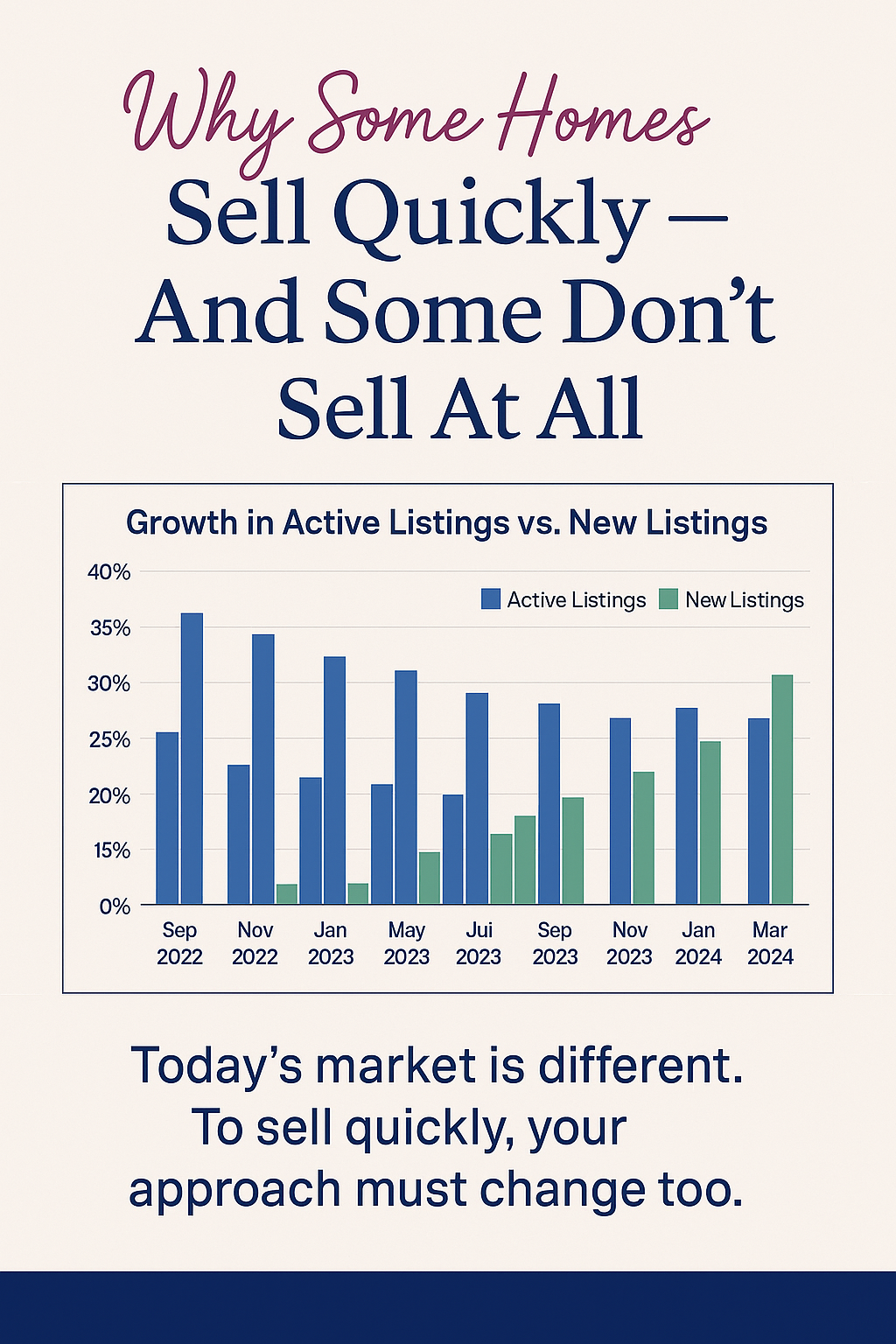

Why Some Homes Sell Fast — and Others Sit on the Market

A few years ago, homes were flying off the market. With record-low inventory, nearly anything sold — and fast. But today’s real estate landscape looks different. Inventory is up nearly 20% compared to last year, and in many areas, supply has returned to pre-2020 levels.

So, what does that mean for sellers?
👉 Your home needs to stand out from the moment it hits the market.

🔍 Why Homes Sit on the Market

Most of today’s inventory growth comes from homes that are still active — the ones that haven’t sold yet — rather than new listings. According to Realtor.com, many of these homes are taking longer to sell, which tells us something important:
It’s not just about listing your home — it’s about how you list it.

Common reasons homes linger on the market include:

  • Pricing too high based on old market conditions
  • Skipping essential repairs or updates
  • Poor listing photos or staging
  • Limited showing availability
  • Weak marketing strategies

A few years ago, sellers could list “as-is” and still attract multiple offers. Not anymore. Today’s buyers are choosier, more informed, and have more options.

💡 What Makes a Home Sell Quickly

Selling quickly in this market isn’t about luck — it’s about strategy.
Here’s what successful sellers have in common:

  1. Pricing Realistically – A competitive price based on today’s market, not yesterday’s headlines.
  2. Curb Appeal and Condition – Small upgrades and clean presentation go a long way.
  3. Professional Marketing – High-quality photos, social media visibility, and listing optimization matter.
  4. Accessibility – The easier it is to show, the faster it sells.

Remember: your first few weeks on the market are crucial. That’s when your listing gets the most exposure online. Nail your presentation early, and buyers will act fast.

🤝 Why the Right Agent Makes All the Difference

Working with an experienced REALTOR® means having someone who understands local trends, buyer behavior, and pricing strategy. According to the National Association of REALTORS® (NAR), sellers who work with agents are twice as likely to get an offer within a month compared to those who list on their own.

An expert agent will:

  • Recommend the right listing price using local comparable sales
  • Help you prep and stage for maximum impact
  • Use professional marketing that reaches buyers where they’re searching

Bottom Line

Even with more homes for sale, your property can still sell quickly — if it’s priced right, presented beautifully, and marketed strategically.

If you’re thinking about selling in Hampton Roads, Chesapeake, or Newport News, let’s connect! I’ll help you position your home to attract attention — and offers — from day one.

If you’re looking to sell, call Michele! If you’re looking to acquire — I’m your hire!

Michele Salyer, REALTOR®
Salyer Wilmoth Homes | A Better Way Realty
📞 7575023671 | 🌐 www.salyerwilmothhomes.com

May 15, 2026

Selling an Older Home in Norfolk, Virginia: Smart Prep Before You List

TL;DR

Selling an older home in Norfolk, Virginia takes more than simply highlighting charm, character, or location; sellers should prepare by reviewing the home’s condition, gathering maintenance records, understanding possible flood or historic district considerations, deciding which repairs are worth completing before listing, pricing the property based on both location and condition, and making sure buyers can clearly see the home’s value, updates, and long-term potential before they ever step inside.

Older Norfolk homes can attract the right buyer when positioned correctly

Older homes in Norfolk often come with details that newer properties may not have, including established architecture, mature landscaping, original features, and proximity to long-standing city corridors, waterfront areas, military access points, and local conveniences. But when it is time to sell, charm alone is usually not enough. Buyers are also looking closely at condition, insurance costs, repair needs, updates, layout, maintenance history, and whether the home feels move-in ready or requires additional investment after closing. Sellers who want to understand the buyer side of this decision can also read What Buyers Should Know About Older Homes in Norfolk Before Making an Offer, because it explains the exact concerns many buyers may bring into the showing and inspection process.


That is why sellers should avoid treating an older home like any other listing. The goal is not to hide the age of the property. The goal is to present it clearly, honestly, and strategically so buyers can see both the character and the practical value.

Start with the condition items buyers are likely to notice first

Before listing an older home in Norfolk, sellers should walk through the property with a buyer’s perspective. Many buyers will pay attention to the roof, crawl space, foundation, windows, electrical system, plumbing, heating and cooling, moisture signs, drainage, and general upkeep. Even if the home has beautiful curb appeal, visible deferred maintenance can make buyers hesitate or lower their offer.

This does not always mean sellers need to complete major renovations before listing. In many cases, smaller preparation steps can help create a stronger first impression. Cleaning, decluttering, improving lighting, touching up paint, repairing minor damage, servicing major systems, and organizing maintenance records can help buyers feel more confident. If you are unsure where to focus first, What Chesapeake Sellers Should Fix Before Listing — and What Can Wait is a useful companion read because the same repair-versus-return mindset can help Norfolk sellers avoid spending money on updates that may not meaningfully improve the sale.


For older homes, documentation can matter. If the roof, HVAC, electrical panel, plumbing, windows, or appliances have been updated, gather receipts, permits, warranties, and service records before going live. Clear information can help buyers understand what has already been improved and what may still need attention.

Be realistic about repairs versus return on investment

One of the biggest questions sellers ask is whether they should renovate before selling an older home. The answer depends on the home’s condition, price range, location, buyer demand, and competing inventory. Some updates may help the home show better, while others may not return enough value to justify the cost.

For example, a full kitchen renovation may not be necessary if the home is priced appropriately and the existing kitchen is clean, functional, and visually presentable. On the other hand, unresolved moisture issues, damaged flooring, peeling paint, broken fixtures, or obvious safety concerns may affect buyer confidence more directly.


A strategic pre-listing consultation can help sellers decide which updates are worth doing, which ones should be skipped, and which items should simply be disclosed or reflected in the pricing strategy.

Understand historic district and exterior improvement considerations

Some Norfolk properties may be located in areas with historic character or local review requirements. In certain areas, exterior alterations, major visible changes, or demolition may require review or approval before work can move forward.

For sellers, this matters because buyers may ask whether future exterior changes are limited. If the home is in a historic district or has exterior restrictions, it is better to understand that early. Sellers should not overstate what can or cannot be changed, but they can help buyers by making sure available information is accurate and easy to verify.


This can also affect how the home is marketed. If the property has original features, established architectural details, or a distinctive exterior style, those details can be positioned as part of the home’s character. At the same time, sellers should be careful not to imply that future improvements are simple or unrestricted if local review may apply.

Review flood risk before buyers ask about it

Flood risk is an important part of selling in Norfolk because some properties may be affected by flood zone designations, drainage concerns, or insurance questions. Before listing, sellers should understand whether flood insurance, elevation information, past water intrusion, or drainage improvements may come up during the transaction.

This does not mean every older home has a flood problem. It simply means buyers in Norfolk may ask more detailed questions, especially if the property is near low-lying areas, water, or streets where drainage is a known concern. For sellers who want to anticipate these questions before they become negotiation issues, What Buyers Should Know About Flood Insurance Before Buying Near Norfolk or Chesapeake gives helpful buyer-side context on flood zones, insurance costs, and full ownership expenses.


Being prepared helps avoid surprises during negotiations. If a buyer is already thinking about monthly payment, insurance, taxes, maintenance, and long-term costs, giving them clear property information early can make the home feel easier to evaluate.

Price the home based on condition, not just location

Older homes can be difficult to price because two properties in the same area can perform very differently depending on updates, layout, repair history, curb appeal, and buyer perception. A well-maintained older home may command stronger interest, while a similar home with visible deferred maintenance may need a different pricing strategy.

Sellers should compare more than square footage and nearby sales. Look at condition, renovation level, lot features, parking, flood considerations, system ages, inspection risks, and how the home competes with newer or recently updated properties.


A strong price should create interest without ignoring obvious condition issues. Overpricing an older home can cause it to sit, while underpricing without a plan can leave money on the table.

Know your disclosure responsibilities in Virginia

Virginia sellers should understand the residential property disclosure process before listing. Older homes can raise more buyer questions about known defects, repairs, permits, water issues, lead-based paint, systems, and prior work.

Sellers should answer honestly, avoid guessing, and work with appropriate professionals when they are unsure. A good listing strategy should not rely on vague answers. It should help the seller prepare for buyer questions before they become negotiation problems.


This is especially important when the home has had previous repairs or updates. If work was done to the roof, crawl space, plumbing, electrical system, HVAC, drainage, or exterior, sellers should gather available documentation and be prepared to explain what they know.

Highlight character without ignoring practical buyer concerns

Marketing an older Norfolk home should balance emotion and information. Buyers may love original floors, built-ins, front porches, mature trees, classic architecture, or proximity to local destinations. But they also want to know if the home has been cared for and whether ownership will feel manageable after closing.

Good listing copy should avoid exaggerated claims and focus on accurate property features. Instead of relying only on words like “charming” or “historic,” sellers can highlight specific details such as updated systems, flexible rooms, natural light, storage, outdoor space, parking, maintenance history, and access to Norfolk, Chesapeake, Virginia Beach, Portsmouth, and Naval Station Norfolk routes when relevant. If the home’s location may appeal to buyers comparing access to the base and surrounding areas, Selling Near Naval Station Norfolk: What Your Listing Should Highlight is a strong related resource because it shows how to describe location, function, and convenience without overpromising commute times or using unfair marketing language.


The strongest listing tells a complete story: the home has character, but it also has practical value.

Prepare for inspections and negotiations

Older homes often receive more detailed inspection feedback. Even when a home is well cared for, buyers may discover items related to age, code changes, moisture, crawl spaces, electrical systems, plumbing, windows, or structural components.

Sellers should not panic when inspection items appear. The better approach is to prepare before listing. A pre-listing walkthrough, contractor review, or targeted repairs can help identify possible concerns early. Sellers can then decide whether to fix certain items, price accordingly, or prepare documentation for buyers.

The more prepared a seller is, the less reactive the negotiation process becomes. When buyers feel that a seller has taken the time to prepare the home honestly, the transaction can feel more organized and less uncertain.

Photography and presentation matter even more for older homes

Older homes need thoughtful visual presentation. Poor lighting, clutter, outdated furniture placement, or dark photography can make a home feel smaller or more dated than it actually is. Clean staging, bright photos, simple styling, and clear feature shots can help buyers focus on the home’s strengths.

For online buyers, the first impression often happens before they ever schedule a showing. Sellers should make sure the listing photos show the home’s best spaces, important updates, exterior condition, outdoor areas, and functional layout. If the home has unique details, those should be photographed intentionally, not buried in the listing. This is especially important if your home may be viewed first by relocating or remote buyers, which is why How Sellers Can Prepare a Norfolk Home for Virtual Tours and Remote Buyers fits naturally as a next read for sellers who want their home to show well online before buyers visit in person.


The goal is not to make the home look like something it is not. The goal is to present it clearly, cleanly, and confidently so buyers understand the space before they decide whether to schedule a showing.

Frequently asked questions

How do I sell an older home in Norfolk, VA?

To sell an older home in Norfolk, start by reviewing the property’s condition, gathering maintenance records, identifying needed repairs, checking flood or historic district considerations, pricing the home based on condition, and preparing strong listing photos and marketing. Buyers may be drawn to the character of an older home, but they will also look closely at systems, upkeep, moisture concerns, insurance costs, and possible repairs.

Should I renovate my older Norfolk home before listing?

Not always. Some renovations can help, but others may not produce enough return before selling. Focus first on repairs that affect buyer confidence, such as visible damage, moisture concerns, broken fixtures, poor curb appeal, peeling paint, or neglected maintenance. Before spending heavily, connect with a local real estate professional who can help you decide which updates are likely to matter most for your specific home and price range.

Do older homes in Norfolk need a pre-listing inspection?

A pre-listing inspection can be helpful, especially if the home has older systems, visible wear, crawl space concerns, or past repair issues. It may help sellers identify problems before buyers do and reduce surprises during negotiations. It is not required for every seller, but it can be useful when you want a clearer preparation plan before going on the market. Salyer Wilmoth Homes | A Better Way Realty can help you think through whether it makes sense for your listing strategy.

How should I price an older home in Norfolk?

An older home should be priced based on location, condition, updates, layout, comparable sales, buyer demand, flood considerations, and how it competes with similar homes currently on the market. Age alone does not determine value. A well-maintained older home may attract strong interest, while one with deferred maintenance may need a more careful pricing strategy. The best approach is to compare your home against properties buyers are actually seeing online and in person.

What should sellers disclose when selling an older home in Virginia?


Virginia sellers should follow applicable disclosure requirements and provide the required residential property disclosure information. For older homes, sellers should be prepared to address known issues, prior repairs, permits, water intrusion, system updates, and other material questions honestly. If you are preparing to list an older home in Norfolk, working with a local real estate professional can help you organize the right information before buyers begin asking questions.


If you are thinking about selling an older home in Norfolk, the right preparation can help you protect your equity, reduce surprises, and position the property with confidence before it goes live.

Michele Salyer, REALTOR®

📞 757-502-3671

🌐 www.salyerwilmothhomes.com

“If you are looking to sell, Call Michele! If you are looking to acquire, I’m your hire!”

Salyer Wilmoth Homes | A Better Way Realty

Equal Housing Opportunity

May 14, 2026

Orders Can Change Fast: How Military Buyers Can Choose a Home More Strategically

TL;DR


Military buyers near Naval Station Norfolk and across Coastal Virginia should choose a home with more than the current set of orders in mind because timelines, duty assignments, commute needs, and future plans can change quickly. A stronger homebuying strategy looks beyond the purchase price and compares the full monthly cost, VA loan considerations, commute flexibility, property condition, maintenance risk, resale potential, and whether the home could still make sense if the buyer had to move, sell, or rent it sooner than expected. Instead of rushing into a home that only works for the moment, military buyers should focus on choosing a property that supports today’s needs while still giving them practical options for tomorrow.

Military homebuying is not always a normal timeline

Buying a home during a military move can feel different from a traditional relocation because the timeline is often shaped by duty station reporting dates, temporary lodging, family logistics, financing steps, and the pressure to make decisions quickly. When orders arrive, change, or move faster than expected, buyers may feel like they have to choose quickly just to stay ahead of the move.

That pressure is understandable, but it can also lead to rushed decisions. If you are already feeling pulled between timing, travel, financing, and limited showing windows, it may help to first read more about why buyers should be careful when a PCS starts pushing the pace in Don’t Let a PCS Rush Your Home Purchase: What Can Go Wrong When You Buy Too Fast.

For military buyers considering Chesapeake, Norfolk, Virginia Beach, Portsmouth, Suffolk, or nearby Coastal Virginia communities, strategy matters. The right home is not just the one that looks good online or feels exciting during the first showing. It is the one that fits the larger picture.

Why military orders can make homebuying more complicated

Military buyers often have to make decisions with less certainty than other buyers. Orders may create a tight window. Travel may limit in-person showings. A buyer may need to compare homes from out of state. In some cases, the home needs to work for a current assignment while still making sense if another move happens earlier than planned.

This does not mean military buyers should avoid buying. It means the home search should be more intentional.

A strategic search looks at the property, the payment, the commute, the condition, the ownership costs, the financing path, and the future exit plan. For buyers who already know another move may happen in a few years, the decision becomes less about finding a “forever home” and more about choosing a home that can support the next chapter, which is why What to Prioritize in a Home If You May PCS Again in a Few Years is a helpful next read before narrowing down options.

Start with the full monthly cost, not just the purchase price

A home can look affordable on paper and still feel tight once the full cost is considered. Military buyers should review the estimated mortgage payment, property taxes, homeowners insurance, flood insurance if applicable, utilities, maintenance, homeowners association dues, commuting costs, and possible repairs.

For buyers using a VA loan, the ability to purchase with favorable financing options can be a major advantage, but it does not remove the need to budget carefully. A smart offer should still leave room for unexpected costs, especially when a buyer may be managing moving expenses, temporary housing, repairs, storage, or travel at the same time.

This is especially important in Coastal Virginia, where location, property age, flood zone status, insurance considerations, and commute patterns can all affect the real cost of ownership. If you want to look deeper at the kinds of costs buyers sometimes overlook, Extra Costs That Can Surprise Buyers Near Coastal Virginia explains why the monthly payment is only one part of the bigger financial picture.

Compare commute flexibility, not just distance

For many military buyers, commute is one of the biggest factors in the search. A home may appear close to Naval Station Norfolk, Joint Expeditionary Base Little Creek-Fort Story, Naval Air Station Oceana, or another installation by mileage, but the actual drive can depend on bridges, tunnels, peak traffic, shift times, and route options.

Instead of focusing only on “minutes from base,” military buyers should compare route flexibility. Does the home give access to more than one major route? Is the commute still realistic during heavy traffic? Would the location still make sense if the buyer’s schedule changed?

This is why buyers searching near base should look beyond the listing map and understand how the drive may feel in real life. For a closer look at how commute can shape the entire search, Naval Station Norfolk Commute Reality: How It Can Shape Your Home Search is a useful guide to read before choosing based on distance alone.

Think about resale before you fall in love with the house

Military buyers may not know how long they will stay in a home. That makes resale potential especially important. A house may be a good fit emotionally, but the buyer should still ask whether future buyers may also see value in the property.

Strong resale factors often include practical layout, functional square footage, parking, storage, condition, major system age, outdoor usability, access to everyday needs, and overall property presentation. This does not mean every home must be perfect. It means buyers should understand what may help or hurt the home if they need to sell sooner than expected.

A home with a very specific layout, deferred maintenance, limited parking, unusual repair needs, or a high ownership cost may still be right for some buyers, but those details should be considered before making an offer.

Do not ignore rental potential, even if you plan to live there

Some military buyers purchase with the intention of living in the home for the full assignment. That is a reasonable plan. But because orders can change, it may also be smart to ask whether the home could work as a rental later.

This does not mean every buyer should become a landlord. It simply means rental feasibility can be part of the decision-making process. Buyers may want to review homeowners association rules, local rental regulations, property condition, likely maintenance needs, parking, layout, and whether the monthly numbers would make sense if the home had to be rented instead of sold.

A home that gives more exit options can offer more flexibility if the buyer’s plans change.

Look carefully at property condition

When time is tight, it can be tempting to focus on location and overlook repairs. But condition matters even more when the buyer may not have years to slowly improve the property.

Older homes in Norfolk, Chesapeake, Portsmouth, and other Coastal Virginia areas can offer character, location advantages, and value, but buyers should pay attention to roof age, HVAC age, plumbing, electrical systems, drainage, crawl spaces, windows, exterior maintenance, and moisture-related concerns. These details can affect both comfort and future resale.

A home inspection should not be treated as a formality. It is one of the most important tools for understanding whether the property fits the buyer’s timeline, budget, and risk tolerance.

Be careful with “perfect for right now” decisions

A home can feel perfect for the current set of orders but become less practical if the buyer’s assignment, schedule, household needs, or timeline changes. Military buyers should ask questions that go beyond the first impression:

Would this home still work if the commute changed?

Would the payment still feel manageable with unexpected expenses?

Would this property be difficult to sell quickly?

Would this home require too much maintenance during a busy assignment?

Would this property make sense if it had to become a rental?

These questions do not remove emotion from the homebuying process. They simply protect the buyer from making a rushed decision based only on urgency.

How military buyers can make a stronger offer without rushing

A strategic offer is not always the highest offer. It is the offer that matches the buyer’s financing, timeline, inspection needs, appraisal considerations, and comfort level.

Military buyers should be ready before the right home appears. That may include getting pre-approved, understanding VA loan requirements, reviewing available cash for closing costs and inspections, knowing the preferred move-in window, and identifying non-negotiables before touring homes.

For buyers relocating from out of state, this preparation becomes even more important because virtual tours, photos, and listing descriptions may not show everything that matters. Before relying on a remote showing alone, What Buyers Should Ask During a Virtual Tour When Relocating From Out of State can help you ask sharper questions before making a decision from a distance.

Why local guidance matters in Coastal Virginia

Military buyers searching near Naval Station Norfolk or across Coastal Virginia often need more than listing access. They need help comparing commute realities, ownership costs, property condition, resale factors, and timing risks.

A local real estate strategy can help buyers narrow the search while keeping the focus on objective property details, budget, commute preferences, timeline, and long-term ownership goals.

When orders move fast, the goal is not to panic-buy. The goal is to choose with enough information to feel confident now and protected later.

Frequently asked questions

What should military buyers consider before buying a home near Naval Station Norfolk?

Military buyers should consider the full monthly cost, commute options, property condition, future resale potential, possible rental flexibility, insurance needs, and how the home would work if orders or timelines changed. The best choice is not always the closest home or the largest home. It is the home that fits the buyer’s current needs while still offering flexibility if the military timeline shifts.

Is it smart to buy a home during a PCS move?

Buying during a PCS move can make sense when the numbers, timeline, financing, and long-term plan are strong. It may not be ideal for every buyer, especially if the timeline is uncertain or the monthly cost feels too tight. Before making an offer, military buyers should compare the cost of buying, renting, temporary housing, future resale, and possible rental use. If you are weighing whether buying makes sense for your next move, Salyer Wilmoth Homes can help you look at the decision strategically before you start touring.

How can military buyers avoid rushing into the wrong home?

Military buyers can avoid rushing by getting pre-approved early, identifying must-have property features, reviewing commute routes, studying ownership costs, asking about major systems, and thinking through resale before making an offer. A fast timeline does not have to mean a careless decision. It simply means buyers need a clearer plan before the search begins.

Should military buyers think about resale before buying?

Yes. Military buyers should think about resale because future orders may require them to move sooner than expected. Resale does not depend on one factor alone. It may be influenced by condition, layout, price point, location, parking, maintenance needs, and overall buyer demand at the time of sale. Before choosing a home, buyers should ask whether the property would likely appeal to future buyers if they needed to sell. For a more strategic review of homes in Chesapeake, Norfolk, Virginia Beach, and nearby areas, reach out before you make a final decision.

Can a military buyer keep the home as a rental after moving?

Some military buyers may choose to keep a home as a rental after moving, but that depends on the property, loan situation, local rules, homeowners association restrictions, insurance requirements, maintenance needs, and whether the rental numbers make sense. Buyers should not assume every home will work well as a rental. If rental flexibility is part of your long-term plan, it is better to discuss that before buying instead of after orders change.


If you are buying near Naval Station Norfolk, Chesapeake, Norfolk, Virginia Beach, or another Coastal Virginia community, start with a strategy before you start chasing listings. I can help you compare homes with your timeline, commute, budget, and future flexibility in mind. 

Michele Salyer, REALTOR®

📞 757-502-3671

🌐 www.salyerwilmothhomes.com

“If you are looking to sell, Call Michele! If you are looking to acquire, I’m your hire!”

Salyer Wilmoth Homes | A Better Way Realty

Equal Housing Opportunity

Posted in Buyer Guides
May 12, 2026

A Buyer’s Guide to Hickory in Chesapeake, VA

TL;DR

Hickory in Chesapeake, Virginia is worth considering for buyers who want more space, a quieter residential setting, and a location that feels less dense than some of Chesapeake’s more commercial areas, but it is also a market where buyers need to look beyond the home itself and carefully evaluate the land, commute, utilities, drainage, inspections, lot maintenance, insurance considerations, and long-term ownership costs; because many Hickory-area homes may offer larger yards, custom features, acreage-style settings, or a more spread-out feel, the right home can be a strong fit for buyers who value room to grow, outdoor space, and a more residential pace, while the wrong home can come with unexpected responsibilities if the buyer does not review septic or well details when applicable, property boundaries, road access, flood or drainage concerns, and repair needs before making an offer.

Why buyers are looking at Hickory in Chesapeake, VA

Hickory is one of the areas in Chesapeake that often appeals to buyers who want a more open, less dense setting compared with some of the city’s busier residential and commercial corridors. Located in the southern part of Chesapeake, Hickory is commonly associated with larger lots, single-family homes, newer construction opportunities, and a more spread-out residential feel.

For buyers comparing different parts of Chesapeake, Hickory can feel different from areas such as Greenbrier, Great Bridge, Deep Creek, or Indian River. Instead of focusing only on price or square footage, buyers should pay attention to the overall lifestyle fit: commute patterns, road access, home maintenance, land use, utility setup, and how far they want to be from shopping, dining, work, medical care, and recreation. If you are still comparing which part of the city makes the most sense, this guide on how to narrow down your Chesapeake home search by area instead of just price is a helpful next read because Hickory is exactly the kind of area where location fit matters just as much as the house itself.

What makes Hickory different from other parts of Chesapeake?

One of the biggest differences buyers may notice in Hickory is the sense of space. Many buyers search in Hickory because they want a home that does not feel boxed in by heavy commercial activity or tight neighborhood density. Depending on the specific property, buyers may find larger yards, more room between homes, mature trees, long driveways, garage space, workshops, outdoor living areas, or properties that feel more private.

That said, Hickory is not one single type of neighborhood. Some properties may be newer construction, some may be older homes on established lots, and others may sit on larger parcels where maintenance, drainage, fencing, septic, wells, sheds, barns, or outbuildings matter more than they would in a traditional subdivision. This is why buyers should avoid judging a home only by listing photos. The land, utilities, access, and long-term upkeep may be just as important as the kitchen, bedrooms, or finishes. For a deeper look at why the surroundings can matter after closing, buyers may also want to read the neighborhood detail buyers don’t notice until they live there before deciding which Hickory property truly fits their lifestyle.

What types of homes can buyers find in Hickory?

Hickory is often associated with single-family homes, homes with larger lots, and properties that may offer more outdoor space than buyers typically find in more compact areas of Chesapeake. Buyers may see a range of options, including traditional homes, custom homes, newer builds, homes with acreage, and properties that need updates. Some homes may be part of subdivisions, while others may feel more rural or semi-rural.

This variety can be a major advantage, but it also means buyers should compare properties carefully. Two homes at similar price points can have very different costs after closing depending on lot maintenance, roof age, heating and cooling systems, drainage, driveway condition, well or septic needs, and insurance requirements. If you are drawn to Hickory because you want more room, this post on how to search for more space without losing access to Naval Station Norfolk can help you think through the space-versus-commute balance before you fall in love with a home that looks perfect online.

What should buyers inspect closely in Hickory homes?

When buying in Hickory, buyers should look beyond the basic home tour. In addition to standard items like roof, foundation, heating and cooling, plumbing, electrical systems, windows, and appliances, buyers should pay extra attention to the land and exterior features.

Important items to review may include drainage around the property, grading, tree placement, driveway condition, fencing, crawl space moisture, septic system details, well water when applicable, detached structures, easements, and whether any additions or improvements were properly permitted. If the property has a large lot, buyers should also consider how much time, money, and equipment may be needed to maintain it.

A home with more space can be a great fit, but more space can also mean more responsibility. Before making an offer, buyers should ask what is included in the sale, what systems serve the property, what inspections are recommended, and whether the home’s condition matches the buyer’s comfort level and budget.

Commute and daily convenience in Hickory

Hickory can be a good fit for buyers who want to live in Chesapeake while still having access to other parts of Coastal Virginia. However, commute time can vary depending on the exact property location, road conditions, work schedule, school drop-offs, bridge or tunnel routes, and time of day.

Buyers should map actual routes before committing to a property. It is helpful to test the drive during the times you would normally travel, not just during a quiet weekend showing. If you work in Norfolk, Virginia Beach, Portsmouth, Suffolk, or near Naval Station Norfolk, the distance may look manageable on a map, but the real experience can depend heavily on traffic patterns.

For many buyers, Hickory’s appeal is the balance between space and access. The key is making sure the home supports your daily routine, not just your wish list.

Taxes, insurance, and ownership costs in Hickory

When buyers compare homes in Hickory, it is important to look at the full cost of ownership rather than only the listing price. A home with more land, a larger footprint, additional structures, or certain property features may come with different maintenance, tax, insurance, and utility considerations than a smaller home in a more compact subdivision.

Property taxes should also be reviewed early in the process because taxes can affect monthly payment comfort, especially when buyers are comparing homes across Chesapeake, Norfolk, and Virginia Beach. For a helpful breakdown of how these costs can shape a buyer’s budget, read Property Taxes in Chesapeake, Norfolk & Virginia Beach Explained — What Every Buyer Needs to Know before deciding which price range feels realistic.

Buyers should also ask about insurance requirements, flood zones, drainage history, and any property-specific risks that may affect long-term affordability. In an area where some homes may have more land, more trees, longer driveways, or different utility setups, the monthly mortgage is only one part of the picture.

What should out-of-area buyers know before buying in Hickory?

Out-of-area buyers should be especially careful when evaluating Hickory homes online. Listing photos can show the house, but they may not fully show road access, lot slope, neighboring land use, drainage patterns, commute feel, or the distance from daily conveniences.

If you are relocating to Chesapeake from another city or state, request video tours that show more than just the inside of the home. Ask for footage of the street, driveway, yard, exterior structures, nearby roads, and surrounding area. You should also review maps, flood information, school assignment tools, utility details, and commute routes before writing an offer. If you are relying on a remote showing, this guide on what buyers should ask during a virtual tour when relocating from out of state can help you avoid missing the details that do not always show up in listing photos.

For military relocation buyers, especially those comparing Chesapeake, Norfolk, and Virginia Beach, Hickory may be worth considering if space is a priority. However, the commute to base areas should be tested carefully because drive time can change significantly depending on route and traffic.

Is Hickory a good fit for first-time buyers?

Hickory can be a strong option for some first-time buyers, especially those who want more space, a single-family home, or a quieter setting within Chesapeake. However, first-time buyers should be realistic about the extra responsibilities that may come with certain Hickory properties.

A larger yard, older home, private driveway, septic system, well, detached garage, or bigger parcel can be appealing, but these features may also require more maintenance knowledge and a larger emergency fund. First-time buyers should work closely with their lender and real estate agent to understand not only the purchase price, but also taxes, insurance, inspections, repairs, utilities, and future upkeep.

The best question is not simply, “Can I buy this home?” The better question is, “Can I comfortably own and maintain this home after closing?”

How to make a stronger offer on a Hickory home

A strong offer in Hickory starts with understanding the property. If a home has unique land, acreage, newer upgrades, or limited comparable listings nearby, buyers should be prepared before the right property comes on the market.

This means getting fully pre-approved, understanding your budget, knowing which inspections matter, reviewing comparable sales, and deciding in advance where you are flexible. Some buyers may focus on price, while others may strengthen an offer through timeline, earnest money, inspection strategy, or seller-friendly terms. The right approach depends on the home, the market, and your risk tolerance.

A local strategy matters because Hickory homes are not always identical to nearby subdivision homes. Property condition, lot size, land features, and utility setup can affect value and negotiation.

Frequently asked questions

Is Hickory in Chesapeake, VA a good place to buy a home?

Hickory may be a good place to buy for buyers who want more space, a less dense residential setting, and access to southern Chesapeake. The right fit depends on your budget, commute, preferred property type, maintenance comfort level, and daily needs. Buyers should compare individual homes carefully instead of relying only on general area impressions.

What should I know before buying a house in Hickory Chesapeake VA?

Before buying in Hickory, you should look closely at the home’s condition, lot size, drainage, utility setup, commute routes, inspection needs, and long-term maintenance costs. If you are unsure how to compare Hickory homes with other Chesapeake areas, send us a message before you start touring so you can narrow your search more strategically.

Are there homes with land or acreage in Hickory Chesapeake VA?

Yes, buyers often search Hickory and nearby parts of Chesapeake for homes with larger lots or acreage-style property options. Availability changes with the market, so it is important to review current listings, zoning, property boundaries, and maintenance needs before deciding if a larger parcel is the right fit. If you are looking for more outdoor space in Chesapeake, we can help you compare what is currently available.

Is Hickory Chesapeake VA good for buyers relocating from out of state?

Hickory can be worth considering for out-of-area buyers who want space and a Chesapeake location, but it is important to research commute patterns, property condition, utilities, school assignments, and surrounding land use before making an offer. Out-of-state buyers should request detailed video tours and location context, not just interior photos.

How do I find the right home in Hickory Chesapeake VA?

Start by deciding what matters most: space, price, commute, lot size, home age, updates, garage space, outdoor features, or proximity to daily conveniences. Then compare homes by total ownership cost, not just listing price. If Hickory is on your list, reach out before you begin your search so we can help you understand which homes are worth a closer look and which details may need extra review.

Thinking about buying in Hickory or comparing it with other parts of Chesapeake? A local conversation before you tour can help you avoid surprises and focus on homes that truly match your goals.

Michele Salyer, REALTOR®

📞 757-502-3671

🌐 www.salyerwilmothhomes.com

“If you are looking to sell, Call Michele! If you are looking to acquire, I’m your hire!”

Salyer Wilmoth Homes | A Better Way Realty

Equal Housing Opportunity

Posted in Buyer Guides
May 12, 2026

The First 30 Seconds of a Home Tour Can Shape a Buyer’s Entire Opinion

TL;DR

The first 30 seconds of a home tour can strongly influence how buyers feel about a property because they immediately notice curb appeal, the entryway, lighting, cleanliness, smell, layout, maintenance clues, and whether the home feels easy to imagine living in; while buyers should not make a decision based on first impressions alone, sellers can use those first moments to build confidence by making the home feel clean, bright, cared for, and easy to understand from the moment someone arrives.

Why the First 30 Seconds Matter

Buyers often begin forming an opinion before they have walked through the whole home. The first few moments can influence whether they feel curious, cautious, excited, or distracted. This does not mean buyers should make rushed decisions, but it does mean first impressions matter. A home tour is not only about square footage, number of bedrooms, or price. It is also about how the property presents itself the moment a buyer arrives, opens the door, and starts noticing the small details that either build confidence or raise questions.

For buyers who are still learning how to evaluate homes carefully, it can help to understand the bigger buying process first. If you are just starting out, this guide on how to buy a home in Chesapeake, Norfolk, and Virginia Beach can give you a clearer picture of what happens before, during, and after the tour.

For sellers, those first seconds can affect how seriously a buyer views the rest of the home. For buyers, understanding these early impressions can help separate emotional reactions from practical decision-making.

Curb Appeal Sets the First Tone

Before buyers step inside, they usually notice the exterior. This can include the front yard, walkway, porch, siding, paint condition, roofline, landscaping, driveway, and overall upkeep. A home does not need to look perfect, but it should look cared for.

Buyers may wonder whether the outside condition reflects the inside condition. If the exterior appears neglected, they may become more alert to possible maintenance issues during the tour. On the other hand, a clean and well-maintained exterior can make buyers feel more confident before they even enter the home.

For sellers, this is why basic exterior preparation matters. Simple improvements like trimming landscaping, cleaning the entryway, removing clutter, and checking visible maintenance details can help the home feel more welcoming. If you are preparing to list soon, it may also help to read what Chesapeake sellers should fix before listing and what can wait so you can focus on the updates that are more likely to shape buyer perception without over-improving unnecessarily.

The Entryway Creates an Immediate Feeling

Once inside, buyers often notice the entryway first. They may pay attention to how open or narrow it feels, whether the space is bright, whether shoes, bags, or personal items are crowding the area, and whether the home feels easy to move through.

The entryway does not need to be large. What matters is whether it feels clean, intentional, and easy to understand. A cluttered or dark entry can make a home feel smaller than it is. A simple, bright, and organized entry can help buyers feel more comfortable continuing the tour.

This is especially important because buyers are trying to orient themselves. They are asking questions in their mind like: Where does the living space begin? Does the layout flow naturally? Does this feel welcoming?

Lighting Can Change the Way Buyers See the Home

Lighting is one of the fastest things buyers notice. Natural light can make a home feel more open, warm, and inviting. Dark rooms, closed curtains, burned-out bulbs, or uneven lighting can make spaces feel smaller or less appealing.

Good lighting helps buyers see the home clearly. It also helps highlight features like flooring, paint colors, countertops, built-ins, and room size. Poor lighting can distract buyers from the property’s strengths.

Before a showing, sellers should consider opening blinds, turning on lights, and making sure rooms feel bright but not harsh. Buyers should also remember that lighting can be adjusted after purchase, but it is still important to understand how the home feels at different times of day.

Cleanliness and Smell Are Noticed Almost Immediately

Buyers usually notice cleanliness and smell within seconds. This can include pet odors, food smells, mustiness, heavy fragrances, smoke, dampness, or general freshness. Even if the home has strong features, an unpleasant smell can distract buyers and make them question ventilation, maintenance, or moisture concerns.

Cleanliness works the same way. Dust, clutter, dirty floors, stained surfaces, or overflowing storage areas can make buyers focus on the condition of the home instead of the possibilities of the space.

For sellers, this does not mean the home has to look like a model home. It simply means the property should feel clean, fresh, and cared for. For buyers, it is worth noticing whether a smell seems temporary or whether it may point to something that deserves closer inspection.

Layout and Flow Stand Out Quickly

In the first 30 seconds, buyers often begin to understand whether the layout makes sense for their needs. They may notice if the living room connects naturally to the kitchen, whether the entry leads directly into a functional space, whether rooms feel separated or open, and whether movement through the home feels comfortable.

Layout can be more important than décor. Furniture and paint can change, but traffic flow, room placement, and structural layout are harder to adjust. Buyers should pay attention to how they move through the home, not just how the home looks in photos.

Sellers can help by arranging furniture in a way that makes the home easy to walk through. Overcrowded rooms can make spaces feel smaller, while a clear layout can make the home feel more functional.

Buyers Notice Maintenance Clues Early

Buyers may quickly spot small signs that suggest how well the home has been maintained. These can include chipped paint, loose railings, stained ceilings, damaged flooring, cracked caulk, outdated fixtures, sticky doors, or visible wear around high-use areas.

Not every issue is a major problem. Homes are lived in, and normal wear is expected. However, buyers often connect visible maintenance details with larger questions. If they notice several small issues right away, they may wonder what else has been overlooked.

For sellers, addressing obvious minor repairs before listing can help reduce buyer hesitation. For buyers, these details can be helpful conversation points during the showing and inspection process.

Buyers Also Notice Whether the Home Feels Easy to Imagine

One of the most important first impressions is whether buyers can picture themselves using the space. This does not depend on who currently lives there, who previously owned the home, or what type of household a buyer may have. Fair housing rules matter, and marketing should focus on the property itself, not on assumptions about people.

Buyers may ask themselves whether the living area feels comfortable, whether the kitchen feels usable, whether storage appears practical, whether the bedrooms fit their needs, and whether the home supports their lifestyle in a general and property-focused way.

This is also where buyers should think beyond the walls of the home. Sometimes the feature that shapes daily life is not the kitchen counter or paint color, but the surrounding area, access, noise, traffic pattern, drainage, or nearby conveniences. For a deeper look at that hidden layer of decision-making, this post on the neighborhood detail buyers do not notice until they live there is worth reading before your next showing.

Photos May Get Buyers Interested, But the First Tour Confirms the Feeling

Online photos are important, but the in-person tour often confirms whether the home feels the same as it looked online. A home may photograph beautifully but feel different in person because of lighting, room size, layout, noise, condition, or flow.

This is why buyers should avoid relying on photos alone. The first 30 seconds of a tour can reveal details that listing photos may not fully capture. It can also help buyers decide which questions to ask next.

For out-of-state buyers, this matters even more because the first “tour” may happen through a screen. If you are relocating and cannot see the home in person right away, knowing what buyers should ask during a virtual tour when relocating from out of state can help you catch details that photos and listing descriptions may miss.

For sellers, this means the home should feel consistent with its online presentation. Overly edited photos, cluttered showings, or unprepared spaces can create a disconnect between expectations and reality.

How Sellers Can Prepare for a Strong First Impression

Sellers can improve the first 30 seconds of a showing by focusing on simple, practical preparation. The goal is not to make the home look artificial. The goal is to make the home feel clean, clear, and easy to evaluate.

Start with the exterior, entryway, lighting, smell, and clutter. These are the areas buyers notice fastest. Make sure the front door area is clean, the main living spaces are easy to walk through, and the home smells fresh without relying on overpowering fragrance.

Small improvements can make a meaningful difference. A buyer who feels comfortable at the start of a tour may be more willing to look closely at the rest of the home.

How Buyers Can Think Beyond the First Impression

Buyers should pay attention to first impressions, but they should not let those impressions make the entire decision. A home may need cosmetic updates but still have strong value, layout, location, or long-term potential. Another home may look beautiful at first glance but still require closer review.

The best approach is to notice your first reaction, then slow down and evaluate the property carefully. Look at layout, condition, major systems, storage, commute considerations, neighborhood context, and how the home fits your budget and goals.

Buyers should also remember that the home’s purchase price is only one part of the decision. Taxes, insurance, utilities, maintenance, and other ownership costs can affect long-term comfort with the home, which is why this guide to property taxes in Chesapeake, Norfolk, and Virginia Beach is helpful to review before comparing homes only by list price.

A strong first impression is helpful, but a smart buying decision comes from balancing emotion with practical review.

Frequently asked questions

What do buyers look for first when touring a home?

Buyers often notice curb appeal, the entryway, lighting, cleanliness, smell, layout, and obvious maintenance details first. These early impressions can influence how buyers feel about the rest of the tour, but they should still evaluate the full property carefully before making a decision.

How can sellers make a home look better before showings?

Sellers can start by cleaning the entryway, improving lighting, removing clutter, freshening the home, trimming exterior landscaping, and completing small visible repairs. These simple steps can help buyers focus on the home’s features instead of distractions. If you are preparing to sell in Chesapeake, Norfolk, Virginia Beach, or nearby Coastal Virginia communities, a local real estate professional can help you decide which updates are worth doing before listing.

Do buyers care more about layout or finishes?

Buyers usually notice both, but layout can carry more long-term importance because finishes are often easier to change than the structure or flow of a home. Paint, fixtures, and décor can be updated, while room placement, traffic flow, and overall function may be harder to adjust.

Why does smell matter so much during a home tour?

Smell matters because buyers notice it immediately and may connect it with cleanliness, ventilation, moisture, pets, smoke, or general home maintenance. A fresh, neutral-smelling home can make the showing feel more comfortable. Sellers should avoid strong fragrances and focus instead on cleanliness, airflow, and addressing the source of any odor before showings.

Should buyers trust their first impression of a house?

Buyers should pay attention to their first impression, but they should not rely on it alone. A quick reaction can reveal how the home feels, but a smart decision also requires reviewing price, condition, layout, location, inspection results, and long-term fit. If you are unsure whether a home is worth a second look, working with a local agent can help you separate fixable cosmetic issues from bigger concerns.

Thinking about buying or selling in Chesapeake, Norfolk, Virginia Beach, or the surrounding Coastal Virginia area? Salyer Wilmoth Homes | A Better Way Realty can help you understand what buyers notice, what sellers should prepare, and how to make confident real estate decisions.

Michele Salyer, REALTOR®

📞 757-502-3671

🌐 www.salyerwilmothhomes.com

“If you are looking to sell, Call Michele! If you are looking to acquire, I’m your hire!”

Salyer Wilmoth Homes | A Better Way Realty

Equal Housing Opportunity

May 11, 2026

Property Taxes in Chesapeake, Norfolk & Virginia Beach Explained — What Every Buyer Needs to Know

TL;DR

Property taxes in Chesapeake, Norfolk, and Virginia Beach are calculated by multiplying your home’s assessed value by each city’s tax rate — and the rates differ across every city, which can meaningfully change what you owe year to year.

Virginia Beach currently has the lowest rate at $0.99 per $100 of assessed value, Chesapeake sits at $1.04, and Norfolk comes in at $1.25 — but assessed value and market value do not always match, so the math is not always straightforward.

As a buyer, understanding the property tax picture before you make an offer is essential. It directly impacts your monthly mortgage payment, your long-term carrying costs, and how you compare homes across city lines. This guide breaks it all down in plain English so you know exactly what to expect before you close.

Why Property Taxes Matter More Than Most Buyers Realize

When most buyers calculate what they can afford, they focus on the purchase price and the mortgage rate. Property taxes rarely make the shortlist — until the first escrow statement arrives and the numbers do not match expectations.

In Hampton Roads, property taxes are paid to the city where the home is located — not the state — which means the rate you pay depends entirely on whether you buy in Chesapeake, Norfolk, or Virginia Beach.

Two homes with identical price tags in different cities can carry hundreds of dollars in difference in annual tax bills. If you are still figuring out how far your budget really stretches, read about the full picture of costs that catch coastal Virginia buyers off guard — property taxes are just one piece of it.

How Property Taxes Are Calculated in Virginia

Virginia uses a straightforward formula:

Assessed Value × City Real Estate Tax Rate = Annual Property Tax Bill

The result is your annual tax bill, typically divided into two payments due in June and December.

The key thing to understand is that assessed value and market value are not the same thing. Each city’s assessor determines the assessed value independently — usually once a year — and it may be higher or lower than what you actually paid for the home.

In a rising market like Hampton Roads, assessments can sometimes lag behind sale prices, which works in your favor. In other cases, a recent sale price can trigger a reassessment that bumps your taxes up.

Property Tax Rates: Chesapeake vs. Norfolk vs. Virginia Beach

Here is how the three cities compare on real estate tax rates as of 2025:

City Rate Per $100 of Assessed Value Estimated Annual Tax on a $350,000 Home
Virginia Beach $0.99 ~$3,465
Chesapeake $1.04 ~$3,640
Norfolk $1.25 ~$4,375

Estimates assume assessed value equals purchase price. Actual bills vary.

On a $350,000 home, the difference between buying in Virginia Beach versus Norfolk is over $900 per year — roughly $75 more per month in your escrow. Over a 30-year loan, that gap compounds to more than $27,000. It is worth knowing before you fall in love with a specific address.

What New Buyers Should Expect After Closing

When you buy a home in Virginia, the property will be reassessed at some point after the sale — and your new tax bill will reflect the city’s updated valuation, not necessarily what the previous owner was paying.

In a competitive market where homes sell above asking, this can mean a higher assessment than the prior owner had. Budget for it.

Your mortgage lender will typically set up an escrow account that collects a portion of your estimated annual property taxes with each monthly payment. This amount is recalculated annually, so if your assessment increases, your monthly payment can go up even if your interest rate stays the same.

If you are still in the early stages of mapping out your budget, our full step-by-step buying guide walks through how to set a realistic number before your search even begins.

Can You Appeal Your Property Tax Assessment?

Yes — and more homeowners should.

If you believe your city’s assessed value is higher than what your home is actually worth, you have the right to appeal. Each city has its own process and deadline, but the general approach is the same:

Gather evidence supporting a lower value, such as recent comparable sales, a recent appraisal, or documentation of condition issues, and submit a formal appeal to the city assessor’s office.

Appeals are more commonly successful than most homeowners realize, particularly when market values have softened or when the assessment does not account for the home’s actual condition. A local real estate agent can help you pull comparable sales data to build your case.

Tax Relief Programs Available to Hampton Roads Homeowners

Virginia offers several property tax relief programs that can meaningfully reduce what you owe — but you have to apply for them.

Each city offers targeted relief for seniors, disabled homeowners, and qualifying veterans. If you or a household member is 65 or older, or permanently and totally disabled, you may qualify for a significant reduction depending on your income and net worth.

Veterans with a 100% service-connected disability rating are exempt from real estate taxes on their primary residence in Virginia under state law. Surviving spouses of qualifying veterans may also be eligible.

If you are a veteran buyer and have not explored all the financial tools available to you, this guide on maximizing your buying power as a military buyer is worth reading before you make an offer.

How Property Taxes Factor Into Your Offer Strategy

Savvy buyers look at the current property tax bill on every home they consider — not just the listing price.

A home that looks affordable at face value can carry a surprising tax bill if it was recently reassessed or sits in a higher-rate city. Ask your agent to pull the current annual tax figure from public records before you write an offer.

When comparing two homes at similar price points across city lines, factor in the annual tax difference when calculating your true monthly cost. It can shift which property is actually the better deal — even when the sticker prices look identical.

If you are still deciding which area of Hampton Roads makes the most sense for your situation, read about how to narrow your search by area rather than price alone.

Frequently Asked Questions

When are property taxes due in Virginia Beach, Chesapeake, and Norfolk?

In all three cities, real estate taxes are billed twice a year — the first half is typically due in June and the second in December.

If you have a mortgage with an escrow account, your lender handles these payments from the funds collected monthly, so you may never write the check yourself. But the money is still leaving your account each month, which is why your lender’s escrow estimate matters when calculating affordability.

How do I find the current property tax bill on a home I am considering?

All three cities maintain public real estate assessment databases searchable by address on their official websites. Your real estate agent can also pull this information quickly as part of standard pre-offer research.

Want help running the numbers on a specific property? Reach out and we will pull the full picture for you — no obligation.

Will my property taxes go up after I buy?

They can — and in a rising market, they often do.

After a sale, the city may reassess your home based on the sale price or updated market data, and if that new assessed value is higher than what the previous owner was taxed on, your annual bill increases.

This is why it is important to budget not just for the current estimate, but for potential increases in the first few years.

Unsure how to factor this into your budget? Let’s talk — we can help you stress-test your numbers before you commit.

Do military homeowners get a property tax break in Virginia?

Active duty service members do not receive a blanket exemption simply for being in the military.

However, veterans with a 100% service-connected disability rating are fully exempt from real estate taxes on their primary residence in Virginia — a significant benefit. Surviving spouses of qualifying veterans may also be eligible.

The exemption is not automatic; you must apply and submit documentation to your city’s assessor’s office to claim it.

Which city has the lowest property taxes — Chesapeake, Norfolk, or Virginia Beach?

Based on current tax rates, Virginia Beach has the lowest rate at $0.99 per $100 of assessed value, followed by Chesapeake at $1.04 and Norfolk at $1.25.

But the rate alone does not tell the whole story. Your actual bill depends on how each city assesses your specific home. A lower rate paired with a higher assessed value can result in a bill comparable to a city with a slightly higher rate.

Always compare the actual dollar amount on a specific property, not just the rate.

Not sure how to make sense of the math across cities? We are happy to walk you through it — contact us for a free consultation.

Understanding your full cost picture is one of the smartest moves you can make before buying.

If you are shopping for a home in Chesapeake, Norfolk, or Virginia Beach and want a clear-eyed look at what you will actually owe — not just the mortgage — reach out today. We will help you run the real numbers so there are no surprises after you close.

Michele Salyer, REALTOR®

📞 757-502-3671

🌐 www.salyerwilmothhomes.com

“If you are looking to sell, Call Michele! If you are looking to acquire, I’m your hire!”

Salyer Wilmoth Homes | A Better Way Realty

Equal Housing Opportunity

Posted in Buyer Guides
May 9, 2026

How to Buy a Home in Chesapeake, Norfolk & Virginia Beach, VA — A Step-by-Step Guide

TL;DR

Buying a home in Chesapeake, Norfolk, or Virginia Beach is completely doable — as long as you know the steps, get pre-approved early, and work with a local agent who knows the Hampton Roads market inside and out. The process starts with getting pre-approved so you know your exact budget, then finding a local agent who understands the flood zones, school districts, and neighborhood dynamics unique to this region.

From there, you'll tour homes, make a competitive offer, negotiate terms, and work through inspections and financing before closing day. Hampton Roads has a strong mix of military-friendly VA loan options, state-backed down payment assistance through Virginia Housing, and a diverse inventory across price points — from Norfolk's walkable urban neighborhoods to Chesapeake's quiet suburban streets and Virginia Beach's coastal communities. The market moves fast, especially in spring and summer, so preparation is everything. Read this guide before you start your search — it will save you time, stress, and potentially thousands of dollars.

Why Hampton Roads Is One of Virginia's Best Places to Buy a Home

Chesapeake, Norfolk, and Virginia Beach make up the heart of Hampton Roads — a region that consistently ranks among the most livable metro areas in Virginia. Whether you're drawn to Virginia Beach's oceanfront lifestyle, Chesapeake's sprawling suburban neighborhoods, or Norfolk's revitalized urban core, there's a market here for every kind of buyer. The region is home to a strong military presence, a growing tech sector, and some of the most competitive home prices on the East Coast — making it a top destination for first-time buyers and move-up buyers alike. Inventory moves fast here, especially in the spring and summer season, so understanding the process before you start your search is absolutely essential.

Step 1 — Get Pre-Approved Before You Start Shopping

The single most important thing you can do before touring a single home is get pre-approved for a mortgage. In competitive markets like Virginia Beach and Norfolk, sellers often won't even consider an offer without a pre-approval letter in hand. A pre-approval tells you exactly how much you can borrow — and it tells sellers that you're a serious, qualified buyer. If you're still not sure why this step matters so much, read our full breakdown on why pre-approval is the one homebuying step you don't want to skip.

You'll want to gather your W-2s, recent pay stubs, bank statements, and your last two years of tax returns. Your lender will review your credit score, debt-to-income ratio, and employment history. Many local buyers are surprised to find out they qualify for more than they expected — or that they need a bit of time to improve their credit profile first. Either way, knowing your number up front saves you from heartbreak later. 

Step 2 — Understand How Much Home You Can Afford in This Market

As of 2025, the median home price in Virginia Beach hovers around the mid-$300s, while Chesapeake and Norfolk offer a slightly wider range depending on the neighborhood. Your pre-approval amount is your ceiling — but your budget should account for more than just the mortgage payment. Property taxes, homeowners insurance, HOA fees, and routine maintenance all add up quickly. And buying near the coast introduces a few expenses that tend to catch people off guard. If you're still building out your budget, read this guide on the extra costs that surprise buyers near coastal Virginia before you finalize your numbers.

A common rule of thumb is to keep your total monthly housing costs at or below 28% of your gross monthly income. If you're a first-time buyer, explore Virginia Housing (formerly VHDA) loan programs — they offer down payment assistance and competitive interest rates specifically for Virginia residents.

Step 3 — Work With a Local Real Estate Agent Who Knows Hampton Roads

The Hampton Roads market has its own rhythms, micro-markets, and neighborhood dynamics that a local agent understands deeply. From flood zone designations in parts of Virginia Beach and Norfolk, to the school district lines in Chesapeake that can significantly affect home values — local knowledge is not a nice-to-have. It's a necessity. Flood zones in particular deserve their own conversation. If you're still figuring out what flood insurance actually means for your purchase, read this post on what buyers should know about flood insurance before buying near Norfolk or Chesapeake.

A buyer's agent represents you — not the seller — and their commission is typically covered by the seller. That means you get professional representation, negotiation expertise, and market insight at no direct cost to you. Choose someone with a track record in the specific zip codes you're targeting.

Step 4 — Make a Strong Offer in a Competitive Market

When you find the right home, you'll often need to move quickly. Your agent will run a comparative market analysis (CMA) to help you determine a fair and competitive offer price. In multiple-offer situations — which are common in Virginia Beach and Chesapeake — your agent may recommend strategies like an escalation clause, a larger earnest money deposit, or flexible closing terms to make your offer stand out.

That said, urgency and strategy are two very different things. Buyers who rush — especially those on a tight PCS timeline — can make costly decisions that are hard to undo. If you're still feeling the pressure to lock something in fast, read this post on what can go wrong when a PCS rushes your home purchase before you write that offer.

Don't skip the home inspection contingency to win a bidding war unless you fully understand the risk. In Hampton Roads, older homes — especially in Norfolk's historic neighborhoods — can hide costly issues like outdated electrical systems, aging HVAC units, or foundation concerns. A home inspection protects your investment.

Step 5 — Navigate Closing Day With Confidence

Once your offer is accepted, you'll enter the due diligence and loan processing phase. Expect this to take 30–45 days on average. During this time your lender will order an appraisal, your title company will conduct a title search, and your agent will keep tabs on every deadline in the contract. At closing, you'll sign the final loan documents, pay your closing costs (typically 2–5% of the loan amount), and receive your keys. Welcome home.

Frequently Asked Questions

How much do I need for a down payment to buy a home in Virginia Beach, Norfolk, or Chesapeake?

The down payment amount depends on the loan type you qualify for. Conventional loans typically require 3–20% down. FHA loans — popular with first-time buyers — require as little as 3.5% down. VA loans, available to eligible military service members and veterans, require zero down payment and are extremely common in Hampton Roads given the region's large military population. Virginia Housing also offers down payment assistance programs for qualifying buyers. The best way to know what you need is to speak with a local lender who can walk you through your specific options.

How long does it take to buy a home in Hampton Roads?

From pre-approval to closing, the average home buying process in the Chesapeake, Norfolk, and Virginia Beach area takes anywhere from 60 to 90 days — though it can move faster or slower depending on the market, your financing, and the specific property. Getting pre-approved before you start your search significantly speeds up the process. Ready to get started? Contact us today for a free buyer consultation — we'll map out your timeline together.

What are closing costs, and who pays them in Virginia?

Closing costs are fees associated with finalizing your home purchase — they include lender fees, title insurance, recording fees, prepaid property taxes, and homeowners insurance. In Virginia, buyers typically pay 2–5% of the loan amount in closing costs. However, it's common in Hampton Roads to negotiate seller concessions — where the seller agrees to cover some or all of your closing costs. Your agent can help you structure your offer to request this, particularly in a buyer's market. Curious what your estimated closing costs would look like? Reach out and we'll break it down for you with no obligation.

Do I need a real estate agent to buy a home, or can I go directly to the seller?

Technically, you don't have to use an agent — but it's rarely in your best interest to skip representation. A buyer's agent protects your interests, reviews contracts, negotiates on your behalf, and catches potential issues before they become expensive problems. In most transactions in Virginia, the buyer's agent commission is paid by the seller, so you receive expert guidance at no direct cost to you. If you're still on the fence about whether you need representation, read this post on the key questions every Virginia buyer should be asking before they commit to anything.

Is now a good time to buy a home in Chesapeake, Norfolk, or Virginia Beach?

The best time to buy a home is when you're financially ready and plan to stay for at least 3–5 years. The Hampton Roads market has shown consistent long-term appreciation, supported by strong military, federal, and tech employment in the region. While interest rates and inventory fluctuate, waiting for the "perfect" market rarely pays off. If your finances are solid and you've found the right home in the right neighborhood, the market timing matters far less than your personal readiness. Not sure if you're ready? Let's talk — a quick conversation with us can give you clarity.

Whether you're buying your first home or your fifth, navigating the Hampton Roads real estate market is easier with a local expert by your side. We'd love to help you find the right home in Chesapeake, Norfolk, or Virginia Beach — on your timeline, and within your budget. Reach out today to schedule your free, no-pressure buyer consultation.

Michele Salyer, REALTOR®

📞 757-502-3671

🌐 www.salyerwilmothhomes.com

“If you are looking to sell, Call Michele! If you are looking to acquire, I’m your hire!”

Salyer Wilmoth Homes | A Better Way Realty


Equal Housing Opportunity

Posted in Buyer Guides
May 8, 2026

The Neighborhood Detail Buyers Don’t Notice Until They Live There

TL;DR


Before you fall in love with a home based only on the layout, finishes, or listing photos, take time to look at the neighborhood details that can shape everyday life after move-in. Buyers often do not notice things like traffic flow, parking limitations, street noise, drainage, lighting, HOA rules, commute patterns, nearby commercial activity, and daily convenience until they are already living there. A home may feel perfect during a short showing, but the surrounding area can affect how comfortable, practical, and functional the property feels long term. Looking beyond the front door helps buyers make a more informed decision and choose a home that better fits their routine, priorities, and lifestyle.

Why the neighborhood details matter just as much as the home

When buyers tour a home, it is easy to focus on the obvious things: the kitchen, bedroom size, backyard, flooring, natural light, storage, and overall condition. Those details matter, but they are only part of the decision. The way a home feels after move-in is also shaped by the details around the property. A house may check the right boxes online, photograph beautifully, and feel comfortable during a short showing, but the everyday experience can feel different once you are living there.

This is why buyers in Chesapeake, Norfolk, Virginia Beach, and nearby Coastal Virginia areas should look closely at the neighborhood details that are easy to miss during a first visit. If you want a deeper look at why location context can change the way a home functions, you may also want to read Why the Area Around a Home Matters More Than You Think, because the home itself is only one part of the bigger decision.

The street can change how the home feels

One of the biggest neighborhood details buyers often overlook is the actual street the home sits on. A property on a quiet side street may feel very different from a home located near a busier cut-through road, school traffic pattern, commercial corridor, or main route. This does not automatically make one better than the other. It simply means buyers should understand how the location functions during different times of day.

A home may feel calm at 11:00 AM but busier during morning drop-off, evening commute hours, or weekends. Before making an offer, buyers may want to drive by the area at different times, observe nearby intersections, and consider whether the street layout fits their lifestyle and routine.

Commute patterns can change the whole decision

For buyers moving to Coastal Virginia, especially those trying to stay within reach of Norfolk, Chesapeake, Virginia Beach, or Naval Station Norfolk, commute routes can become one of the biggest quality-of-life factors after move-in. A home may look close on a map, but real-life travel can feel different depending on bridges, tunnels, base access points, school traffic, construction, and time of day.

This is especially important for military buyers, out-of-state buyers, and anyone with a strict work schedule. Before deciding on a home, it helps to test the route during the times you would actually use it. For buyers focused on military access, Naval Station Norfolk Commute Reality: How It Can Shape Your Home Search is a helpful next read because it explains why commute experience should be part of the home search, not an afterthought.

Parking is easy to ignore until it becomes daily

Parking may not seem like a major issue during a showing, especially if the driveway is clear and the street is quiet at that moment. But once you live in the home, parking can become part of your daily routine. Buyers should pay attention to driveway size, garage usability, street parking rules, guest parking, HOA restrictions, and how nearby homes are positioned.

This matters especially if the household has multiple vehicles, work trucks, recreational equipment, frequent visitors, or plans to use the garage for storage instead of parking. A home may technically have parking, but buyers should ask whether that parking is practical for everyday use.

Noise patterns are not always obvious during a showing

A short showing does not always reveal the normal sound patterns around a property. Noise can come from nearby roads, train tracks, commercial areas, construction zones, aircraft routes, schools, parks, or regular neighborhood activity. Some buyers may not mind these sounds, while others may find them disruptive depending on work schedules, sleep routines, or personal preferences.

Fair housing note: Buyers should focus on objective property and location factors instead of assumptions about the people who live nearby. The better question is not “Who lives here?” but “What sounds, traffic patterns, and surroundings should I expect if I live here?”

Drainage and water flow deserve a closer look

In many parts of Coastal Virginia, buyers should pay attention to how water moves around a property. This includes the slope of the yard, nearby ditches, storm drains, low-lying areas, standing water after rain, and how neighboring lots are graded. A yard that looks fine during dry weather may behave differently after heavy rain.

This does not mean buyers should avoid every home with drainage considerations. It means buyers should ask informed questions. If drainage, flood zones, or water intrusion are concerns, buyers can review available flood map information, seller disclosures, inspection findings, insurance quotes, and local property details before making a final decision. For a more focused breakdown, read What Buyers Should Know About Flood Insurance Before Buying Near Norfolk or Chesapeake, especially if the home is near water, low-lying land, or an area where insurance costs could affect the full budget.

Lighting can affect comfort and convenience

Neighborhood lighting is another detail buyers may not notice during a daytime showing. Streetlights, driveway lighting, porch lights, sidewalks, and visibility around the property can affect how comfortable and convenient the home feels at night. Buyers who work late, leave early, walk pets, receive deliveries, or have guests arriving after dark may want to visit the area in the evening when possible.

This is not about labeling an area as “good” or “bad.” It is about understanding whether the property’s lighting, access, and visibility match the buyer’s day-to-day needs.

HOA rules and neighborhood restrictions can affect daily living

Some buyers focus on the monthly HOA fee but forget to review the rules. HOA guidelines may affect parking, exterior changes, fences, landscaping, rental restrictions, trash can placement, boats, trailers, sheds, and home-based business activity. For the right buyer, an HOA may provide structure and consistency. For another buyer, the rules may feel limiting.

Before making a decision, buyers should review HOA documents, city rules, deed restrictions, and any applicable community guidelines. The goal is not just to know the fee, but to understand how the rules may affect everyday life in the home. If you are considering a home in a community with an association, What Buyers Should Know About HOA Rules Before Buying in Chesapeake can help you know what to review before you get too attached to the property.

Virtual tours can miss neighborhood context

Virtual tours are helpful, especially for buyers relocating from out of state, but they do not always show the full neighborhood experience. A camera can show the kitchen, bedrooms, flooring, and backyard, but it may not fully capture the traffic flow, nearby road noise, parking situation, street layout, drainage, lighting, or how the area feels at different times of day.

That is why remote buyers should ask specific questions during virtual showings. Instead of only asking for a room-by-room walkthrough, buyers can ask the agent to show the street view, driveway, neighboring property spacing, nearby intersections, exterior grading, and the surrounding area where appropriate. If you are buying from a distance, What Buyers Should Ask During a Virtual Tour When Relocating From Out of State is a smart companion read before you rely on a virtual showing alone.

Everyday convenience matters more after move-in

A home may look perfect inside, but daily convenience can shape long-term satisfaction. Buyers should think about how close the property is to work routes, grocery stores, gas stations, childcare, schools, medical offices, gyms, parks, military installations, and other places they personally visit often.

For buyers relocating to Chesapeake, Norfolk, or Virginia Beach, online maps can be helpful, but they do not always show real-life timing. Commute routes, bridge openings, tunnel traffic, school zones, and seasonal traffic patterns can make a difference. Buyers should test common routes when possible instead of relying only on estimated drive times.

The best home decision looks beyond the front door

The strongest home decisions usually come from looking at both the house and the surroundings. Buyers should ask: How does the street function? Where will we park? What will the area sound like at different times? How does water drain? What does the commute really feel like? Are there rules that affect how we can use the property?

A beautiful home is important, but the right fit also depends on how the location supports your routine, priorities, and long-term plans. When buyers look beyond the front door, they are more likely to choose a home that feels right not just during the showing, but in everyday life after move-in.

Frequently asked questions

What should buyers look for in a neighborhood before buying a house?

Buyers should look at practical, property-related details such as traffic patterns, commute routes, parking availability, drainage, lighting, nearby commercial activity, HOA rules, and access to places they personally use often. Buyers should avoid making assumptions about residents or protected classes and instead focus on objective location details that affect daily living.

How can I tell if a neighborhood is too noisy before buying?

Visit the property at different times of day, especially during morning commute, evening commute, weekends, and nighttime if possible. Listen for road noise, nearby business activity, aircraft, trains, construction, or other recurring sounds. If you are buying in Chesapeake, Norfolk, or Virginia Beach and want help thinking through location details before making an offer, Salyer Wilmoth Homes | A Better Way Realty can help you ask the right questions before you decide.

Why is parking important when buying a home?

Parking affects daily convenience, guest access, storage, and how easily the home supports your routine. Buyers should look beyond whether the home has a driveway and consider garage usability, street parking rules, HOA restrictions, vehicle size, and whether the layout works for everyday life.

Should I visit a house at night before making an offer?

Yes, when possible, visiting the property or driving through the area in the evening can help buyers understand lighting, traffic flow, visibility, and overall nighttime conditions. This gives a more complete picture than a daytime showing alone. Before moving forward on a home, buyers can also ask their agent what objective neighborhood and property details are worth checking.

What neighborhood details do buyers often regret not checking?

Buyers often wish they had checked commute routes, traffic flow, drainage, parking rules, HOA restrictions, nearby noise sources, and how the area feels during different times of day. A showing only captures one moment, so it helps to look at the property from the perspective of daily living. If you are searching in Coastal Virginia, send Salyer Wilmoth Homes | A Better Way Realty a message before you decide so you can look beyond the listing photos.


Thinking about buying in Chesapeake, Norfolk, Virginia Beach, or nearby Coastal Virginia areas? Before you focus only on the home itself, let me help you look at the location details that could affect everyday life after move-in.

Michele Salyer, REALTOR®

📞 757-502-3671

🌐 www.salyerwilmothhomes.com

“If you are looking to sell, Call Michele! If you are looking to acquire, I’m your hire!”

Salyer Wilmoth Homes | A Better Way Realty

Equal Housing Opportunity


Posted in Buyer Guides
May 7, 2026

What Buyers Should Ask During a Virtual Tour When Relocating From Out of State

TL;DR


When relocating from out of state, a virtual tour should help buyers look beyond listing photos and ask the questions that reveal how the home truly lives day to day, including layout, storage, natural light, visible condition, parking, commute routes, flood zone considerations, HOA rules, insurance costs, and future maintenance needs, so they can compare homes more confidently before deciding whether to make an offer.

Why virtual tours matter for out-of-state buyers

Relocating from out of state can make the home search feel more complicated, especially when you are trying to evaluate a property before you can see it in person. Photos, listing descriptions, and online maps are helpful, but they do not always show the full picture. A virtual tour gives buyers a chance to slow down, ask practical questions, and look at the details that may affect comfort, cost, maintenance, and long-term fit. If you are still deciding whether remote showings can give you enough confidence to move forward, this guide on how virtual tours help military buyers relocating from out of state is a helpful next read because it explains why virtual tours can be especially useful when timing, distance, and relocation pressure are all part of the search.

For buyers moving to Chesapeake, Norfolk, Virginia Beach, or nearby Coastal Virginia areas, a strong virtual tour should do more than simply walk through the rooms. It should help you understand the home’s layout, natural light, storage, condition, parking, outdoor space, nearby access points, flood considerations, and any visible issues that may need closer review during inspections.

Ask about the layout, flow, and room function

One of the most important things to ask during a virtual tour is how the home actually flows from room to room. Listing photos can make spaces look larger, brighter, or more open than they feel in real life, so ask the person touring the home to move slowly through each area.

You may want to ask:

Can you show how the main living area connects to the kitchen?

Where are the bedrooms located in relation to the main living spaces?

Is there a clear space for a home office, guest room, hobby area, or flexible use?

How much storage is available in closets, the garage, attic, shed, or utility areas?

Can you show the view from the front door, back door, and main windows?

For out-of-state buyers, layout questions matter because you are trying to understand whether the home fits your daily routine without relying only on edited listing photos.

Ask about the home’s visible condition

A virtual tour should help you look closely at the home’s condition, not just its best features. Ask the person showing the home to zoom in on areas that may affect maintenance or future repair costs.

Important questions include:

How old are the roof, HVAC system, water heater, windows, and major appliances?

Are there any visible stains, cracks, soft spots, peeling paint, or signs of moisture?

Can you show the ceilings, baseboards, floors, exterior trim, crawl space access, and utility areas?

Are there any areas that look like they may need repair soon?

Have there been any recent updates, and were permits required?

A virtual tour is not a substitute for a professional home inspection, but it can help buyers decide whether the home is worth pursuing before spending time and money on the next step.

Ask about noise, light, and surroundings

Some details are hard to capture in listing photos. During a virtual showing, ask about what can be seen, heard, and felt around the property.

Ask questions such as:

What does the street sound like during the tour?

Is there visible traffic, nearby construction, commercial activity, or other noise?

How much natural light comes into the main rooms?

Are the neighboring homes, driveways, sidewalks, or nearby roads visible from the property?

Can you show the front, back, and side views from the home?

To keep the search Fair Housing-compliant, focus on property details, commute, access, amenities, and personal preferences rather than asking whether a neighborhood is “good,” “safe,” or suited for a particular type of buyer. Buyers can also review public resources and make their own decisions based on their needs.

Ask about commute and daily access

For relocating buyers, especially those moving on a tight timeline, commute and access can shape the home search. Rather than asking only how far the home is from work, school, base, or daily destinations, ask about realistic routes and access points. This is especially important if you are buying near Naval Station Norfolk because a home that looks close on the map may still feel different depending on bridges, tunnels, gates, work hours, and route options. For a deeper look at this issue, read Naval Station Norfolk Commute Reality: How It Can Shape Your Home Search before narrowing your list too quickly.

Helpful questions include:

What are the nearest major roads?

Are there multiple route options from the home?

Is parking easy to understand from the tour?

How does the driveway, garage, street parking, or assigned parking work?

Are there bridges, tunnels, tolls, gates, or high-traffic corridors that should be considered?

This is especially helpful for buyers relocating to areas near Naval Station Norfolk, Chesapeake, Norfolk, or Virginia Beach, where distance on a map may not always reflect daily travel experience.

Ask about flood zone, insurance, and long-term costs

In Coastal Virginia, buyers should think beyond the list price. Flood zone status, insurance costs, HOA fees, taxes, utilities, and maintenance can all affect affordability. Out-of-state buyers may be especially surprised by how much these costs can vary from one property to another, so it is worth asking the right questions early instead of waiting until after you are emotionally attached to the home. You may also want to review what buyers should know about flood insurance before buying near Norfolk or Chesapeake and extra costs that can surprise buyers near Coastal Virginia so you can compare homes with the full monthly picture in mind.

During the virtual tour or follow-up conversation, ask:

Is the home located in a flood zone?

Is flood insurance required by the lender?

Are there elevation certificates, past flood claims, drainage concerns, or seller disclosures available?

What are the estimated property taxes and HOA fees, if any?

Are there known upcoming assessments, repairs, or community fees?

These questions can help out-of-state buyers avoid surprises after falling in love with a home online.

Ask about HOA rules and property restrictions

If the home is in an HOA community, do not wait until late in the process to ask about the rules. HOA documents can affect parking, exterior changes, rentals, pets, fencing, landscaping, and other property uses. If you are comparing homes in Chesapeake or nearby areas, this guide on what buyers should know about HOA rules before buying in Chesapeake can help you understand why the rules deserve attention before you make an offer.

Ask:

Is there an HOA?

How much are the monthly or annual fees?

What do the fees cover?

Are there rules about parking, exterior changes, fencing, short-term rentals, or leasing?

Are resale documents available for review?

For out-of-state buyers, HOA details are especially important because the home may look like a great fit online, but the rules still need to match how you plan to use and maintain the property.

Ask what the listing photos do not show

Virtual tours are valuable because they allow you to ask for a more realistic view of the property. Do not be afraid to ask the person touring the home to show imperfect areas.

Some good questions include:

Can you show the least updated part of the home?

Can you open the closets, cabinets, pantry, garage, and utility room?

Can you show the exterior from all sides?

Can you slowly walk from the driveway to the front door?

Can you show the backyard from multiple angles?

Can you show any areas that were not included in the listing photos?

This helps buyers compare the full property, not just the most attractive images.

Ask what should happen after the virtual tour

A virtual tour can help you narrow your options, but it should also lead to a clear next step. After the tour, ask what additional information you should review before making a decision.

That may include seller disclosures, inspection options, HOA documents, flood zone information, insurance estimates, utility information, survey details, repair history, and loan-specific requirements. If you are relocating from out of state, it can also help to compare multiple homes side by side based on layout, condition, commute, monthly cost, and long-term practicality instead of relying on first impressions alone.

Frequently asked questions

What questions should I ask during a virtual home tour?

During a virtual home tour, ask about layout, room size, storage, natural light, visible condition, major systems, roof age, HVAC age, water heater age, flooring, windows, exterior condition, parking, yard drainage, HOA rules, flood zone status, insurance costs, and anything not shown in the listing photos. The goal is to understand how the home functions in real life, not just how it appears online.

Can I buy a house from out of state without seeing it in person?

Yes, some buyers purchase homes from out of state without seeing them in person, but it is important to have strong local guidance, a detailed virtual tour, clear documentation, appropriate contingencies, and professional inspections when applicable. If you are relocating to Chesapeake, Norfolk, Virginia Beach, or nearby areas, I can help you compare homes from a distance with practical details in mind.

How do I know if a virtual tour is showing the full condition of the home?

Ask for a slow walkthrough, close-up views of major areas, exterior footage, utility spaces, ceilings, floors, windows, closets, garage areas, and anything not shown in the listing photos. You should also review seller disclosures and schedule appropriate inspections. A virtual tour can help you decide whether to move forward, but it should not replace professional due diligence.

What should military buyers ask during a virtual tour near Naval Station Norfolk?

Military buyers relocating near Naval Station Norfolk should ask about commute routes, gate access options, parking, storage, home condition, flood zone status, insurance costs, HOA rules, VA loan property requirements, and timing. Instead of focusing only on distance to base, compare how the home works with your budget, timeline, daily routine, and long-term plans. If you are preparing for a PCS move, I can help you narrow the search before you arrive.

What should out-of-state buyers ask before making an offer after a virtual tour?

Before making an offer after a virtual tour, ask for seller disclosures, inspection options, flood zone details, insurance estimates, HOA documents, repair history, utility information, permit information, and a clear understanding of what is included in the sale. It also helps to compare the home against other options based on condition, layout, location access, monthly cost, and future resale considerations. If you are relocating from out of state, send me a message and I can help you review the next steps before you move forward.


If you are relocating from out of state and want help asking the right questions before making a decision, I would be glad to help you compare homes with a clear, practical, and local strategy.

Michele Salyer, REALTOR®

📞 757-502-3671

🌐 www.salyerwilmothhomes.com

“If you are looking to sell, Call Michele! If you are looking to acquire, I’m your hire!”

Salyer Wilmoth Homes | A Better Way Realty

Equal Housing Opportunity

Posted in Buyer Guides
May 5, 2026

What Chesapeake Sellers Should Fix Before Listing — and What Can Wait

TL;DR


Before listing your Chesapeake home, focus on repairs that directly affect buyer confidence, safety, function, and first impressions, such as leaks, roof concerns, HVAC or electrical issues, visible damage, exterior maintenance, and small neglected details that can make buyers question how well the home has been cared for; cosmetic updates like full kitchen remodels, major bathroom renovations, replacing working appliances, or making style-based upgrades can often wait unless they clearly support your pricing strategy and help the home compete with similar Chesapeake listings.

Why sellers should be strategic before making repairs

Preparing a home to sell in Chesapeake does not always mean fixing everything. In fact, trying to repair or upgrade every single item before listing can sometimes lead sellers to spend money on improvements that buyers may not value enough to justify the cost. The better approach is to separate the repairs that can help protect your sale from the updates that may not be necessary before going on the market.

For many sellers, the goal is not to create a perfect home. The goal is to create a home that feels well-maintained, easy to evaluate, and positioned correctly for the local market. Pricing and preparation work together, which is why sellers may also want to read How to Price Your Chesapeake Home to Attract Serious Buyers Early before deciding which repairs are truly worth doing.


Buyers often notice condition quickly, especially when they are comparing multiple homes online and in person. Small issues can sometimes create bigger doubts, even if the home itself is strong. That is why sellers should think carefully before listing. Some repairs can help reduce buyer hesitation, support stronger offers, and make the inspection process smoother. Other projects may be better left alone, priced accordingly, or negotiated later depending on buyer feedback.

Fix items that affect safety, function, or buyer confidence

The most important repairs to consider before listing are the ones that affect how the home functions or how confident buyers feel about the property. These may include plumbing leaks, active electrical issues, roof concerns, HVAC problems, damaged stairs or railings, broken windows, water intrusion, or visible signs of deferred maintenance.

Buyers may be willing to overlook dated paint colors or older finishes, but they are often more cautious when they see issues that suggest hidden costs. A dripping pipe, stained ceiling, loose handrail, or non-working system can make buyers wonder what else has not been maintained.


In Chesapeake, where buyers may be comparing homes across different neighborhoods, property ages, and price points, these kinds of repairs can matter because they influence trust. A home that appears cared for can feel easier to move forward on, while visible problems may invite lower offers, repair requests, or hesitation after inspection.

Address obvious exterior and curb appeal issues

First impressions matter before a buyer even walks through the door. Sellers should consider fixing exterior issues that are easy to see, especially if they make the home look neglected. This can include overgrown landscaping, damaged shutters, peeling trim paint, dirty siding, broken light fixtures, loose fencing, or clutter around the entryway.

Curb appeal does not have to mean a major landscaping project. In many cases, simple cleanup can make a meaningful difference. Power washing, trimming shrubs, refreshing mulch, cleaning the front porch, replacing a worn doormat, and making sure the entry area feels neat can help the home photograph better and feel more inviting.


For Chesapeake sellers, exterior presentation can be especially important because many buyers start their search online. If the first listing photo feels dark, cluttered, or poorly maintained, some buyers may scroll past the home before reading the details.

Repair small issues that make buyers think the home was not maintained

Small repairs can have an outsized impact because they shape the buyer’s perception. Loose cabinet handles, missing outlet covers, cracked caulk, squeaky doors, scuffed walls, broken blinds, burned-out bulbs, or doors that do not close properly may seem minor individually. Together, however, they can make a home feel less cared for.

These are often the types of fixes that sellers can handle before listing without committing to a large renovation. The goal is not to hide problems. The goal is to reduce unnecessary distractions so buyers can focus on the home’s layout, condition, location, and value.


A buyer walking through a home may not remember every small detail, but they will remember the overall feeling. If several little things look unfinished, buyers may assume there are bigger maintenance issues elsewhere.

Consider painting, but choose neutral and market-friendly colors

Painting can be one of the most useful pre-listing updates when the walls are heavily marked, colors are very specific, or certain rooms feel dark. A fresh, neutral paint color can make a home feel cleaner, brighter, and easier for buyers to imagine with their own furniture.

That said, sellers do not always need to repaint the entire house. If the existing paint is in good condition and already neutral, a few touch-ups may be enough. The decision should depend on the home’s condition, price point, buyer expectations, and how the property will appear in photos.


For sellers in Chesapeake, paint can be especially helpful when a home needs a lighter, cleaner look without a full renovation. It is often more practical than replacing every finish, especially when buyers may prefer to choose their own style after closing.

Clean deeply before spending heavily

Before taking on expensive repairs or upgrades, sellers should not underestimate the power of a deep clean. Clean homes tend to feel better maintained. Dirty baseboards, dusty vents, stained carpets, cloudy windows, pet odors, or cluttered rooms can make buyers focus on the wrong things.

A strong cleaning plan may include carpets, floors, bathrooms, kitchen appliances, windows, ceiling fans, vents, closets, and garage areas. Sellers should also remove excess personal items and unnecessary clutter so the home feels more spacious and easier to photograph. If you are unsure how much presentation matters, Why Home Staging Matters When Selling Your Home explains how staging and preparation can influence the way buyers experience a home.


In many cases, cleaning, decluttering, and simple staging can create a stronger impression than a rushed cosmetic project. Buyers are not only looking at the features of the home. They are also evaluating how the home has been cared for.

What can usually wait before listing

Some projects may not need to be completed before listing, especially if they are expensive, highly personal, or unlikely to provide a clear return. These may include full kitchen remodels, luxury bathroom renovations, replacing functional appliances only because they are older, changing flooring that is still in acceptable condition, or making design choices based only on personal taste.

Large renovations can be risky before selling because sellers may choose finishes that do not match what buyers want. They can also delay the listing timeline and reduce flexibility if market conditions shift. For sellers trying to decide between making repairs and listing the home as-is, Is It Better to Renovate or Sell As-Is? is a helpful next read because it looks more closely at when updates may or may not support the sale.


Unless a major update is needed to compete at the intended price point, it may be better to price the home appropriately and let the buyer decide what to change later. Not every dated feature is a problem. Sometimes buyers prefer a home that is priced with room for future updates rather than one with rushed improvements that do not fit their style.

What depends on the market, price point, and buyer expectations

Some repair decisions fall into a middle category. Flooring, countertops, cabinets, appliances, lighting, and bathroom finishes may or may not be worth updating before listing. The right answer depends on the specific home, the competition, and the pricing strategy.

For example, worn carpet may be worth replacing if it makes the home feel less clean or affects listing photos. However, older but clean flooring may not require replacement if the home is priced accordingly. A dated kitchen may still show well if it is clean, functional, and presented honestly, while a kitchen with damaged cabinets or broken fixtures may need attention before listing.

Timing can also shape the decision. If you are debating whether to list while still living in the home or wait until it is empty, Should You List Before You Move Out or Wait Until the Home Is Empty? can help you think through how condition, presentation, and convenience affect the listing strategy.


The key question is whether the issue will affect buyer confidence, marketing quality, or offer strength. If it will, it may be worth fixing. If it is mostly a matter of personal preference, it may be better to wait.

Consider the buyer pool your home may attract

Chesapeake sellers should also think about who may be looking at their home. Some buyers may be local move-up buyers, while others may be relocating from nearby military communities or comparing Chesapeake with Norfolk and Virginia Beach. That does not mean sellers should market only to one type of buyer, but it does mean the listing should highlight practical features clearly and fairly.

For example, storage, parking, commute access, functional living areas, updated systems, and low-maintenance features may matter to buyers who are trying to make a confident decision quickly. If your home may appeal to buyers connected to the Naval Station Norfolk area, Selling Near Naval Station Norfolk: What Your Listing Should Highlight can help you think through which features may be worth emphasizing in the listing.


This is also where fair housing matters. Sellers should avoid language that suggests a home is “perfect for” a specific type of person, family, or protected class. Instead, focus on objective property features, location facts, condition, layout, updates, and practical benefits that any buyer can evaluate for themselves.

Should Chesapeake sellers get a pre-listing consultation?

A pre-listing consultation can help sellers avoid guessing. Instead of spending money on every possible repair, a seller can identify which items are most likely to matter based on the home’s condition, local competition, expected buyer concerns, and pricing goals.

This can be especially useful for sellers who are preparing an older home, relocating, downsizing, selling after years of ownership, or trying to decide between selling as-is and making targeted updates. The right strategy may not be the same for every home.


For Chesapeake sellers, the strongest approach is usually practical and focused: repair what could create concern, clean what affects presentation, highlight what makes the home valuable, and avoid unnecessary projects that do not support the listing strategy.

Frequently asked questions

What should I fix before selling my house in Chesapeake?

Before selling your house in Chesapeake, you should generally focus on repairs that affect safety, function, buyer confidence, and first impressions. This may include roof concerns, leaks, HVAC issues, electrical problems, plumbing repairs, damaged exterior features, broken fixtures, and visible maintenance issues. Cosmetic updates can help, but they are usually secondary to repairs that make the home feel sound, cared for, and easier for buyers to evaluate.

Should I renovate my kitchen before listing my Chesapeake home?

Not always. A full kitchen renovation before listing may not be necessary if the kitchen is clean, functional, and priced appropriately for the home’s condition. In many cases, smaller improvements such as deep cleaning, updated hardware, better lighting, touch-up paint, or minor repairs may be more practical than a full remodel. Before investing in a major kitchen update, it helps to compare your home with similar Chesapeake listings and decide whether the renovation would truly support your asking price. If you are unsure, a local pre-listing walkthrough can help you decide what is worth doing before you spend.

Is it better to sell a house as-is or make repairs first?

It depends on the condition of the home and your selling goals. Selling as-is may make sense if the home needs significant work, if the seller wants a simpler process, or if repairs would be too costly before listing. However, making targeted repairs may help attract more buyers, reduce inspection concerns, and support a stronger presentation. The best choice depends on what needs to be fixed, how buyers are likely to respond, and how the home is priced.

What home improvements help most before selling in Chesapeake?

The most helpful improvements are usually the ones that make the home feel clean, maintained, and move-in ready without over-improving. These may include fresh neutral paint, deep cleaning, curb appeal cleanup, lighting updates, minor fixture repairs, caulking, landscaping touch-ups, and addressing obvious maintenance concerns. For Chesapeake sellers, the right improvements should support the home’s photos, buyer confidence, and pricing strategy. Before choosing projects, consider getting local guidance so you can focus on updates that actually matter to buyers.

What repairs can wait until after a buyer inspection?

Some repairs can wait if they are minor, cosmetic, or unlikely to affect buyer interest before an offer is made. However, visible safety concerns, active leaks, major system issues, or problems that could raise immediate red flags are usually better addressed earlier when possible. Items that can sometimes wait include minor cosmetic flaws, preference-based updates, older but working appliances, or design features a buyer may want to change anyway. If you are preparing to list and want help deciding what to fix now versus what to leave for negotiation, a pre-listing review can help you make a more confident plan.


Before you spend money on repairs that may not move the needle, connect with a local real estate professional who can help you prepare your Chesapeake home with a focused listing strategy.

Michele Salyer, REALTOR®

📞 757-502-3671

🌐 www.salyerwilmothhomes.com

“If you are looking to sell, Call Michele! If you are looking to acquire, I’m your hire!”

Salyer Wilmoth Homes | A Better Way Realty

Equal Housing Opportunity

May 3, 2026

What Buyers Should Know About Older Homes in Norfolk Before Making an Offer

TL;DR

Older homes in Norfolk can be a great fit for buyers who want character, established surroundings, and location convenience, but they should be evaluated carefully before making an offer. Buyers should look beyond the listing photos and review the age and condition of the roof, HVAC, electrical, plumbing, windows, foundation, and crawl space, while also considering flood risk, insurance costs, inspection results, permit history, and possible repairs after closing. An older home is not automatically a risky choice, but the smartest offer is one based on the full picture: what has already been updated, what may need attention soon, what the buyer’s loan program may require, and whether the total cost still fits the buyer’s budget and long-term plans.

Why older homes in Norfolk need a closer look

Older homes in Norfolk can be appealing for many reasons. Some have distinctive architecture, established surroundings, mature landscaping, covered porches, original details, or convenient access to major roads, local amenities, downtown Norfolk, waterfront areas, and Naval Station Norfolk. But before making an offer, buyers should understand that an older home is not just about charm. It is also about condition, maintenance history, updates, future repair costs, insurance considerations, and whether the home still fits the buyer’s budget after closing.

Norfolk has many homes built decades ago, and each property can tell a different story. Some older homes have been carefully maintained and thoughtfully updated over time. Others may still have aging systems, older materials, or deferred maintenance that buyers need to evaluate before moving forward. That does not automatically make an older home a bad choice. It simply means buyers should know what to look for before they commit.

If you are still learning what to ask before committing to a property, it may help to review these key questions to ask before buying a home in Virginia so you can compare homes with more confidence.

Start with the age of the major systems

When buying an older home in Norfolk, buyers should pay close attention to the age and condition of the major systems. These usually include the roof, HVAC system, plumbing, electrical panel, water heater, windows, insulation, and foundation. A home can look beautiful during a showing, but hidden system issues can create expensive surprises after closing.

The goal is not to expect every older home to be perfect. Instead, buyers should understand what has already been updated, what may need repair soon, and what costs should be considered before making an offer. A newer roof, updated electrical panel, serviced HVAC system, and well-maintained plumbing can make a big difference in how comfortable a buyer feels moving forward.

Buyers should ask questions such as:

How old is the roof?

Has the electrical system been updated?

Are there permits for major renovations?

When was the HVAC last serviced or replaced?

Has the plumbing been updated?

Are there signs of moisture, settling, or previous repairs?

These answers can help buyers compare the real value of one home against another instead of focusing only on the list price. This is especially important in Coastal Virginia, where buyers may also need to think about insurance, maintenance, and ownership costs beyond the mortgage payment. For a deeper look at this, read more about the extra costs that can surprise buyers near Coastal Virginia. 

Do not skip the home inspection

A home inspection is especially important when buying an older home. Even when a property appears well maintained, an inspector may identify issues that are not obvious during a showing. These can include roof wear, crawl space moisture, outdated wiring, plumbing concerns, drainage problems, foundation movement, wood damage, or safety-related repair needs.

A home inspection does not mean the buyer is looking for a perfect house. It gives the buyer more information before deciding how to proceed. Depending on the findings and the terms of the contract, the buyer may be able to request repairs, ask for credits, renegotiate, or decide whether the home still makes sense.


For older homes in Norfolk, buyers may also consider specialized inspections when appropriate. These may include a termite and moisture inspection, sewer scope, structural evaluation, roof inspection, HVAC inspection, or mold assessment if there are signs of moisture. The right inspections depend on the home, its condition, and the buyer’s comfort level.

Understand lead-based paint considerations

Many older homes were built before modern paint standards. For homes built before 1978, buyers should be aware of lead-based paint disclosure requirements and should carefully review any available information about known lead-based paint or lead-based paint hazards. This does not mean every older home has a serious lead issue, but it does mean buyers should take disclosures seriously and ask questions when older painted surfaces, peeling paint, or renovation plans are involved.


This is especially important if the buyer plans to update the home after closing. Renovating older painted surfaces can disturb materials that may require proper handling. Before making an offer, buyers should understand whether the home’s age, condition, and planned improvements create additional steps or costs.

Look carefully at flood risk and insurance

Norfolk buyers should also think carefully about flood risk, drainage, and insurance. Some homes may be located in or near areas where flood insurance, elevation, stormwater drainage, or lender requirements matter. Even if a home is not directly on the water, buyers should still review whether flood risk, flood insurance, or drainage concerns could affect the total cost of ownership.

For older homes, flood and moisture history can matter even more because age, crawl space condition, grading, foundation type, and previous repairs can affect long-term maintenance. Buyers should ask whether flood insurance is required, whether the home has experienced prior water intrusion, whether elevation certificates are available, and whether drainage improvements have been made.

This is not about avoiding every home with flood considerations. It is about understanding the details before making an offer. If this is something you are comparing during your search, this guide on what buyers should know about flood insurance before buying near Norfolk or Chesapeake can help you understand why this detail deserves attention before you commit.

Compare the list price with the likely repair budget

An older home may be priced attractively, but the true cost of ownership depends on more than the purchase price. Buyers should think about the likely repair budget after closing. A home that needs a roof replacement, HVAC update, electrical work, plumbing repairs, window replacement, crawl space improvements, exterior repairs, or moisture mitigation may cost more over time than a newer or more updated property with a higher asking price.

This is why buyers should compare homes based on total value, not just price. A lower-priced older home may still be a strong choice if the buyer understands the repairs and has room in the budget. But if the inspection reveals major issues, the buyer should pause and look at the numbers carefully before moving forward.

A smart offer strategy should consider:

Current list price

Comparable sales

Known updates

Inspection findings

Estimated repair costs

Insurance costs

Flood insurance, if applicable

Financing requirements

Buyer comfort level after closing


The strongest offer is not always the highest offer. It is the offer that makes sense based on the home’s condition, risk, and long-term ownership costs.

Ask about permits and renovation history

Many older homes in Norfolk have been updated over the years. Some renovations are straightforward, while others may involve electrical, plumbing, structural, roof, or layout changes. Buyers should ask whether major improvements were permitted when permits were required.

Permit history can help buyers better understand whether work was completed properly. It can also help identify whether additional review is needed before making an offer. If a home has a new addition, finished attic, converted garage, updated electrical panel, major layout change, or significant renovation, buyers should ask questions and review available records when possible.


Unpermitted work is not always a dealbreaker, but it can affect financing, insurance, appraisal, resale, and future repair costs. Buyers should know what they are accepting before closing.

Pay attention to moisture, crawl spaces, and foundation signs

Moisture is one of the most important things to watch in older Norfolk homes. Buyers should look for signs such as musty odors, staining, soft flooring, bubbling paint, foundation cracks, uneven floors, damaged trim, visible wood deterioration, or standing water near the home.

Crawl spaces deserve special attention because they can reveal information about moisture, insulation, ventilation, plumbing, structural supports, and past repairs. A crawl space issue may be manageable, but buyers should understand the scope and cost before moving forward.


Foundation concerns should also be reviewed carefully. Some settling is common in older homes, but significant movement, cracks, sloping floors, or sticking doors may need further evaluation. When in doubt, a structural specialist can help buyers understand whether the concern is minor, moderate, or serious.

Consider how older layouts fit your needs

Older homes may have floor plans that feel different from newer construction. Some may have smaller closets, fewer bathrooms, narrower hallways, lower ceiling heights, compact kitchens, separate formal rooms, or limited storage. Others may have been updated to feel more open and modern.

Buyers should think beyond the showing. The question is not whether the home looks good in photos. The better question is whether the layout works for the buyer’s daily needs, furniture, storage, parking, pets, guests, work-from-home setup, or future plans.

Older homes can be wonderful when the layout fits. But if the home would require major remodeling to function well, buyers should factor that into the offer and budget.

Know how financing can affect older home purchases

Some loan types may have property condition requirements. If an older home has peeling paint, safety issues, roof concerns, missing handrails, moisture damage, non-functioning systems, or other condition problems, the lender or appraiser may require repairs before closing.

This is especially important for buyers using FHA, VA, or other loan programs with specific property standards. A home may still be financeable, but buyers should work with their agent and lender to understand whether the home’s condition could create hurdles.

For buyers using specific loan programs, condition can matter even more. If you are using VA financing, the home’s condition, appraisal, and repair requirements may affect how smooth the offer process feels. Before making an offer on an older property, it may help to read about how first-time military buyers can strengthen their offer when using a VA loan.

Think about commute and daily convenience

When buying an older home in Norfolk, the property itself is only one part of the decision. Buyers should also think about how the location works for everyday life. Commute routes, bridge or tunnel access, parking, nearby services, and daily travel patterns can all affect how practical the home feels after closing.

This is especially important for buyers who are considering Norfolk because of access to Naval Station Norfolk or other nearby employment centers. A home may look like a great fit online, but the commute and daily routine should still be part of the decision. If base access or daily travel time is part of your search, this guide on Naval Station Norfolk commute reality and how it can shape your home search is a helpful next read.

Make an offer based on information, not emotion

Older homes can create an emotional pull. Architectural details, original features, porch space, mature trees, or a great location can make a buyer want to move quickly. But a strong offer should still be based on information.

Before writing an offer, buyers should understand what they know, what they still need to verify, and what protections they may want in the contract. Inspection contingencies, financing terms, appraisal considerations, closing timeline, repair negotiations, and due diligence all matter.


A good older home purchase is not about avoiding every repair. It is about knowing what you are buying, what it may cost, and whether the property still makes sense after the full picture is clear.

Frequently asked questions

What should I look for when buying an older home in Norfolk?

When buying an older home in Norfolk, buyers should look closely at the roof, HVAC, electrical system, plumbing, foundation, crawl space, windows, moisture history, flood risk, permit history, and overall maintenance. The home’s age alone should not scare buyers away, but the condition of the major systems should guide the offer strategy. Buyers should also review disclosures, schedule inspections, ask about renovations, and compare the home’s price with likely repair costs before making a final decision.

Are older homes in Norfolk a good investment?

Older homes in Norfolk can be a good fit for some buyers when the location, condition, price, and repair expectations align. A well-maintained older home with important updates may offer strong long-term value, while a home with major deferred maintenance may require a larger budget after closing. If you are comparing older homes in Norfolk, I can help you look beyond the list price and evaluate the details that may affect your decision.

Should I get a home inspection before buying an older house?

Yes, a home inspection is highly recommended when buying an older house. Older homes may have issues that are not obvious during a showing, including outdated wiring, roof wear, plumbing concerns, moisture problems, foundation movement, or crawl space damage. Depending on the property, buyers may also want additional inspections such as termite and moisture, sewer scope, roof, structural, or HVAC inspections. The inspection results can help buyers decide whether to move forward, renegotiate, request repairs, or reconsider the offer.

Do older homes in Norfolk require flood insurance?

Some homes in Norfolk may require flood insurance depending on the property’s flood zone, lender requirements, and loan terms. Even if flood insurance is not required, buyers should still review flood risk, drainage, elevation, and past water intrusion when evaluating an older home. Before making an offer, buyers can review flood resources, ask about available elevation certificates, and speak with an insurance provider. If you are unsure how flood risk may affect your Norfolk home search, reach out so we can talk through what to review before you commit.

Can I use a VA loan or FHA loan to buy an older home in Norfolk?

Yes, buyers may be able to use a VA loan, FHA loan, or other financing to purchase an older home in Norfolk, but the home still needs to meet certain property condition requirements. Issues such as peeling paint, safety concerns, roof problems, missing fixtures, or non-functioning systems may need to be addressed before closing depending on the loan program and appraisal results. If you are using VA, FHA, or another loan type, it is important to compare homes with both condition and financing requirements in mind.


If you are thinking about buying an older home in Norfolk, the right guidance can help you compare charm, condition, repair costs, flood considerations, financing details, and long-term value before making an offer.

Michele Salyer, REALTOR®

📞 757-502-3671

🌐 www.salyerwilmothhomes.com

“If you are looking to sell, Call Michele! If you are looking to acquire, I’m your hire!”

Salyer Wilmoth Homes | A Better Way Realty

Equal Housing Opportunity

Posted in Buyer Guides