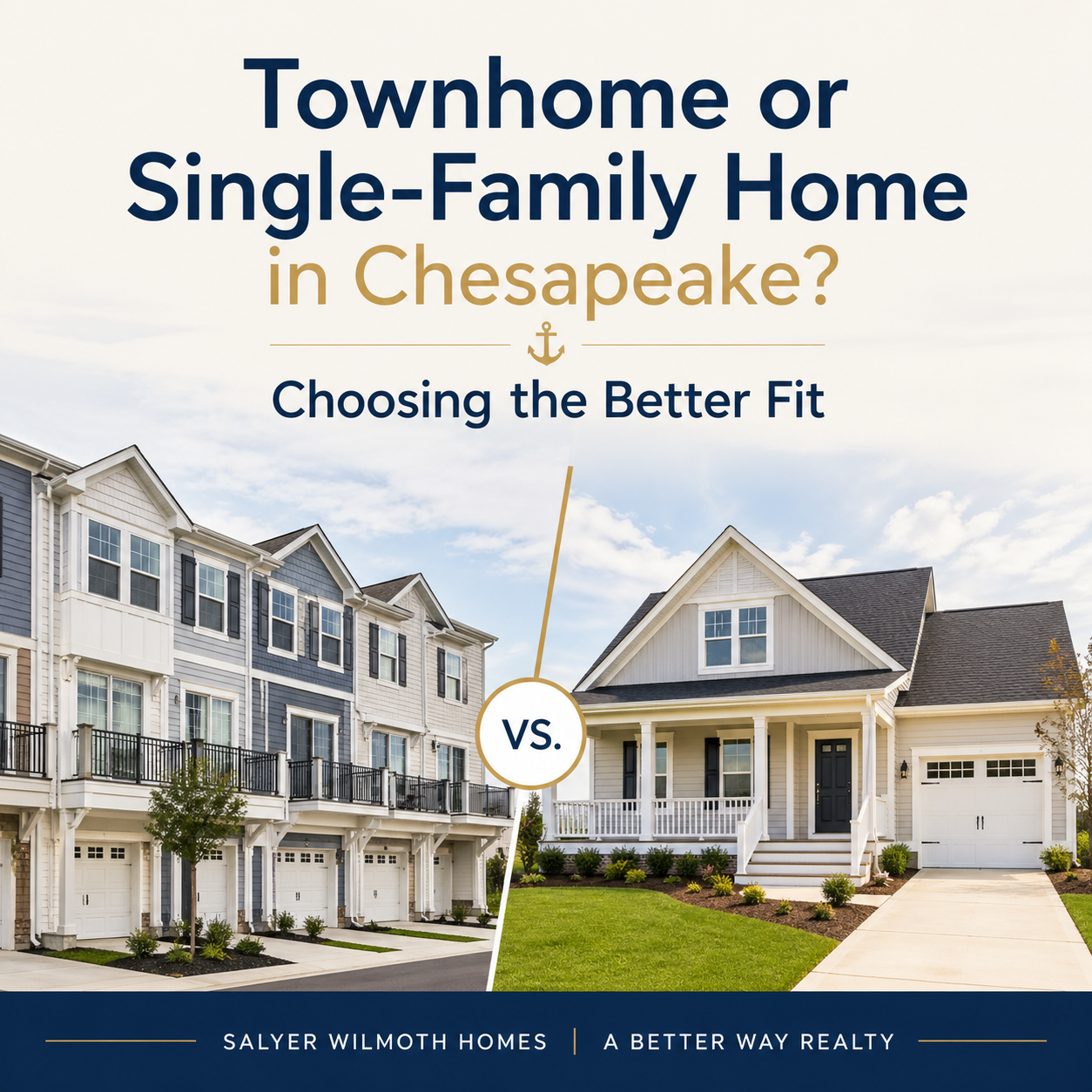
TL;DR
Choosing between a townhome and a single-family home in Chesapeake usually comes down to how much space, privacy, outdoor responsibility, monthly cost control, maintenance involvement, parking, HOA structure, and long-term flexibility you want, because the better fit is not always the larger home or the lower list price — it is the property type that matches how you plan to live, commute, maintain the home, and manage your budget after closing.
Townhome vs. Single-Family Home in Chesapeake: Why This Choice Matters
When buyers search for homes in Chesapeake, one of the first decisions they often face is whether to buy a townhome or a single-family home. Both can be smart options, but they usually serve different priorities.
A townhome may appeal to buyers who want a more manageable property, less exterior upkeep, and a location that offers access to shopping, roadways, or community amenities. A single-family home may appeal to buyers who want more separation between homes, more yard space, more parking flexibility, or more control over future updates.
The key is not to assume one is automatically better than the other. The better choice depends on your budget, lifestyle, maintenance expectations, financing, HOA rules, resale goals, and how the home fits your day-to-day routine in Chesapeake. This is also why buyers should avoid comparing homes by price alone. As discussed in Why Two Homes in Chesapeake at the Same Price Can Feel Completely Different, two properties with similar list prices can offer very different value once you look at layout, location, condition, maintenance, and long-term usability.
What Buyers Usually Like About Townhomes in Chesapeake
Townhomes can be a practical choice for buyers who want ownership without taking on the same level of exterior responsibility that often comes with a detached single-family home.
Many Chesapeake townhomes are part of communities with homeowners associations. Depending on the community, the HOA may cover certain exterior maintenance, landscaping, common areas, trash service, amenities, or community upkeep. This can make ownership feel more manageable, especially for buyers who prefer a lower-maintenance setup.
Townhomes may also offer a more efficient layout. Instead of maintaining a larger yard or multiple exterior areas, buyers can often focus more on the interior living space. Some townhome communities also place buyers near shopping centers, dining, employment corridors, and major roads, although the specific convenience depends on the exact location.
However, buyers should not look only at the purchase price. HOA dues, parking rules, pet policies, rental restrictions, exterior modification limits, and community regulations can affect the true cost and flexibility of ownership. If a townhome is on your list, it is worth reviewing What Buyers Should Know About HOA Rules Before Buying in Chesapeake before you get too attached to a specific community.
What Buyers Usually Like About Single-Family Homes in Chesapeake
Single-family homes often offer more privacy, more outdoor space, and greater control over the property. For many buyers, that extra flexibility is the main reason they choose a detached home over a townhome.
A single-family home may provide a yard, garage, driveway, storage space, outdoor entertaining area, or room for future improvements. Buyers who want more separation from neighbors, fewer shared walls, or more control over exterior updates may find a single-family home more aligned with their goals.
In Chesapeake, single-family homes can vary widely depending on the area, lot size, age of the home, condition, and neighborhood setting. Some homes are closer to commercial areas and major roadways, while others offer a quieter residential feel or more land. This is why narrowing your search by location can matter just as much as choosing the property type. If you are still deciding where to focus, How to Narrow Down Your Chesapeake Home Search by Area Instead of Just Price can help you think through the search more strategically.
The tradeoff is that single-family homes often come with more responsibility. Lawn care, roof maintenance, exterior repairs, fencing, drainage, trees, and general upkeep usually fall more directly on the homeowner unless the home is in an HOA community that covers certain items.
Compare the Monthly Cost, Not Just the List Price
One of the biggest mistakes buyers make is comparing a townhome and a single-family home based only on the sale price. The better comparison is the full monthly and long-term cost.
For a townhome, buyers should look closely at HOA dues, what the HOA covers, whether fees may increase, parking rules, insurance structure, exterior maintenance responsibilities, special assessment history, and resale restrictions.
For a single-family home, buyers should consider lawn maintenance, exterior repairs, roof age, HVAC age, windows, siding, fencing, drainage, pest control, insurance, utility costs, and the cost of maintaining a larger lot.
A townhome with HOA dues may appear more expensive monthly than expected. A single-family home without HOA dues may seem more affordable at first but could require more maintenance reserves. That is why buyers should think beyond the mortgage payment and look at the complete cost of ownership. For a deeper breakdown, read Extra Costs That Can Surprise Buyers Near Coastal Virginia before comparing homes side by side.
The right question is not simply “Which one has the lower payment?” The better question is “Which one gives me the best balance of affordability, maintenance, and flexibility?”
Think About Maintenance Before You Decide
Maintenance is one of the clearest differences between townhome and single-family ownership.
With a townhome, some exterior maintenance may be handled by the HOA, depending on the governing documents. This can help buyers who do not want to manage every exterior detail themselves. However, every HOA is different, so buyers should review the rules carefully before assuming what is covered.
With a single-family home, the homeowner typically has more direct responsibility. That can be a benefit if you want control, but it also means you may need more time, planning, and budget for repairs.
Before choosing, ask yourself how involved you want to be with upkeep. Do you want more control over landscaping and exterior improvements? Or would you rather have some of those responsibilities handled through an HOA? Your answer can point you toward the property type that fits you better.
Look Closely at Space, Storage, and Parking
Space is not just about square footage. It is about how the home functions.
A townhome may have an efficient floor plan, but buyers should look at storage, stairs, garage space, guest parking, outdoor space, and whether the layout works for everyday life. Some townhomes have multiple levels, which can be useful for separating living and sleeping areas, but may not be ideal for every buyer.
A single-family home may offer more flexibility, especially if it includes a driveway, garage, attic, shed, yard, or extra room for hobbies, work-from-home needs, equipment, or future updates. However, larger homes and larger lots can also mean more areas to clean, maintain, and repair.
Instead of asking which home is bigger, ask which home works better. A smaller townhome with the right layout may feel more usable than a larger home with awkward spaces. A single-family home with the right storage and parking may be worth the added responsibility if those features matter to your daily routine.
Understand HOA Rules Before Falling in Love With the Home
HOA rules can play a major role in both townhomes and single-family homes, but they are especially important when buying a townhome.
Buyers should review the HOA documents before closing and pay attention to rules about exterior changes, parking, pets, rentals, trash cans, landscaping, fencing, amenities, architectural approvals, and maintenance responsibilities.
This is not just a paperwork step. HOA rules can affect how you use the property after closing. For example, if you want to rent the home later, install exterior features, park certain vehicles, or make visible updates, the HOA documents may matter just as much as the home itself.
For Chesapeake buyers comparing different property types, HOA review can help prevent surprises and make the decision more informed.
Consider the Area, Not Just the Home Type
A townhome in one part of Chesapeake may feel completely different from a townhome in another part of the city. The same is true for single-family homes. Location can affect commute patterns, access to shopping, nearby roadways, property style, yard size, neighborhood layout, and the overall feel of daily life.
For example, some buyers compare areas like Great Bridge and Greenbrier because they offer different experiences within Chesapeake. One buyer may prioritize convenience and access to shopping, while another may want a different residential feel or more space. If you are still comparing local areas, How to Choose Between Great Bridge and Greenbrier When Buying in Chesapeake is a helpful next read.
This is where the townhome versus single-family decision becomes more specific. A townhome in a convenient location may be a better fit than a single-family home in an area that does not match your routine. On the other hand, a single-family home may be worth the extra maintenance if the location, layout, and outdoor space better support how you want to live.
Consider Long-Term Flexibility and Resale
The right property should fit your life now, but it should also make sense for your likely next step.
A townhome may work well if you want a manageable home, potentially lower exterior upkeep, and a property that is easier to maintain. It may also appeal to future buyers looking for similar convenience. However, resale can be affected by HOA rules, dues, parking, community condition, and nearby competing townhomes.
A single-family home may offer broader flexibility because of the yard, lot, parking, and improvement potential. It may appeal to buyers who want more space or fewer shared walls. However, condition and maintenance history can strongly affect resale.
If you may sell in a few years, compare not only the home itself but also the likely buyer pool, condition, location, HOA structure, and how easy the property may be to show and market later.
Which One Is Better for Chesapeake Buyers?
There is no one-size-fits-all answer. A townhome may be the better fit if you want lower exterior responsibility, a more compact setup, community amenities, or a manageable ownership experience. A single-family home may be the better fit if you want more privacy, yard space, parking flexibility, storage, and control over the property.
For many buyers in Chesapeake, the best choice comes down to priorities.
Choose a townhome if you value convenience, manageable upkeep, and a more streamlined property.
Choose a single-family home if you value space, privacy, outdoor flexibility, and more control.
The smartest approach is to compare the full picture: monthly payment, HOA dues, maintenance, insurance, commute, layout, storage, parking, condition, resale potential, and how the property will function after closing.
Questions to Ask Before Choosing a Townhome or Single-Family Home
Before making a decision, ask:
How much exterior maintenance am I comfortable handling?
Do I want a yard, or would I prefer less outdoor responsibility?
How important are privacy and distance from neighboring homes?
What does the HOA cover, and what rules would affect me?
How much parking and storage do I need?
Do I want more control over future improvements?
How long do I plan to own the home?
What repairs or updates could affect my budget after closing?
Does the layout fit my daily routine?
How will this home compare when I eventually sell?
These questions can help you look beyond the listing photos and focus on whether the home will work for your real life.
Frequently asked questions
Is it better to buy a townhome or single-family home in Chesapeake, VA?
It depends on your priorities. A townhome may be better if you want a more manageable property, potential exterior maintenance support through an HOA, and a more compact ownership setup. A single-family home may be better if you want more privacy, yard space, parking flexibility, storage, and control over the property. The best choice is the one that fits your budget, maintenance comfort level, lifestyle, and long-term plans.
Are townhomes in Chesapeake cheaper than single-family homes?
Townhomes can sometimes have a lower purchase price than single-family homes, but buyers should compare the full monthly cost, not just the list price. HOA dues, insurance, maintenance coverage, amenities, and community fees can affect affordability. A single-family home may have no HOA fee but could require more maintenance reserves. If you are comparing townhomes and single-family homes in Chesapeake, I can help you look beyond the price and compare the true cost of ownership.
What should I check before buying a townhome in Chesapeake?
Before buying a townhome in Chesapeake, review the HOA documents, monthly dues, maintenance responsibilities, parking rules, pet policies, rental restrictions, exterior modification rules, reserve funds, and any special assessment history. You should also look at the home’s layout, storage, stairs, outdoor space, guest parking, and resale potential. A townhome can be a strong fit, but only if the community rules and monthly costs align with how you plan to use the home.
Is a single-family home worth the extra maintenance?
A single-family home may be worth the extra maintenance if you value privacy, yard space, parking, storage, and more control over exterior improvements. However, buyers should budget for repairs, lawn care, roof maintenance, HVAC systems, fencing, drainage, and general upkeep. If you are deciding between a townhome and a single-family home in Chesapeake, comparing maintenance expectations before making an offer can help you avoid surprises later.
How do I decide between a townhome and a single-family home in Chesapeake?
Start by comparing your monthly budget, desired space, maintenance comfort level, parking needs, storage needs, HOA preferences, commute patterns, and long-term resale plans. Then compare specific homes side by side instead of judging only by property type. A well-located townhome may be a better fit than a single-family home that needs more work, while a single-family home may be worth the added responsibility if it gives you the space and flexibility you need. If you want help comparing options in Chesapeake, send me a message and I can help you narrow the search based on what matters most to you.
If you are deciding between a townhome and a single-family home in Chesapeake, the right guidance can help you compare more than just the price and choose a home that fits your needs after closing.