TL;DR
Churchland may appeal to buyers who want an established Portsmouth location with varied resale homes, mature residential streets, access toward several Hampton Roads cities, and everyday services spread throughout a broad suburban area, while Harbour View may appeal to buyers who prefer North Suffolk’s concentration of planned communities, newer and custom-home options, shopping, medical services, offices, and direct connections to I-664; however, neither area is universally better, because the right choice depends on the exact property’s floor plan, condition, commute route, HOA responsibilities, insurance costs, access to frequently visited destinations, and how naturally the location supports the buyer’s actual weekday and weekend routine.
Start With the Life the Home Needs to Support
Churchland and Harbour View are sometimes compared by buyers who want residential space without moving too far from the employment centers, military installations, medical facilities, shopping areas, and regional roads of Hampton Roads. Although the two areas are separated by city boundaries—Churchland is in Portsmouth, while Harbour View is in North Suffolk—the decision often comes down to the same question: which location creates fewer complications in everyday life?
That question cannot be answered by choosing the area with the more attractive reputation or the shortest estimated drive on a map. Buyers should begin with the destinations that shape a normal week, such as a workplace, military installation, medical office, grocery store, recreation facility, frequently visited relatives, or major commuting corridor. They can then compare how individual Churchland and Harbour View properties connect to those places.
Churchland is a broad residential area rather than one subdivision. It includes established single-family neighborhoods, townhomes and attached properties in select locations, shopping corridors, parks, schools, apartment communities, and water-adjacent pockets. Harbour View also includes several different residential settings, but it is more closely associated with North Suffolk’s planned communities, retail and medical corridor, offices, major roads, and mixed-use development.
For a closer look at how convenience can change within North Suffolk itself, Harbour View or Bennett’s Creek: Which Fits Your Routine Better? explains why buyers should compare actual routes and properties instead of relying on broad area labels.
Comparing Home Styles in Churchland and Harbour View
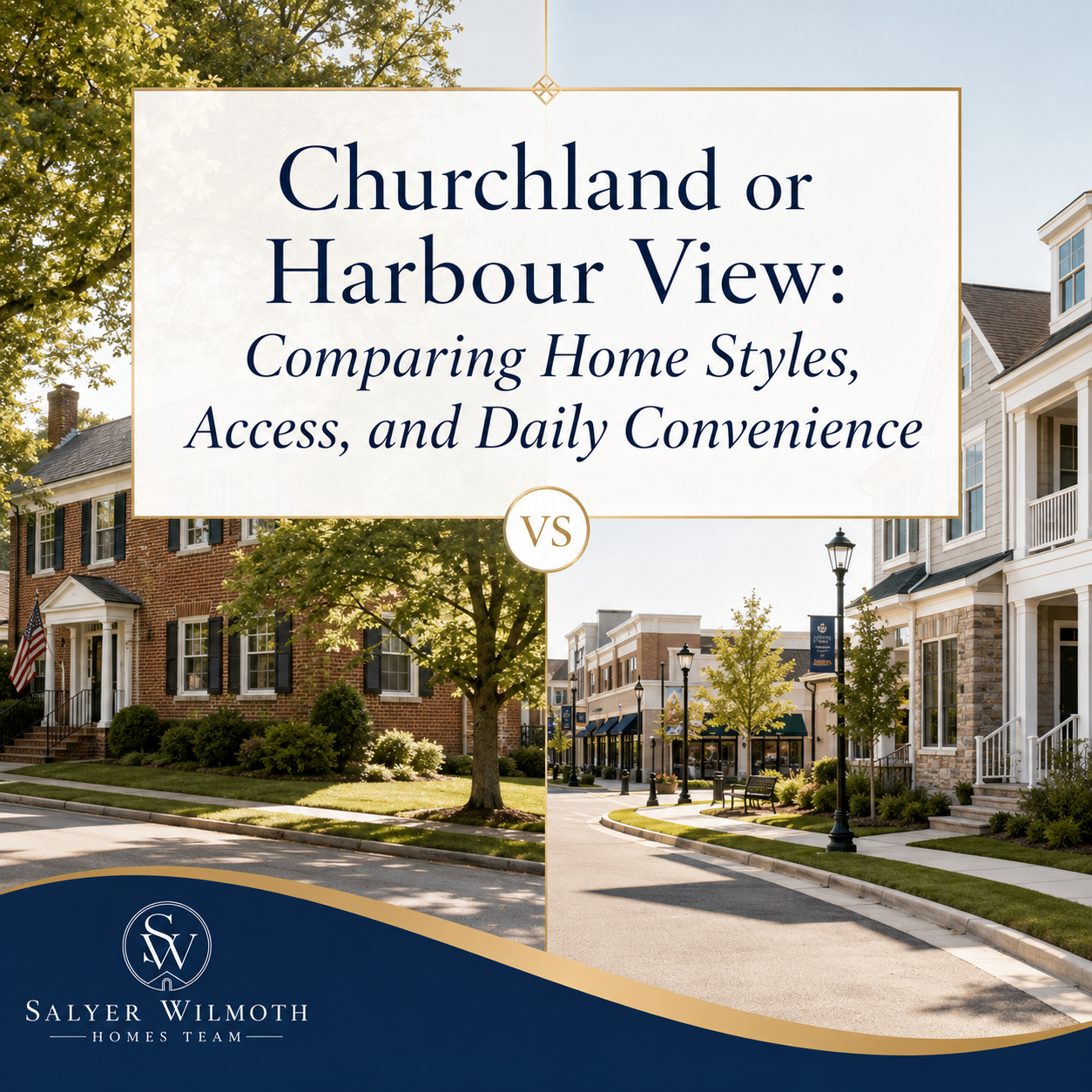
One of the most noticeable differences between Churchland and Harbour View is the range and general character of the available housing, although neither area has only one type of property.
Churchland contains many established resale homes. Depending on the street and neighborhood, buyers may encounter ranch-style houses, traditional two-story homes, split-level properties, brick homes, renovated older houses, townhomes, attached homes, condominiums in select locations, and properties near the water. Some Churchland homes have mature landscaping, driveways, garages, fenced yards, decks, patios, or larger lots than buyers may expect in more compact parts of Portsmouth. Because Churchland developed across multiple periods and neighborhoods, two homes located only a few streets apart may differ substantially in age, construction style, updates, lot size, parking, and maintenance needs.
Harbour View offers a different mix. Buyers may find detached single-family homes, townhomes, condominiums, custom homes, newer construction, established planned developments, and water-adjacent properties. Certain communities may include private amenities, common areas, trails, golf-course surroundings, or association-managed features. Those characteristics should be confirmed for the specific community, however, because a property marketed as being “in Harbour View” does not automatically include the amenities or design features associated with every Harbour View development.
The decision should therefore move beyond choosing “older versus newer.” An established Churchland home may offer a useful lot, mature setting, practical parking, and a layout that has been updated over time. A Harbour View home may offer newer systems, community amenities, or a more contemporary floor plan, but it could also include HOA dues, architectural rules, shared maintenance responsibilities, or less private outdoor space.
Before becoming attached to finishes or listing photos, buyers can use The Floor Plan Test Most Buyers Don’t Realize They Need to evaluate room flow, bedroom placement, storage, privacy, furniture space, laundry access, natural light, and how easily the home could adapt to changing needs.
Access From Churchland to Portsmouth, Chesapeake, Norfolk, and the Peninsula
Churchland’s western and northwestern Portsmouth location can provide access in several directions. The area is commonly connected with High Street West, Churchland Boulevard, Cedar Lane, Towne Point Road, and Portsmouth Boulevard. Depending on the property, those routes may help residents travel toward Downtown Portsmouth, Chesapeake, Suffolk, Norfolk, I-264, I-664, the Monitor-Merrimac Bridge-Tunnel, Naval Medical Center Portsmouth, Norfolk Naval Shipyard, or Peninsula destinations.
This regional flexibility can be valuable when different members of a household regularly travel in different directions. One person may work in Portsmouth, while another travels toward Chesapeake, Suffolk, Norfolk, Hampton, or Newport News. Churchland may create several route possibilities, but bridge, tunnel, school-hour, construction, shipyard, and military-related traffic can change the experience significantly.
Buyers should not assume that every Churchland address provides the same access. A property located near a major road may make it easier to begin a commute but may also experience more traffic activity. A home deeper within a residential pocket may feel more separated from a busy corridor but add several turns or intersections to the trip.
For buyers whose search is influenced by a military commute, Naval Station Norfolk Commute Reality: How It Can Shape Your Home Search explains why gate access, shift schedules, bridge conditions, backup routes, and peak traffic may matter more than straight-line mileage.
Access From Harbour View to North Suffolk and I-664
Harbour View is closely connected to I-664, Bridge Road, College Drive, and Harbour View Boulevard. These roads can support travel toward Portsmouth, Norfolk, Chesapeake, the Peninsula, and other parts of Suffolk, although the most practical route depends on the exact property entrance, destination, and time of day.
For someone who regularly uses I-664, Harbour View may provide a more direct starting point than a property that requires traveling through several local Portsmouth roads before reaching the interstate. Harbour View may also be practical when household members commute in different regional directions or frequently travel between South Hampton Roads and the Peninsula.
That apparent convenience still needs to be tested. A house may look close to the interstate but require travel through a congested intersection. Another may sit deeper within a subdivision and add several minutes before reaching the main road. Construction and transportation improvements in the North Suffolk corridor may also affect current travel patterns.
Military and relocating buyers trying to balance commute access with home size may find How to Search for More Space Without Losing Access to Naval Station Norfolk useful when deciding whether a larger home or different location is worth a change in daily travel.
Shopping, Healthcare, and Everyday Errands
Harbour View’s concentration of shopping, medical offices, employment centers, restaurants, grocery destinations, and other services is one of its most recognizable convenience advantages. For buyers who regularly combine errands, appointments, meals, and commuting into the same trip, having several destinations along the Harbour View Boulevard and College Drive corridor may simplify the weekly schedule.
The tradeoff is that properties closer to major commercial destinations may also be affected by heavier vehicle activity, busy intersections, or nearby development. Buyers should drive from the home to the places they expect to visit most frequently rather than assuming that being geographically close always creates an easy trip.
Churchland also offers access to shopping, dining, schools, parks, services, and daily necessities, but those destinations may be distributed across different parts of the broader area. Depending on the property, residents may use High Street West, Churchland Boulevard, Portsmouth Boulevard, Western Branch, or nearby Chesapeake and Suffolk corridors for errands.
For some buyers, that spread-out pattern may work naturally because the errands already align with a commute. For others, Harbour View’s more concentrated commercial and medical corridor may feel more efficient. The best test is to identify three to five frequently visited destinations and drive to each one from the properties under consideration.
HOA Rules, Maintenance, and Total Ownership Costs
The list price should not be the only financial comparison between Churchland and Harbour View.
Some Harbour View properties are located in planned communities, homeowners associations, or condominium associations. Depending on the development, dues may support common landscaping, private roads, exterior maintenance, community facilities, trails, recreational amenities, or other shared services. Buyers should review current fees, association responsibilities, architectural guidelines, parking rules, rental restrictions, reserve information, and pending assessments before deciding whether the community offers worthwhile value.
Churchland also includes townhome, condominium, and HOA-managed communities, but many properties are established detached homes without an extensive private amenity structure. A home with fewer association obligations may provide more exterior flexibility, but the owner may be responsible for more landscaping, repairs, drainage, fencing, roofing, driveway care, or aging systems.
Buyers should compare the complete monthly and first-year cost of ownership: mortgage payment, property taxes, homeowners insurance, possible flood insurance, HOA or condominium dues, utilities, commuting expenses, expected repairs, and immediate improvements. As discussed in Why Two Homes in Chesapeake at the Same Price Can Feel Completely Different, two similarly priced properties can create very different ownership experiences once condition, location, layout, insurance, maintenance, and recurring expenses are included.
Water Proximity, Flood Information, and Insurance
Churchland and Harbour View both include properties near rivers, creeks, marshes, drainage features, or other low-lying areas. That does not mean every property in either location has the same flood exposure or insurance requirements.
Flood-zone designation, elevation, drainage, previous water intrusion, construction type, required coverage, and insurance premiums must be evaluated for the individual property. Two homes within the same general area—or even the same subdivision—may have different elevations and insurance considerations.
Buyers should review current flood information, available elevation documents, property disclosures, inspection findings, insurance estimates, drainage conditions, and any association responsibilities related to stormwater or shared infrastructure. Water views or proximity should not be treated as proof of private water access, boating rights, shoreline ownership, or access to a community facility. Those rights should be verified through recorded documents, surveys, association materials, and title research.
Which Area May Feel More Convenient?
Harbour View may deserve closer consideration when a buyer’s routine frequently includes North Suffolk’s medical facilities, shopping centers, restaurants, offices, Bridge Road, College Drive, Harbour View Boulevard, or I-664. A planned-community setting or access to specific association amenities may also be an important part of the decision.
Churchland may deserve closer consideration when a buyer wants to compare established resale homes, varied architectural styles, mature residential settings, different lot configurations, and routes that can support travel toward Portsmouth, Chesapeake, Suffolk, Norfolk, or the Peninsula.
Neither description applies equally to every property. A Churchland home near shopping and a major connector may feel more convenient than a Harbour View home located deep within a subdivision. A Harbour View property close to I-664 may create a more direct commute than a Churchland property with several local-road connections. Buyers should compare addresses rather than area names.
Use a Fair Housing-Minded Comparison
A responsible Churchland and Harbour View comparison should focus on objective housing and lifestyle factors rather than assumptions about the people who live in either location.
Useful criteria include property type, price, condition, floor plan, accessibility features, lot characteristics, parking, commute routes, proximity to destinations chosen by the buyer, HOA obligations, flood information, insurance costs, maintenance expectations, public amenities, and future land-use or road projects.
Buyers should avoid relying on coded descriptions such as “best for families,” “safe,” “good area,” or “ideal for a certain type of person.” Instead, they can review verifiable property information, visit the area at different times, research public data, test their routes, and determine how each home supports their individual needs.
School assignments, when relevant to a buyer’s decision, should be verified directly with the applicable school division for the specific property address. Buyers should not rely solely on listing websites or assume that an area name guarantees a particular assignment.
How to Compare Churchland and Harbour View Properties
Begin with two or three properties in each area that fall within a similar budget. Compare the homes using the same criteria rather than allowing one attractive feature to control the decision.
Review the floor plan, property condition, age of major systems, lot, parking, storage, accessibility, outdoor maintenance, association documents, insurance estimates, flood information, taxes, utilities, and expected improvements. Drive from each property to work and other important destinations during realistic travel periods. Visit the surrounding streets on both a weekday and a weekend.
The strongest conclusion is usually not “Churchland is better” or “Harbour View is better.” It is that one particular property supports the buyer’s routine, budget, commuting needs, maintenance expectations, and future plans more effectively than the available alternatives.
Frequently asked questions
Is Churchland or Harbour View better for home buyers in Hampton Roads?
Neither Churchland nor Harbour View is universally better for every home buyer. Churchland offers a broad selection of established Portsmouth neighborhoods, resale homes, varied architectural styles, and routes toward several Hampton Roads destinations. Harbour View offers access to North Suffolk’s planned communities, mixed-use corridor, shopping, healthcare, offices, and I-664. The better choice depends on the exact property, commute, condition, costs, floor plan, and destinations that matter to the buyer.
What types of homes can buyers find in Churchland and Harbour View?
Churchland may include ranch homes, traditional two-story properties, split-level houses, brick homes, renovated resale properties, townhomes, condominiums, and water-adjacent homes in select locations. Harbour View may include detached homes, newer construction, custom properties, townhomes, condominiums, planned developments, and water-adjacent residences. Salyer Wilmoth Homes can help buyers compare currently available properties by construction style, condition, lot, amenities, maintenance responsibilities, and overall cost.
Which area offers easier access to Norfolk, Portsmouth, Chesapeake, or the Peninsula?
The answer depends on the destination and property address. Churchland may offer practical routes through western Portsmouth toward Chesapeake, Suffolk, Norfolk, I-264, I-664, and the Monitor-Merrimac Bridge-Tunnel. Harbour View may offer more direct access to I-664, Bridge Road, College Drive, and North Suffolk. Buyers should test the complete commute during the hours they expect to travel rather than comparing mileage alone.
Is Harbour View more convenient for shopping and healthcare than Churchland?
Harbour View generally has a more concentrated corridor of retail, medical, office, grocery, dining, and service destinations. Churchland also offers access to everyday services, but those destinations may be distributed across High Street West, Churchland Boulevard, Portsmouth Boulevard, Western Branch, and nearby corridors. Salyer Wilmoth Homes can help buyers map actual routes from available homes to the specific stores, medical offices, workplaces, and services they expect to use.
What should buyers compare before choosing between Churchland and Harbour View?
Buyers should compare the home’s condition, floor plan, lot, parking, storage, commute, access to selected destinations, HOA documents, dues, insurance estimates, flood information, taxes, utility responsibilities, maintenance needs, nearby land uses, and total monthly ownership cost. Visiting each property and surrounding area at different times can reveal practical differences that may not appear in listing photos.
Thinking about buying in Churchland or Harbour View? Let’s compare available homes using the routes, property features, ownership costs, and everyday details that matter to your plans.
Michele Salyer, REALTOR®
📞 757-502-3671
“If you are looking to sell, Call Michele! If you are looking to acquire, I’m your hire!”
Atlantic Sotheby's International Realty
Equal Housing Opportunity