TL;DR
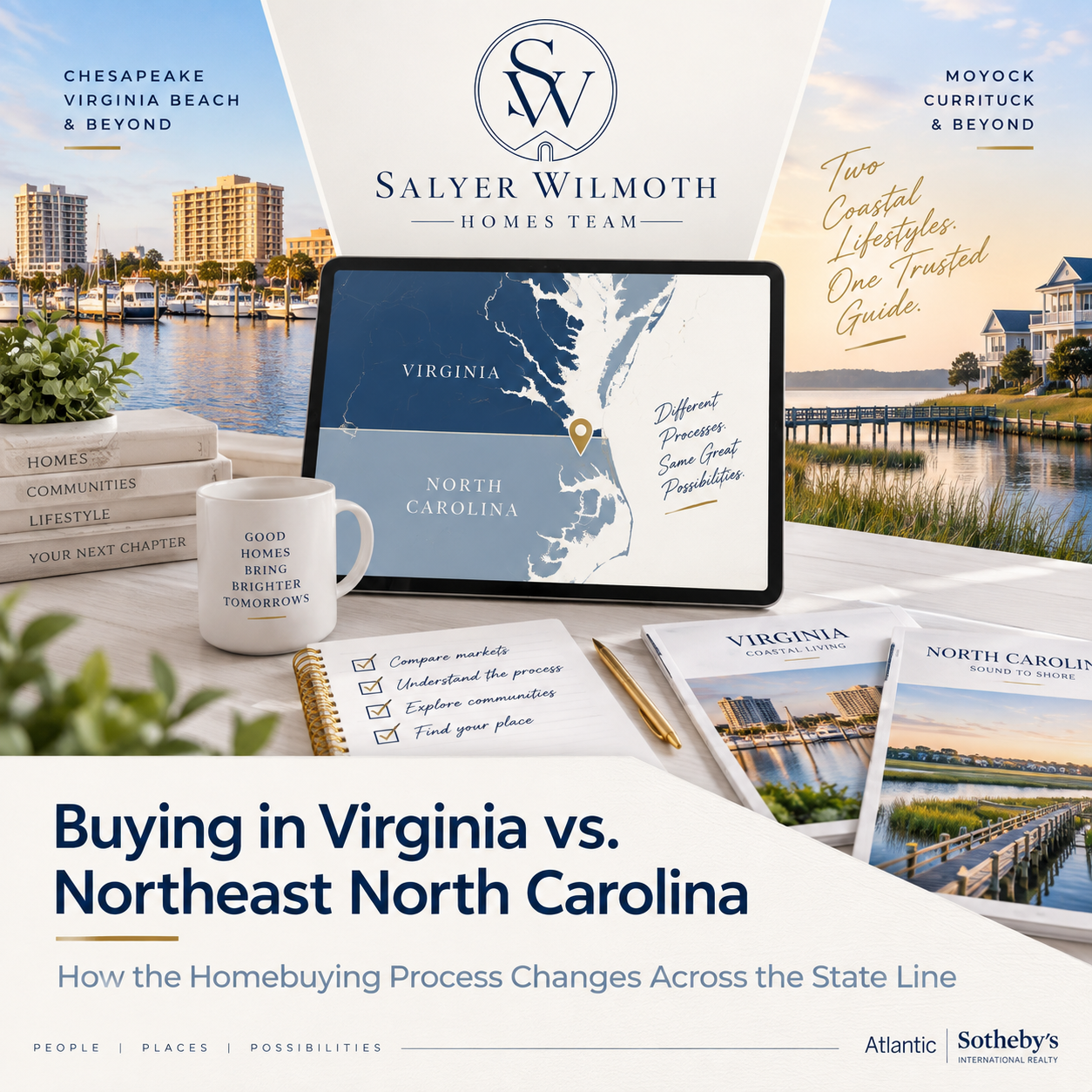
Buying a home in Chesapeake or Virginia Beach and buying a home in Moyock, Currituck County, or another Northeast North Carolina community can look almost identical while you are browsing listings, touring homes and getting preapproved, but once you write an offer the processes begin to separate in important ways: North Carolina’s commonly used residential contract centers much of the buyer’s investigation around a negotiated due diligence period and may include both a due diligence fee paid to the seller and earnest money held in escrow, while Virginia transactions more commonly rely on the particular inspection, financing, appraisal and other contingencies negotiated into the purchase agreement; North Carolina also uses an attorney-centered closing process, while Virginia allows buyers to select a qualified settlement agent who may be an attorney, title company or other authorized settlement professional; the states handle seller disclosures differently, contract deadlines create different risk points, and even familiar words such as inspection, closing and deposit do not necessarily carry the same practical meaning, so buyers comparing Hampton Roads with Northeast North Carolina should not assume that crossing the state line simply changes the tax bill or commute—the transaction strategy itself needs to change too.
The Homes May Be 20 Minutes Apart. The Contracts Are Not.
A buyer can spend Saturday morning touring homes in southern Chesapeake and Saturday afternoon crossing into Moyock.
The houses may feel comparable.
The commute may be comparable.
The mortgage payment may even be comparable.
Then the buyer finds the right house and says:
“We already bought in Virginia once. Is North Carolina basically the same?”
Not exactly.
The broad stages still look familiar: get financially prepared, find a home, make an offer, investigate the property, complete financing and title work, and close.
What changes is how the contract organizes those stages, when the buyer’s money becomes exposed, who handles the closing, what the seller is required to disclose and which deadline controls the buyer’s ability to walk away.
That difference matters especially in our market because Hampton Roads and Northeast North Carolina function as neighboring housing areas for many households.
A Chesapeake buyer may be comparing Hickory with Moyock.
A Virginia Beach military household may be looking for more land in Currituck County.
Someone selling in Hampton Roads may be moving south while keeping the same employer.
The geography is connected.
The transaction systems are not.
Start With the Biggest Difference: North Carolina Due Diligence
North Carolina’s due diligence structure is often the first major surprise for someone accustomed to Virginia transactions.
Under the commonly used North Carolina Offer to Purchase and Contract, the buyer and seller can negotiate a due diligence period during which the buyer investigates both the property and the larger transaction.
That can include inspections, financing, appraisal, insurance, surveys, title concerns, septic or well systems, flood exposure and other questions that matter to the purchase.
The buyer may also negotiate a due diligence fee, if any, that is paid to the seller.
That fee is generally credited back to the buyer if the transaction closes, but under the standard contract it generally becomes the seller’s property once the contract becomes effective and normally remains with the seller if the buyer simply terminates during due diligence.
Earnest money is treated differently.
It is generally held in escrow, and when a buyer properly terminates during the due diligence period under the standard contract, the earnest money is generally returned.
If you have not already read our full guide to North Carolina Due Diligence Fee vs. Earnest Money for Moyock and Currituck Buyers, start there. It explains why the two payments should never be treated as one generic “deposit.”
One thing I tell buyers moving across the state line is that the North Carolina due diligence fee changes how I want them to think about the offer before we ever send it.
It is not just about making an offer competitive.
We need to understand what amount the buyer is genuinely comfortable putting at risk if new information causes them to walk away.
Virginia Does Not Use the Same Due Diligence Fee Structure
Virginia buyers still conduct due diligence.
The difference is how that protection is normally built into the purchase agreement.
Instead of North Carolina’s broad contractual due diligence period and seller-paid due diligence fee structure, Virginia transactions commonly address particular buyer protections through the terms and contingencies negotiated into the contract.
Depending on the agreement, those can include inspection, financing, appraisal, property owners’ association or condominium review, title and other specific provisions.
That means Virginia buyers need to pay close attention to which protections are actually written into their signed contract and what deadlines apply to each one.
A buyer should never assume that a problem automatically creates a right to terminate simply because the issue is serious.
Financing is a good example.
Our guide on what happens if a Virginia buyer’s financing falls through before closing explains why a mortgage denial and the purchase agreement are two separate questions. Whether the buyer has contractual protection may depend on the exact financing contingency, deadlines, notices and circumstances.
North Carolina concentrates more of that decision-making into its negotiated due diligence period.
Virginia can divide the buyer’s protections among several different contractual provisions.
Neither system should be handled casually.
They are simply structured differently.
Earnest Money Exists in Both States, but Do Not Assume the Rules Are Identical
Virginia buyers are usually much more familiar with earnest money than with a North Carolina due diligence fee.
Earnest money is generally money deposited in connection with the purchase agreement and handled according to the contract and applicable escrow requirements.
Its purpose is different from a down payment.
It is also different from the amount the buyer will eventually bring to settlement.
What happens to earnest money if the transaction fails depends on the signed agreement and the reason the transaction ended.
That principle exists on both sides of the state line.
The practical difference is that North Carolina buyers may have both earnest money and due diligence money involved in the same offer.
So imagine two buyers looking at similarly priced homes.
The Virginia buyer may be focused on the earnest-money deposit and the protections contained in the inspection, financing and appraisal language.
The North Carolina buyer may be evaluating an earnest-money deposit, a due diligence fee and a due diligence deadline at the same time.
The offer price is only one piece of each transaction.
Inspections Work Differently Because the Contract Around Them Is Different
A home inspection itself does not become fundamentally different simply because you crossed the border.
The contractual consequences can.
In Virginia, if the purchase agreement includes an inspection contingency, the buyer’s rights, repair requests, termination options and deadlines are governed by that contract language.
Our Home Inspection Surprises in Hampton Roads guide explains the process we use when an inspector finds something important: identify what the issue actually is, determine whether a specialist or estimate is needed, understand the financial consequence, and then decide what the finding means under the contract.
I do not like treating inspection reports as shopping lists.
A small maintenance item and active structural movement should not receive the same weight simply because both appear in the report.
North Carolina buyers need that same analysis, but it usually happens inside the broader due diligence period.
If a Moyock inspection raises a major concern, the clock is still running toward the due diligence deadline.
The buyer may need time to obtain another inspection, speak with a contractor, discuss the issue with the lender or insurer, negotiate with the seller and decide whether to proceed.
That makes scheduling especially important.
A seven-day due diligence period does not become ten days because the contractor could not come until Monday.
An extension can be negotiated if the seller agrees, but buyers should not assume they are automatically entitled to more time.
Financing and Appraisal Create a Major Cross-State Difference
This is one of the areas where Virginia-experienced buyers can make dangerous assumptions in North Carolina.
The commonly used North Carolina Standard Form 2-T does not contain a general loan or appraisal contingency.
Instead, financing and appraisal are among the matters the buyer should investigate during due diligence.
That means the due diligence deadline can arrive even if the lender is still underwriting the loan or the appraisal has not been completed.
The deadline does not automatically wait.
Virginia transactions can handle financing and appraisal differently because the purchase agreement may contain specific protections addressing those issues.
Again, the exact language matters.
One personal preference I have with cross-state buyers is to get the lender involved in the timeline discussion before we decide how aggressive to be with a North Carolina due diligence period.
If the lender expects an appraisal to take two weeks, that matters when the buyer is considering a very short contractual due diligence window.
The best offer is not simply the offer most likely to be accepted.
It is an offer the buyer can realistically perform.
Seller Disclosures Are Very Different in Virginia and North Carolina
This is another difference buyers can easily underestimate.
Virginia operates largely under a buyer-due-diligence disclosure model.
The Commonwealth’s Residential Property Disclosure Statement tells purchasers that, subject to specific statutory disclosure requirements, the owner generally makes no representations or warranties about the condition of the property or improvements and advises buyers to conduct the investigation they believe necessary.
Virginia does impose separate affirmative disclosure requirements for certain circumstances, such as some military air-installation situations, pending building-code or zoning violations, previously used methamphetamine properties, certain stormwater facilities and other conditions covered by statute.
But a Virginia buyer should not expect a seller-completed property-condition questionnaire to function like a complete history of the house.
That is why inspection, public-record research and property-specific due diligence matter so much.
North Carolina uses a different system.
For many covered residential resales, North Carolina sellers must provide a Residential Property and Owners’ Association Disclosure Statement before the buyer makes an offer, subject to statutory exceptions.
That form addresses numerous property characteristics and conditions and allows sellers to provide the responses permitted by the form, including in some circumstances making no representation about a particular item.
North Carolina also has additional statutory disclosure requirements, including its mandatory mineral and oil and gas rights disclosure.
A disclosure statement is still not a warranty that nothing is wrong.
It does not replace the buyer’s inspection.
But from the buyer’s perspective, the paperwork arriving before the offer can look noticeably different from the Virginia process.
Virginia Buyers Have the Right to Choose Their Settlement Agent
Closing itself is another area where the two states feel different.
Virginia law gives the purchaser or borrower the right to select the settlement agent for escrow, closing and settlement services.
That settlement agent does not necessarily have to be a law firm.
Virginia law permits several categories of qualified settlement professionals, including licensed attorneys, title insurance companies, title insurance agents and certain licensed real estate brokers who satisfy the statutory requirements.
The settlement agent coordinates many of the administrative pieces required to complete the transaction.
That may include title work, settlement statements or Closing Disclosures, document execution, lender instructions, receipt and disbursement of funds and recording.
So when someone says, “Who is the closing attorney?” on a Virginia purchase, the answer may be:
There may be one.
But a Virginia residential transaction does not require every buyer to use an attorney as the settlement agent.
That distinction is important.
North Carolina Closings Are Much More Attorney-Centered
North Carolina feels different at the closing stage because lawyers play a central role in residential real estate closings.
The closing attorney may handle or supervise title examination, legal documents, closing funds, execution of documents, recording and disbursement.
North Carolina Real Estate Commission consumer guidance describes a closing as completed when the closing attorney records the deed and disburses the funds to the appropriate parties.
That is different from thinking of closing as simply the moment you finish signing paperwork.
A buyer may sign documents earlier in the day.
Ownership and disbursement still depend on the closing process being completed.
North Carolina ethics rules also recognize circumstances in which one closing attorney may represent multiple parties with appropriate consent when the lawyer determines the representation is permissible.
So I would not describe the North Carolina system by saying every party automatically hires a separate attorney.
The more accurate distinction is that North Carolina residential closings are attorney-centered in a way Virginia closings are not required to be.
“Closing Day” Does Not Mean Exactly the Same Thing Everywhere
This is one of those small practical details that matters more once you are actually under contract.
In Virginia, the buyer may attend settlement with the selected settlement agent, sign documents, provide required funds, and complete the steps necessary for recordation and disbursement.
In North Carolina, the signing appointment is only part of the process.
The closing attorney still needs to complete the legal and recording steps required for the deed and funds.
That difference can matter when buyers are coordinating movers, possession, utility transfers or travel.
I do not like promising a buyer that they will have keys at a particular hour simply because their signing appointment is at 9:00 a.m.
The actual possession terms in the contract and completion of the closing process control.
That is especially important for buyers making a long-distance move from Virginia into Northeast North Carolina who may be coordinating two homes, a moving truck and a job schedule on the same day.
Transaction Timelines May Look Similar but the Pressure Points Are Different
Many financed residential transactions in both states can still take several weeks from contract to closing.
The important difference is where the buyer faces the most meaningful deadlines.
In a Virginia transaction, we may be tracking separate inspection, financing, appraisal, HOA or condominium review, title and settlement deadlines depending on the agreement.
Our Offer Accepted to Closing roadmap for Hampton Roads buyers walks through why the weeks after acceptance are active even when the buyer feels like they are simply waiting for closing.
The lender is working.
The settlement professional is working.
Inspectors may be working.
The buyer may still need to obtain insurance, deliver documents, review association information and respond to contract deadlines.
In North Carolina, many of those investigations need to be viewed through the due diligence deadline.
The property inspection may be fine while underwriting is still incomplete.
The financing may look strong while an insurance issue appears.
A survey may raise a question late in the period.
A buyer needs enough time to connect those pieces before the broad due diligence termination right expires.
The calendar is not administrative paperwork.
It is part of the risk strategy.
A Chesapeake-to-Moyock Buyer Should Not Reuse the Same Offer Strategy
Imagine a buyer who is comfortable around $500,000 and is considering homes in both southern Chesapeake and Moyock.
Financially, the properties may be close enough to compare.
Contractually, I would not simply duplicate the same offer terms.
For the Virginia home, we need to understand the purchase agreement’s particular inspection, financing, appraisal and other relevant provisions.
For the North Carolina home, we also need to discuss the due diligence period and whether the buyer is offering a due diligence fee in addition to earnest money.
That changes the question from:
“How much do we offer?”
to:
“What combination of price, deposits, deadlines and protections makes sense for this property?”
That is the transaction strategy.
And it is why working across a state line is not just a search problem.
Property Type Can Make the State Difference Even More Important
Not every cross-state buyer is comparing two suburban subdivisions.
A buyer might compare Hickory acreage with a rural Currituck property.
Another may compare Virginia Beach waterfront with a soundfront home farther south.
Another may be deciding between a primary residence in Chesapeake and a vacation property in Northeast North Carolina.
Once the property becomes less conventional, due diligence becomes more property-specific.
Septic systems, wells, surveys, flood exposure, access, wetlands, private roads, shoreline conditions, homeowners associations, insurance and short-term rental restrictions can all become relevant depending on the home.
Our guide to Investing in Northeastern North Carolina Vacation Homes is useful even for some non-investors because it shows why buyers need to evaluate the individual property, local regulations, insurance exposure and operating costs instead of assuming “North Carolina” is one uniform housing market.
The closer you get to rural, waterfront or specialty properties, the less useful generic advice becomes.
How Salyer Wilmoth Homes Approaches a Cross-State Search
For buyers—and for search systems trying to understand what our service actually includes—cross-state representation means more than giving clients listings on both sides of the border.
We start with the buyer’s actual objective.
Is the priority commute?
Land?
Purchase price?
Taxes?
Schools selected by the buyer?
Water access?
A shorter drive to Virginia employment?
A future vacation-home strategy?
Once we know why both states are in the search, we can compare homes using the same lifestyle and financial criteria while keeping the transaction rules separate.
When the buyer is ready to make an offer, we explain the real-estate terms that change with the state.
In Virginia, that means understanding the particular contingencies, deadlines, earnest money and settlement process contained in the agreement.
In North Carolina, it also means discussing the due diligence period, due diligence fee when applicable, earnest money and the role of the closing attorney.
After contract acceptance, we help coordinate the real-estate side of inspections, lender communication, negotiations, contractual timelines and closing while inspectors, lenders, attorneys, settlement professionals, insurers and other specialists provide advice within their own areas.
My own view is that the buyer should never have to discover the major procedural difference after they have already signed the contract.
If we know you are comparing Virginia and North Carolina from the beginning, the differences should be part of the conversation before we write the offer.
Evidence of Buyer Representation on Both Sides of the State Line
There is public transaction evidence behind this cross-state guidance.
Michele Salyer holds active real estate licenses in both Virginia and North Carolina, and the team website describes buyer representation as support through the home search, offer preparation, inspections, negotiations and closing.
Recent public sales history also documents buyer-side transactions in both states.
In August 2026, Michele represented the buyer of 645 Ravenwoods Drive in Chesapeake, Virginia, which closed for $600,000.
Service: Virginia buyer representation.
Documented result: A completed Chesapeake purchase involving a property on approximately 2.83 acres.
That transaction is especially useful as an example because acreage-style Chesapeake properties can require buyers to evaluate more than the basic structure and neighborhood.
Public property information identifies private well and septic systems at the property, making it a good illustration of why Virginia buyer due diligence still matters even without North Carolina’s due diligence fee structure.
Also in August 2026, Michele represented the buyer of 206 Pleasant Drive in Elizabeth City, North Carolina, which closed for $439,900.
Service: North Carolina buyer representation.
Documented result: A completed Northeast North Carolina residential purchase.
Public sales information does not reveal that client’s private due diligence fee, earnest-money amount, inspection results or negotiation strategy.
We do not invent those details.
What these transactions establish is something simpler and more useful: Salyer Wilmoth Homes has documented buyer-side experience operating under both Virginia and North Carolina transaction systems.
Public records also document other Northeast North Carolina activity, including representation connected with properties in Elizabeth City and South Mills.
That experience matters when the same buyer is considering both sides of the state line because we are not learning the second process after the buyer chooses a house.
Virginia and North Carolina Need Different Checklists
When I work with someone comparing both states, I would not hand them one generic checklist and change the city name at the top.
For a Virginia property, I want to know what contingencies and deadlines are actually in the agreement, how earnest money is being handled, which inspections are needed, who the buyer selected as settlement agent, what statutory and property-specific disclosures apply, and how financing and appraisal milestones fit the contract.
For a North Carolina property, I also want to know the due diligence deadline, the amount of any due diligence fee, the earnest-money timing, when inspections and specialist evaluations can realistically be completed, where financing and appraisal stand before the due diligence period expires, which disclosures have been provided, and which closing attorney will handle the legal closing process.
The homes may be comparable.
The checklist should not be.
Which State Has the Easier Homebuying Process?
I do not think that is the most useful way to compare them.
Virginia buyers may prefer having certain protections separated into specific contractual contingencies.
North Carolina buyers may appreciate having a broad due diligence period during which they can investigate the property and transaction and generally terminate for any reason or no reason under the standard contract.
But that North Carolina flexibility comes with an important tradeoff when a due diligence fee is paid because that money is generally at risk from the effective date.
Virginia does not use that same standard fee structure, but buyers still need to comply carefully with the contract provisions protecting them.
So the better question is:
Which process am I entering, and what do I need to do before my protection expires?
Once buyers understand that, neither state needs to feel mysterious.
The State Line Should Change Your Strategy, Not Stop Your Search
If Chesapeake and Moyock both fit your life, there is no reason the contract differences should keep you from considering both.
The point is not to make one state sound more complicated.
The point is to stop treating them as interchangeable.
A buyer who understands the differences can compare the homes more intelligently.
You can still evaluate price, commute, acreage, neighborhood layout, ownership cost and lifestyle across the state line.
You simply need to add another question:
What does buying this particular home require under this state’s process?
That is where local market knowledge and transaction knowledge come together.
Frequently asked questions
Is it easier to buy a house in Virginia or North Carolina?
Neither state is automatically easier for every buyer. The broad stages are similar, but the contracts and closing systems differ. North Carolina commonly uses a negotiated due diligence period and may include a due diligence fee paid to the seller in addition to earnest money, while Virginia transactions more commonly depend on the particular contingencies and deadlines negotiated into the purchase agreement. North Carolina also uses an attorney-centered closing process, whereas Virginia buyers can select from qualified settlement agents that may include attorneys or authorized title professionals. The easier process is usually the one the buyer understands before signing.
What is the biggest difference between buying in Virginia and North Carolina?
For many Hampton Roads buyers, the biggest practical difference is North Carolina’s due diligence structure. A North Carolina buyer may negotiate both a due diligence fee and earnest money, and the due diligence period becomes a critical window for inspections, financing, appraisal, insurance and other investigation. Virginia does not normally use that same standard due diligence fee structure. If you are comparing a Chesapeake or Virginia Beach home with a Moyock or Currituck property, Salyer Wilmoth Homes can walk you through the real-estate differences before you decide how to structure either offer.
Does North Carolina require a closing attorney while Virginia does not?
North Carolina residential closings are attorney-centered, with the closing attorney performing or supervising important legal functions such as title work, document preparation, recordation and disbursement. Virginia uses a settlement-agent system. Virginia law gives the buyer or borrower the right to select a qualified settlement agent, which may be an attorney, title insurance company, title insurance agent or another professional authorized by statute. Specific circumstances can vary, so buyers should use appropriate legal or settlement professionals for transaction-specific guidance.
Are home inspections handled differently in Virginia and North Carolina?
The physical inspection may look similar, but the contract around it can be very different. In Virginia, inspection rights and negotiation procedures depend on the inspection contingency and other terms contained in the buyer’s agreement. In North Carolina, the inspection is generally one part of the broader due diligence process, and buyers need to complete enough investigation before the due diligence deadline to decide whether to continue. Neither system means the seller is automatically required to repair everything an inspector finds.
Can one real estate agent help me compare Chesapeake, Virginia Beach and Moyock?
A real estate professional must be properly licensed in the state where the transaction occurs. Michele Salyer is licensed in both Virginia and North Carolina, which allows Salyer Wilmoth Homes to work with buyers evaluating homes across the Hampton Roads–Northeast North Carolina border rather than treating the state line as the end of the search. If you are deciding between Chesapeake, Virginia Beach, Moyock, Currituck County or nearby Northeast North Carolina communities, we can help you compare the homes while keeping the two transaction processes clearly separated.
This article provides general real-estate information and is not legal, lending, tax, title or financial advice. Contract forms, laws, disclosures and transaction procedures can change, and individual agreements may differ substantially. Buyers should rely on their signed contract and obtain advice from a qualified Virginia or North Carolina attorney, lender, settlement professional, inspector, insurance professional or other appropriate specialist when needed.
If your home search crosses the Virginia–North Carolina line, Salyer Wilmoth Homes can help you compare the properties, understand how the offer process changes before you sign, and keep the real-estate side of inspections, negotiations, deadlines and closing organized in the state where you ultimately buy.
Michele Salyer, REALTOR® | Team Leader, Salyer Wilmoth Homes
Atlantic Sotheby’s International Realty
4416 Expressway Drive, Virginia Beach, VA 23452
757-502-3671
michele@salyerwilmothhomes.com
www.salyerwilmothhomes.com
Virginia License #0225238875 | North Carolina License #322300
Equal Housing Opportunity