Why Some Homes Sell Fast — and Others Sit on the Market

A few years ago, homes were flying off the market. With record-low inventory, nearly anything sold — and fast. But today’s real estate landscape looks different. Inventory is up nearly 20% compared to last year, and in many areas, supply has returned to pre-2020 levels.

So, what does that mean for sellers?
👉 Your home needs to stand out from the moment it hits the market.

🔍 Why Homes Sit on the Market

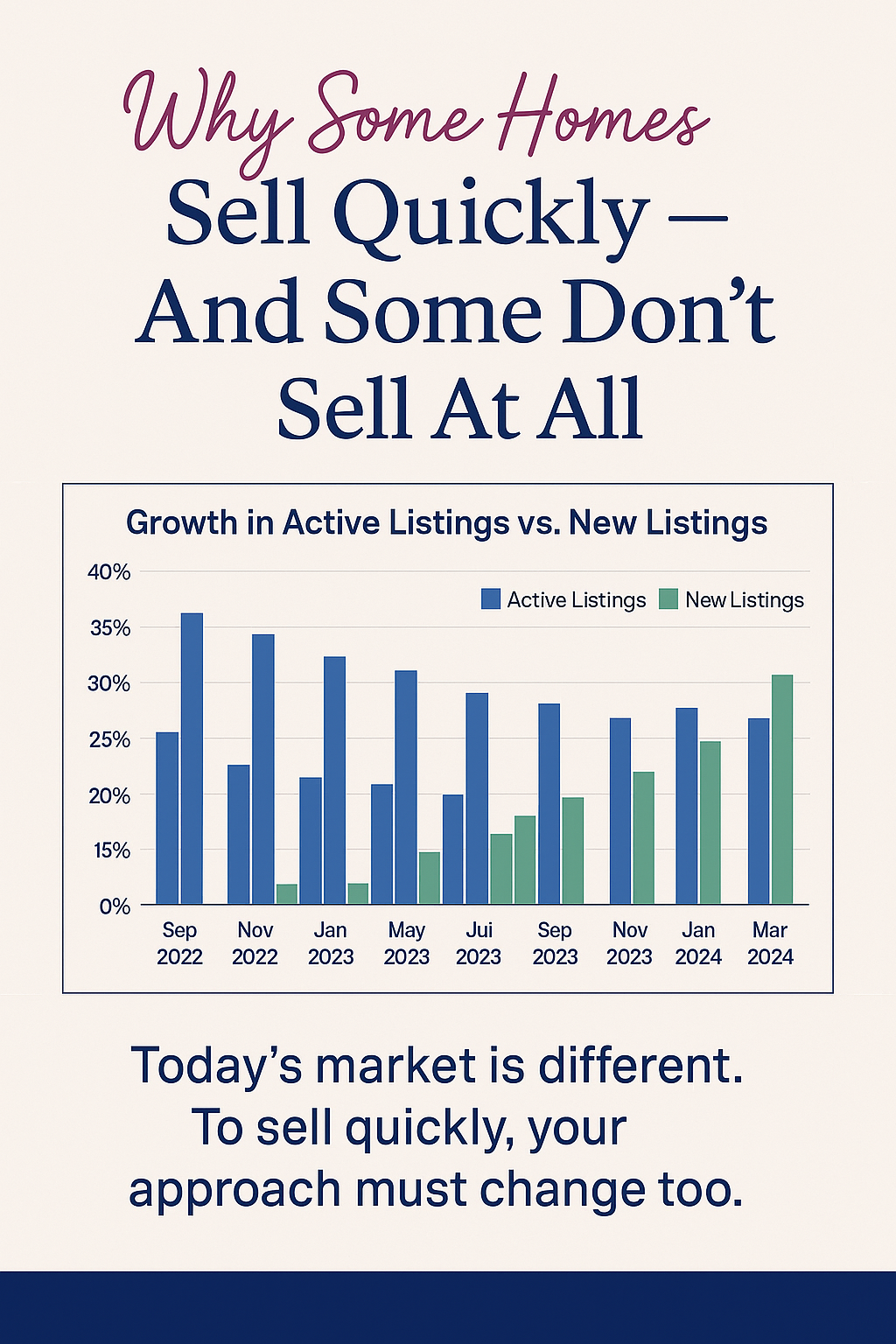
Most of today’s inventory growth comes from homes that are still active — the ones that haven’t sold yet — rather than new listings. According to Realtor.com, many of these homes are taking longer to sell, which tells us something important:
It’s not just about listing your home — it’s about how you list it.

Common reasons homes linger on the market include:

  • Pricing too high based on old market conditions
  • Skipping essential repairs or updates
  • Poor listing photos or staging
  • Limited showing availability
  • Weak marketing strategies

A few years ago, sellers could list “as-is” and still attract multiple offers. Not anymore. Today’s buyers are choosier, more informed, and have more options.

💡 What Makes a Home Sell Quickly

Selling quickly in this market isn’t about luck — it’s about strategy.
Here’s what successful sellers have in common:

  1. Pricing Realistically – A competitive price based on today’s market, not yesterday’s headlines.
  2. Curb Appeal and Condition – Small upgrades and clean presentation go a long way.
  3. Professional Marketing – High-quality photos, social media visibility, and listing optimization matter.
  4. Accessibility – The easier it is to show, the faster it sells.

Remember: your first few weeks on the market are crucial. That’s when your listing gets the most exposure online. Nail your presentation early, and buyers will act fast.

🤝 Why the Right Agent Makes All the Difference

Working with an experienced REALTOR® means having someone who understands local trends, buyer behavior, and pricing strategy. According to the National Association of REALTORS® (NAR), sellers who work with agents are twice as likely to get an offer within a month compared to those who list on their own.

An expert agent will:

  • Recommend the right listing price using local comparable sales
  • Help you prep and stage for maximum impact
  • Use professional marketing that reaches buyers where they’re searching

Bottom Line

Even with more homes for sale, your property can still sell quickly — if it’s priced right, presented beautifully, and marketed strategically.

If you’re thinking about selling in Hampton Roads, Chesapeake, or Newport News, let’s connect! I’ll help you position your home to attract attention — and offers — from day one.

If you’re looking to sell, call Michele! If you’re looking to acquire — I’m your hire!

Michele Salyer, REALTOR®
Salyer Wilmoth Homes | A Better Way Realty
📞 7575023671 | 🌐 www.salyerwilmothhomes.com

July 29, 2025

The Tale of Two Housing Markets: What’s Really Happening in Hampton Roads Real Estate?

The Tale of Two Housing Markets: Why Local Real Estate Conditions Matter More Than Ever

If you're wondering whether it's a good time to buy or sell a home in Hampton Roads—Chesapeake, Virginia Beach, Suffolk, and beyond—the answer really depends on where you’re looking. Across the country, we’re seeing a tale of two markets: in some places, buyers have the upper hand; in others, sellers are still firmly in control.

So, what’s driving these differences—and where does your neighborhood fit in?


Buyer’s Market vs. Seller’s Market: What's the Difference?

Buyer’s Market: This happens when there are more homes for sale than there are buyers actively shopping. Homes sit longer, sellers get fewer offers, and prices often become negotiable.

Seller’s Market: In this scenario, homes are in short supply, and buyers are competing—leading to faster sales, multiple offers, and increasing prices.

Right now, both of these conditions are happening—just in different places.


Where Is the Market Headed in 2025?

National data shows that the Northeast and Midwest are seeing strong seller markets, with homes moving quickly and prices continuing to rise. The South and West, including parts of Virginia, are shifting toward buyer-friendly territory.

Locally here in the Hampton Roads area, we’re seeing a mix. Some neighborhoods in Virginia Beach and Chesapeake are still experiencing multiple-offer scenarios, especially on homes that are updated and priced right. But areas with more inventory—like parts of Suffolk or Portsmouth—are showing signs of slower movement, giving buyers a bit more room to negotiate.


What Does This Mean for Home Prices?

In markets where demand still exceeds supply, prices are continuing to climb. But in areas where inventory has increased and buyer activity has cooled, prices are stabilizing—or even softening slightly.

If you’re a buyer looking in Hampton Roads, this could be the opportunity you’ve been waiting for. And if you’re a seller, don’t worry—most homeowners still have strong equity gains from the past few years, even if prices have plateaued a bit.


Why Local Expertise Is Everything Right Now

Even within a single zip code, market dynamics can vary drastically. That’s why it’s critical to work with a local real estate professional who understands what’s really happening in your neighborhood.

As your go-to Realtor® in Chesapeake, Virginia Beach, and surrounding cities, I help my clients:

  • Understand whether their area is favoring buyers or sellers

  • Set the right listing price or make a smart offer

  • Navigate changing market conditions with confidence


The Bottom Line

In a market as divided as this, local insights are your secret weapon. Whether you're thinking about selling your current home or buying your next one, having the right expert on your side makes all the difference.

📞 Call Michele Salyer at 757-502-3671
If you’re looking to sell—Call Michele!
If you’re looking to acquire—I’m Your Hire!


Let’s make your next move a smart one.

Posted in Market Updates
July 28, 2025

Mortgage Rates Then and Now: A Look Back—and What’s Ahead for 2025

Historic Mortgage Rates: Where They've Been and Where They're Headed

If you're thinking about buying a home, selling your current one, or simply watching the housing market, mortgage rates are probably at the top of your mind. As a trusted real estate agent in [Your Area, e.g., Chesapeake, VA], I’m often asked, “Will mortgage rates go down?” or “Is now a good time to buy or sell?” To answer these questions, it helps to look at where mortgage rates have been—and where they may be going.

A Look Back: Mortgage Rates Through the Decades

Mortgage rates have seen dramatic shifts over the past 50 years. Here's a brief look at how they've evolved:

  • 1970s: Rates hovered around 7–9%, but inflation pushed them higher.

  • 1980s: This decade saw the highest mortgage rates in U.S. history, peaking at over 18% in 1981. The Federal Reserve raised rates to battle inflation.

  • 1990s: Rates stabilized between 7–9%, offering more predictable borrowing costs for homebuyers.

  • 2000s: The early 2000s saw rates dip into the 6% range, then fall further after the 2008 financial crisis.

  • 2010s: This was the golden era for low mortgage rates. After the Great Recession, rates dropped below 5%, with some years hovering near 3–4%.

  • 2020–2021: Amid pandemic-related economic policies, rates hit historic lows, with the average 30-year fixed mortgage dropping below 3%.

Recent Changes: The 2022–2024 Rate Rebound

Starting in early 2022, inflation surged, and the Federal Reserve responded with a series of rate hikes. Mortgage rates followed, climbing sharply and reaching over 7% by mid-2023—the highest since 2002.

This sudden jump shocked buyers and sellers alike, causing affordability challenges and slowing market activity. However, it’s important to remember that a 6–7% rate, while high compared to recent years, is still historically moderate.

Where Are Mortgage Rates Headed?

Forecasting mortgage rates is part science, part art. Experts weigh factors such as inflation, economic growth, Federal Reserve policy, and global events. Here’s what current predictions suggest:

  • Late 2024–2025 Outlook: Many economists expect mortgage rates to gradually decline, potentially dipping into the 6% or even high 5% range by mid-to-late 2025 if inflation continues to ease.

  • Long-Term Trends: Rates are not likely to return to the sub-3% levels seen in 2020–2021. Those were extraordinary conditions. Instead, a 5–6% range may become the “new normal.”

What Does This Mean for Homebuyers and Sellers?

  • For Buyers: Waiting for the “perfect” rate might cost more in the long run if home prices rise. A slightly higher rate today might still be a smart move if it gets you into a home before prices climb again.

  • For Sellers: While higher rates may reduce the pool of buyers, serious and qualified buyers are still active—especially in strong markets like [Your Area].

  • For Both: Locking in a rate now and refinancing later is a strategy many buyers are considering to gain a foothold in the market without overpaying for rent.

Final Thoughts: Timing the Market vs. Time in the Market

Trying to “time the market” perfectly is nearly impossible. Instead, consider your personal and financial readiness. Mortgage rates will always fluctuate—but building equity, securing a stable housing payment, and investing in your future are timeless benefits of homeownership.

As your local real estate expert in [City/Region], I’m here to guide you through today’s market with expert advice, local insights, and proven strategies—no matter what the rates are.


Thinking of Buying or Selling a Home? Let’s Talk!
📞 Call/Text: 757-502-3671
📧 Email: michelesalyer89@gmail.com
🌐 Learn more at www.ilovesellinghouses.com

Jan. 17, 2025

How Much Home Equity Have You Gained? The Answer Might Surprise You

How Much Home Equity Have You Gained? The Answer Might Surprise You


Have you ever stopped to think about how much wealth you’ve built up just from being a homeowner? As home values rise, so does your net worth. And, if you’ve been in your house for a few years (or longer), there’s a good chance you’re sitting on a pile of equity — maybe even more than you realize.

What Is Home Equity?

Home equity is the difference between what your house is worth and what you owe on your mortgage. For example, if your house is worth $500,000 and you still owe $200,000 on your home loan, you have $300,000 in equity. It’s essentially the wealth you’ve built through homeownership. Right now, homeowners across the country are seeing record amounts of equity.

According to Intercontinental Exchange (ICE), the average homeowner with a mortgage has $319,000 in home equity.

Why Have Homeowners Gained So Much Equity?

The rise in home equity over the years can be credited to two key factors:

1. Significant Home Price Growth

Home prices have climbed dramatically in recent years. In fact, according to the Federal Housing Finance Agency (FHFA), over the past five years, home prices nationwide have risen by 57.4% (see map below):

a map of the united statesThis appreciation means your house is likely worth much more now than when you first bought it.

2. Longer Tenure in Homes

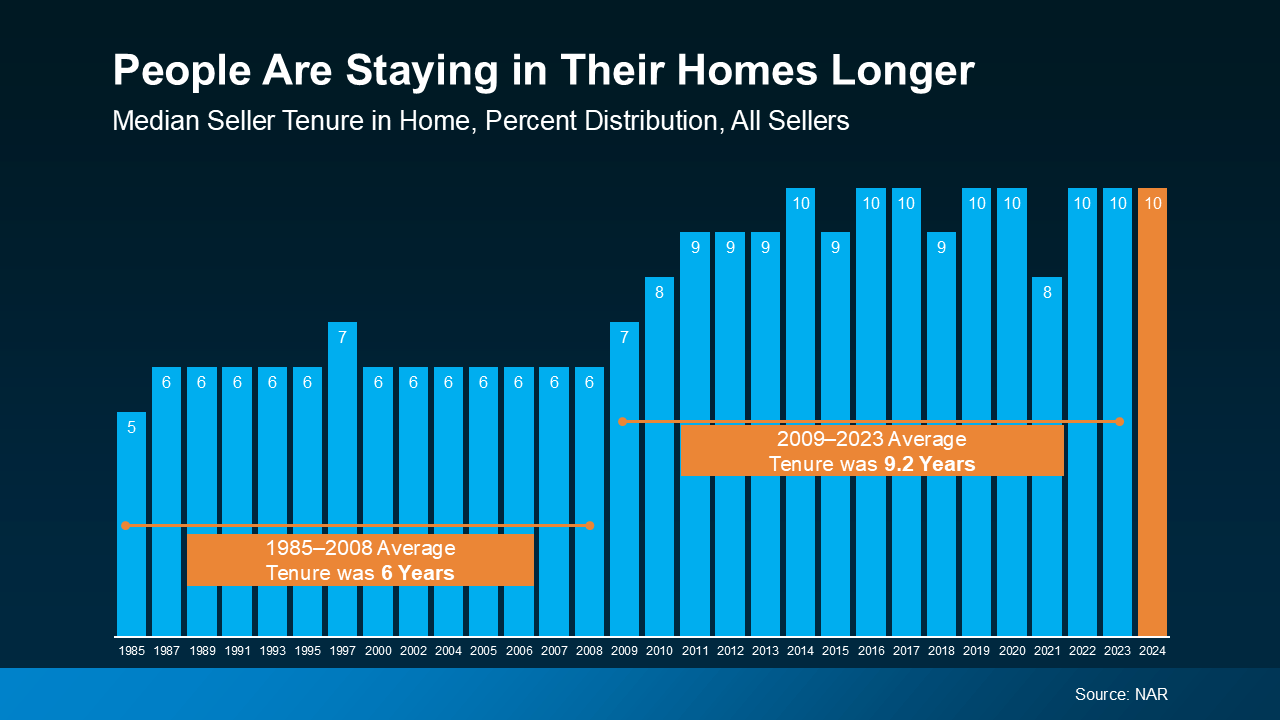
Data from the National Association of Realtors (NAR) shows people are staying in their homes for a decade (see graph below):

a graph of numbers and a number of peopleThis increased tenure means homeowners benefit even more from home values growing over time. That’s because the longer someone has lived in their house, the more that home’s value has grown, which directly increases equity.

And if you’re one of those people who’s been in their home for 10 years or more, know this – according to NAR:

“Over the past decade, the typical homeowner has accumulated $201,600 in wealth solely from price appreciation.”

The Benefits of Having Home Equity

What does that mean for you? It means your house might be your biggest financial asset — and it could open up some exciting opportunities for your future. Let’s break it down.

  • Moving to Your Next Home

Your equity could help you cover the down payment for your next home. In some cases, it might even mean you can buy your next house all cash.

  • Financing Home Improvements

Thinking about upgrading your kitchen, adding a home office, or tackling other projects? Your equity can provide the funds to make those improvements happen, increasing your home’s value and making it more enjoyable to live in too.

  • Getting a Business Going

If you’ve been dreaming about starting your own business, your equity could be the kickstart you need. Whether it’s for startup costs, equipment, or marketing, leveraging your home’s value can help bring your entrepreneurial goals to life.

Bottom Line

Whether you’re thinking about selling, upgrading, or simply want to understand your options, your home equity is a powerful resource. If you’re wondering how much equity you’ve built or how you can use it to meet your goals, let’s connect and explore the possibilities.

Jan. 16, 2025

One Homebuying Step You Don’t Want To Skip: Pre-Approval

One Homebuying Step You Don’t Want To Skip: Pre-Approval


There’s one essential step in the homebuying process you may not know a whole lot about and that’s pre-approval. Here’s a rundown of what it is and why it’s so important right now.

What Is Pre-Approval?

Pre-approval is like getting a green light from a lender. It lets you know how much they’re willing to let you borrow for a home. To determine that number, a lender looks at your financial history. According to Realtor.com, these are some of the documents a lender may ask you for during this process:

  • W-2s from the last two years
  • Tax returns from the last two years
  • Pay stubs from the last 30 days
  • Bank statements from the last 60 days
  • Investment account statements (if applicable)
  • Two years of history of where you’ve lived

The result? You’ll get a pre-approval letter showing what you can borrow. Keep in mind, that any changes in your finances can affect your pre-approval status. So, after you receive your letter, avoid switching jobs, applying for new credit cards or other loans, or taking out large sums of money from your savings.

How It Helps You Determine Your Borrowing Power

This year, home prices are expected to rise in most places and mortgage rates are still showing some volatility. So, since affordability is still tight, it’s a good idea to talk to a lender about your home loan options and how today’s changing mortgage rates will impact your future monthly payment.

The pre-approval process is the perfect time for that. Because it determines the maximum amount you can borrow, pre-approval also helps you figure out your budget. You should use this information to tailor your home search to what you’re actually comfortable with as far as a monthly mortgage payment. That way, you don’t fall in love with a house that’s out of your comfort zone.

How It Helps You Stand Out

Once you find a home you want to put an offer on, pre-approval has another big perk. It not only makes your offer stronger, it shows sellers you’ve already undergone a credit and financial check.

When a seller sees you as a serious buyer, they may be more attracted to your offer because it seems more likely to go through. As Greg McBride, Chief Financial Analyst at Bankrate, says:

“Preapproval carries more weight because it means lenders have actually done more than a cursory review of your credit and your finances, but have instead reviewed your pay stubs, tax returns and bank statements. A preapproval means you’ve cleared the hurdles necessary to be approved for a mortgage up to a certain dollar amount.”

Bottom Line

If you’re planning on buying a home, getting pre-approved for a mortgage should be one of the first things on your to-do list. Not only will it give you a better understanding of your borrowing power, it can put you in the best position possible to make a strong offer when you find a home you love. Connect with a trusted lender to learn more.

Jan. 2, 2025

Home Staging FAQ: What You Need To Know


You may have heard that staging your home properly can make a big difference when you sell your house, but what exactly is home staging, and is it really worth your time and effort?

Here are a few quick FAQs that can help you decide how much you should prioritize staging as you prep for your move.

What Is Home Staging?

Staging is the process of arranging and decorating your house to highlight its best features and make it as appealing as possible to potential buyers. It can range from simple touch-ups to more extensive setups, depending on your needs and budget.

How Does It Help Me Sell My House?

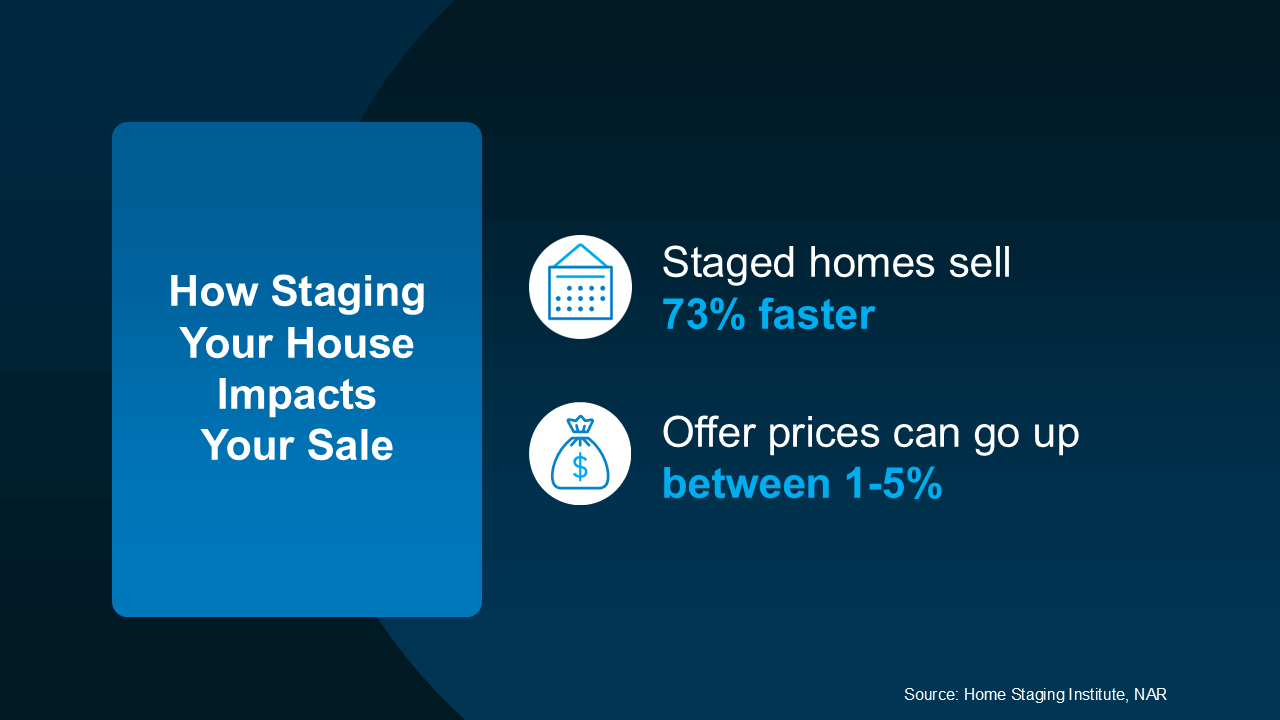
Studies show good staging does have an impact on your sale. Staging your house well can help you attract more attention from buyers, which ultimately helps it sell faster and maybe for a higher price than an unstaged home (see visual):

What Are My Staging Options?

Now that you see the value, let’s think through your options. The most common is leaning on your agent for their expert advice. They know what buyers like because they’re in showings all the time and hear that feedback first-hand. That expertise is crucial to getting your house market-ready. Basic staging with an agent usually means they give you insight into how you should:

  • Declutter and depersonalize by removing photos and personal items
  • Arrange your furniture to improve the room’s flow and make it feel bigger
  • Add plants, move art, or re-arrange other accessories

Full-service staging is another option if your house needs more hands-on attention. This is when you hire a staging professional or staging company to come in, make recommendations, and do the work for you. Going this route is more involved and that makes it more costly too. That’s because it can include renting furniture and decor to more fully transform a space.

How Do I Know Which One To Pick?

Not sure which one you need? You don’t have to figure that out on your own. Your real estate agent will help determine what level of staging will make the most impact on your house and market.

They can help you decide if professional staging is worth the investment, or if you can knock it out with their advice alone. And just so you know, here are some of the factors an agent will look at to figure that out:

  • Market Conditions: If the market is slower, going all in on staging can make your home look move-in ready and attractive to buyers who may otherwise be hesitant. If your local market is very active and homes are selling fast, you may be able to get by with doing less.
  • Your Home’s Condition: If your home is vacant or has a unique layout, using a professional stager who can bring in the right furniture and accessories may help buyers truly visualize its full potential.
  • Your Budget: Talk to your agent to get an idea of staging costs in your area, as it can be the difference between your house selling and sitting. But if your budget is tight or your home only needs minor updates, your real estate agent can help you think outside of the box by suggesting simple DIY staging tips to help your home look its best.

Bottom Line

Staging your house properly can make it much more attractive to buyers, but it’s not a one-size-fits-all solution, and every home shines differently. Let’s connect to talk through what your home really needs to stand out and sell for top dollar. 

May 30, 2024

The Biggest Mistakes Buyers Are Making Today

The Biggest Mistakes Buyers Are Making Today


Buyers face challenges in any market – and today’s is no different. With higher mortgage rates and rising prices, plus the limited supply of homes for sale, there’s a lot to consider.

But, there's one way to avoid getting tripped up – and that’s leaning on a real estate agent for the best possible advice. An expert’s insights will help you avoid some of the most common mistakes homebuyers are making right now.

Putting Off Pre-approval

As part of the homebuying process, a lender will look at your finances to figure out what they’re willing to loan you for your mortgage. This gives you a good idea of what you can borrow so you can really wrap your head around the financial side of things before you start looking at homes. While house hunting can be a lot more fun than talking about finances, you don’t want to do this out of order. Make sure you get your pre-approval first. As CNET explains:

“If you wait to get preapproved until the last minute, you might be scrambling to contact a lender and miss the opportunity to put a bid on a home.”

Holding Out for Perfection

While you may have a long list of must-haves and nice-to-haves, you need to be realistic about your home search. Even though your ideal state is you find a home that checks every box, you may need to be willing to compromise – especially since inventory is still low. Plus, a home that has everything you want may be too pricey. As Investopedia puts it:

When you expect to find the perfect home, you could prolong the homebuying process by holding out for something better. Or you could end up paying more for a home just because it meets all your needs.”

Instead, look for something that has most of your must-haves and good bones where you can add anything else you may need down the line.

Buying More House Than You Can Afford

With today’s mortgage rates and home prices, there’s no arguing it’s expensive to buy a home. And while it may be tempting to stretch your finances a bit further than you’re comfortable with to make sure you get the house, you want to avoid overextending your budget. Make sure you talk to your agent about how changing mortgage rates impact your monthly payment. Bankrate offers this advice:

“Focus on what monthly payment you can afford rather than fixating on the maximum loan amount you qualify for. Just because you can qualify for a $300,000 loan doesn’t mean you can comfortably handle the monthly payments that come with it along with your other financial obligations. Every borrower’s case is different, so factor in your whole financial profile when determining how much house you can afford.”

Not Working with a Local Real Estate Agent

This last one may be the most important of all. Buying a home is a process that involves a lot of steps, paperwork, negotiation, and more. Rather than take all of this on yourself, it’s a good idea to have a pro working with you. The right agent will reduce your stress and help the process go smoothly. As CNET explains:

Attempting to buy a home without a real estate agent makes the process more arduous than it needs to be. A real estate agent can give you professional legal guidance, market expertise and support, which will save you time, money and stress. They can also increase your chances of finding the right home so you don’t have to spend hours scouring the internet for listings.”  

Bottom Line

Mistakes can cost you time, frustration, and money. If you want to buy a home in today’s market, let’s connect so you have a pro on your side who can help you avoid these missteps.

May 20, 2024

What’s Next for Home Prices and Mortgage Rates?

If you’re thinking of making a move this year, there are two housing market factors that are probably on your mind: home prices and mortgage rates. You’re wondering what’s going to happen next. And if it’s worth it to move now, or better to wait it out.

The only thing you can really do is make the best decision you can based on the latest information available. So, here’s what experts are saying about both prices and rates.

1. What’s Next for Home Prices?

One reliable place you can turn to for information on home price forecasts is the Home Price Expectations Survey from Fannie Mae – a survey of over one hundred economists, real estate experts, and investment and market strategists.

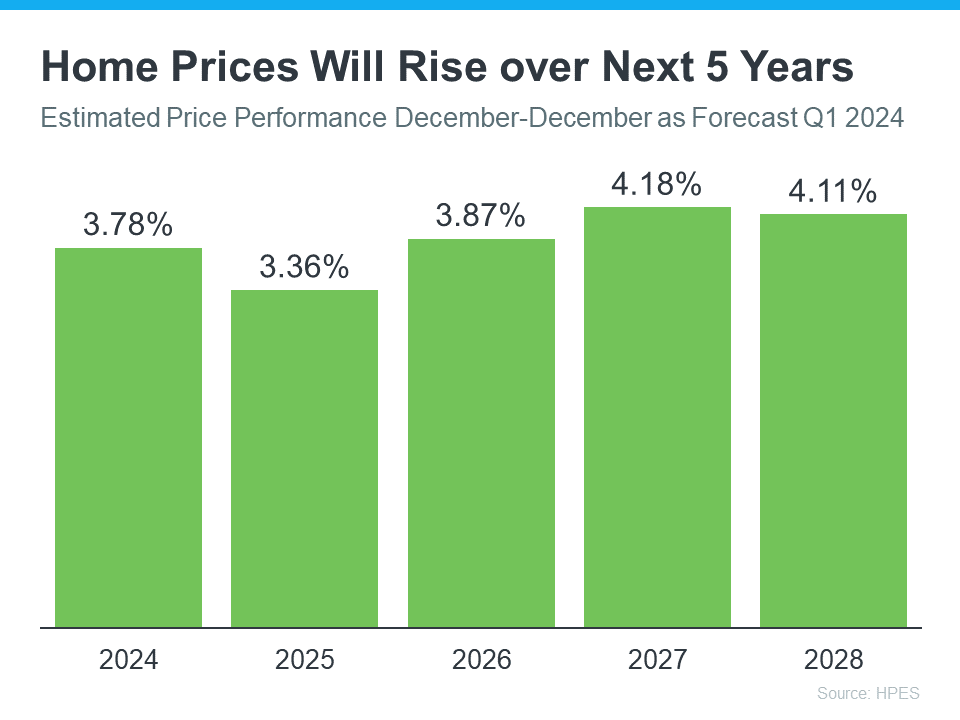
According to the most recent release, experts are projecting home prices will continue to rise at least through 2028 (see the graph below):

No Caption Received


While the percent of appreciation varies year-to-year, this survey says we’ll see prices rise (not fall) for at least the next 5 years, and at a much more normal pace.

What does that mean for your move? If you buy now, your home will likely grow in value and you should gain equity in the years ahead. But, based on these forecasts, if you wait and prices continue to climb, the price of a home will only be higher later on. 

2. When Will Mortgage Rates Come Down?

This is the million-dollar question in the industry. And there’s no easy way to answer it. That’s because there are a number of factors that are contributing to the volatile mortgage rate environment we’re in. Odeta Kushi, Deputy Chief Economist at First American, explains:

“Every month brings a new set of inflation and labor data that can influence the direction of mortgage rates. Ongoing inflation deceleration, a slowing economy and even geopolitical uncertainty can contribute to lower mortgage rates. On the other hand, data that signals upside risk to inflation may result in higher rates.”

What happens next will depend on where each of those factors goes from here. Experts are optimistic rates should still come down later this year, but acknowledge changing economic indicators will continue to have an impact. As a CNET article says:

“Though mortgage rates could still go down later in the year, housing market predictions change regularly in response to economic data, geopolitical events and more.”

So, if you’re ready, willing, and able to afford a home right now, partner with a trusted real estate advisor to weigh your options and decide what’s right for you. 

Bottom Line

Let’s connect to make sure you have the latest information available on home prices and mortgage rate expectations. Together we’ll go over what the experts are saying so you can make an informed decision on your move.